



 Chat with AI
Exam 10: Externalities

Exam 1: Ten Lessons From Economics149 Questions
Exam 2: Thinking Like an Economist147 Questions
Exam 3: Interdependence and the Gains From Trade153 Questions
Exam 4: The Market Forces of Supply and Demand222 Questions
Exam 5: Elasticity and Its Application181 Questions
Exam 6: Supply, Demand and Government Policies148 Questions
Exam 7: Consumers, Producers and the Efficiency of Markets177 Questions
Exam 8: Application: The Costs of Taxation141 Questions
Exam 9: Application: International Trade161 Questions
Exam 10: Externalities199 Questions
Exam 11: Public Goods and Common Resources182 Questions
Exam 12: The Design of the Tax System154 Questions
Exam 13: The Costs of Production191 Questions
Exam 14: Firms in Competitive Markets200 Questions
Exam 15: Monopoly214 Questions
Exam 16: Business Strategy184 Questions
Exam 17: Competition Policy104 Questions
Exam 18: Monopolistic Competition214 Questions
Exam 19: The Markets for the Factors of Production215 Questions
Exam 20: Earnings, Unions and Discrimination206 Questions
Exam 21: Income Inequity and Poverty111 Questions
Exam 22: The Theory of Consumer Choice161 Questions
Exam 23: Frontiers of Microeconomics120 Questions
Exam 24: Measuring a Nations Income51 Questions
Exam 25: Measuring the Cost of Living52 Questions
Exam 26: Production and Growth62 Questions
Exam 27: Saving, Investment and the Financial System62 Questions
Exam 28: The Natural Rate of Unemployment59 Questions
Exam 29: The Monetary System66 Questions
Exam 30: Inflation: Its Causes and Costs74 Questions
Exam 31: Open-Economy Macroeconomics: Basic Concepts68 Questions
Exam 32: A Macroeconomic Theory of the Open Economy64 Questions
Exam 33: Aggregate Demand and Aggregate Supply82 Questions
Exam 34: The Influence of Monetary and Fiscal Policy on Aggregate Demand73 Questions
Exam 35: The Short-Run Trade-Off Between Inflation and Unemployment58 Questions
Exam 36: Five Debates Over Macroeconomic Policy38 Questions
Select questions type


An additional electric automobile on a congested freeway creates:
(Multiple Choice)
4.9/5  (81)
(81) Graph 10-3
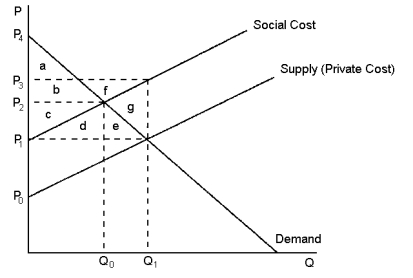 This graph reflects the market for kiwifruit, where pesticide used by kiwifruit orchardists also unintentionally kills honey bees.
-Refer to Graph 10-3. What price and quantity combination best represents the optimum price and number of kiwifruit trays that should be produced?
This graph reflects the market for kiwifruit, where pesticide used by kiwifruit orchardists also unintentionally kills honey bees.
-Refer to Graph 10-3. What price and quantity combination best represents the optimum price and number of kiwifruit trays that should be produced? (Multiple Choice)
4.8/5 (77)
(77) The owner of a luxury 4WD enjoys a positive externality because the luxury 4WD offers added safety when compared to a small car.
(True/False)
4.8/5 (84)
(84) Graph 10-3
This graph reflects the market for kiwifruit, where pesticide used by kiwifruit orchardists also unintentionally kills honey bees.
-Refer to Graph 10-3. The difference between the social cost curve and the supply curve reflects the:
This graph reflects the market for kiwifruit, where pesticide used by kiwifruit orchardists also unintentionally kills honey bees.
-Refer to Graph 10-3. The difference between the social cost curve and the supply curve reflects the: (Multiple Choice)
4.9/5 (78)
(78) Internalising a negative consumption externality will cause the market supply curve to shift to the left.
(True/False)
4.9/5 (68)
(68) Many countries now have laws to discourage and hinder unwanted emails (spam) being sent over the Internet. Are spammers merely a minor nuisance or do they generate enough of an externality to merit laws being passed to stop it?
(Essay)
5.0/5 (89)
(89) Which of the following statements about internalising a negative production externality is most correct?
(Multiple Choice)
4.8/5 (77)
(77) Mobile phones are banned in some public places. This is likely to be because:
(Multiple Choice)
4.7/5 (82)
(82) Social welfare can be enhanced by allowing firms to trade their carbon credits.
(True/False)
4.9/5 (79)
(79) Graph 10-3
This graph reflects the market for kiwifruit, where pesticide used by kiwifruit orchardists also unintentionally kills honey bees.
-Refer to Graph 10-3. For each tray of kiwifruit produced, the social cost would include which of the following? (i) the private costs of the kiwifruit farmers
(ii) the enjoyment that buyers get from eating kiwifruit
(iii) the cost beekeepers incur to replace hives that die because of pesticide use
This graph reflects the market for kiwifruit, where pesticide used by kiwifruit orchardists also unintentionally kills honey bees.
-Refer to Graph 10-3. For each tray of kiwifruit produced, the social cost would include which of the following? (i) the private costs of the kiwifruit farmers
(ii) the enjoyment that buyers get from eating kiwifruit
(iii) the cost beekeepers incur to replace hives that die because of pesticide use (Multiple Choice)
4.9/5 (74)
(74) When Jake takes into account how his actions affect Jill, and changes these, an externality is solved.
(True/False)
4.8/5 (70)
(70) Assume that your housemate is very messy. (There is no law against being messy.) Suppose she gets a $100 benefit from being messy but imposes a $200 cost on you. The Coase theorem would suggest that an efficient solution would be for you to:
(Multiple Choice)
4.8/5 (82)
(82) When the government chooses an externality policy that aligns private incentives with social efficiency to solve an externality:
(Multiple Choice)
4.9/5 (76)
(76) Graph 10-3
This graph reflects the market for kiwifruit, where pesticide used by kiwifruit orchardists also unintentionally kills honey bees.
-Refer to Graph 10-3. At the private market outcome, price P3 represents the:
This graph reflects the market for kiwifruit, where pesticide used by kiwifruit orchardists also unintentionally kills honey bees.
-Refer to Graph 10-3. At the private market outcome, price P3 represents the: (Multiple Choice)
4.9/5 (93)
(93) In essence, the Pigovian tax places a price on the right to pollute.
(True/False)
4.8/5 (82)
(82) Luckily, the free market corrects for the cost to bystanders of a crying child, because the parent is irritated as much as, if not more than the bystander.
(True/False)
4.7/5 (91)
(91) Government subsidies to scientific research is aimed at controlling the negative externalities associated with technological advances.
(True/False)
4.9/5 (72)
(72) Private markets fail to reach a socially optimal level when negative consumption externalities are present because:
(Multiple Choice)
4.8/5 (83)
(83) 
Filters
- Essay(0)
- Multiple Choice(0)
- Short Answer(0)
- True False(0)
- Matching(0)