



 Chat with AI
Exam 10: Externalities

Exam 1: Ten Lessons From Economics149 Questions
Exam 2: Thinking Like an Economist147 Questions
Exam 3: Interdependence and the Gains From Trade153 Questions
Exam 4: The Market Forces of Supply and Demand222 Questions
Exam 5: Elasticity and Its Application181 Questions
Exam 6: Supply, Demand and Government Policies148 Questions
Exam 7: Consumers, Producers and the Efficiency of Markets177 Questions
Exam 8: Application: The Costs of Taxation141 Questions
Exam 9: Application: International Trade161 Questions
Exam 10: Externalities199 Questions
Exam 11: Public Goods and Common Resources182 Questions
Exam 12: The Design of the Tax System154 Questions
Exam 13: The Costs of Production191 Questions
Exam 14: Firms in Competitive Markets200 Questions
Exam 15: Monopoly214 Questions
Exam 16: Business Strategy184 Questions
Exam 17: Competition Policy104 Questions
Exam 18: Monopolistic Competition214 Questions
Exam 19: The Markets for the Factors of Production215 Questions
Exam 20: Earnings, Unions and Discrimination206 Questions
Exam 21: Income Inequity and Poverty111 Questions
Exam 22: The Theory of Consumer Choice161 Questions
Exam 23: Frontiers of Microeconomics120 Questions
Exam 24: Measuring a Nations Income51 Questions
Exam 25: Measuring the Cost of Living52 Questions
Exam 26: Production and Growth62 Questions
Exam 27: Saving, Investment and the Financial System62 Questions
Exam 28: The Natural Rate of Unemployment59 Questions
Exam 29: The Monetary System66 Questions
Exam 30: Inflation: Its Causes and Costs74 Questions
Exam 31: Open-Economy Macroeconomics: Basic Concepts68 Questions
Exam 32: A Macroeconomic Theory of the Open Economy64 Questions
Exam 33: Aggregate Demand and Aggregate Supply82 Questions
Exam 34: The Influence of Monetary and Fiscal Policy on Aggregate Demand73 Questions
Exam 35: The Short-Run Trade-Off Between Inflation and Unemployment58 Questions
Exam 36: Five Debates Over Macroeconomic Policy38 Questions
Select questions type


Vaccinations are heavily subsidised in order to get the optimal number of people vaccinated.
(True/False)
4.9/5  (77)
(77) Which of the following statements about a market that is affected by a positive production externality is correct?
(Multiple Choice)
4.8/5 (81)
(81) Hikers frequently claim that livestock grazing in wilderness recreation areas reduce the satisfaction of their recreational hiking experience. An explanation would be that:
(Multiple Choice)
4.9/5 (85)
(85) Consider a local factory that pollutes a nearby stream. Local fishers may be unable to negotiate a deal with the local factory to eliminate the negative externality because:
(Multiple Choice)
4.8/5 (90)
(90) Evaluate the following statement: 'The problem of second hand smoke in places of employment is different to the problem in public restaurants. People typically don't have very many employment options but they do have many alternatives for selecting a place to eat. As such, direct regulation of second hand smoke in public restaurants is likely to be inefficient'.
(Essay)
4.9/5 (68)
(68) Graph 10-5
 -Refer to Graph 10-5. Which of the graphs shown best depicts the case of a positive production externality?
 (Multiple Choice)
4.9/5 (81)
(81) Internalising a positive production externality will cause the supply curve faced by an industry to:
(Multiple Choice)
4.9/5 (78)
(78) The size and scope of technology spillovers is easy for governments to measure.
(True/False)
4.8/5 (71)
(71) Suppose that a steel factory emits a certain amount of air pollution and that this pollution constitutes a negative externality. If this market is not required to internalise this externality:
(Multiple Choice)
4.8/5 (78)
(78) Total pollution is increased when firms are allowed to trade in carbon credits.
(True/False)
4.8/5 (69)
(69) In Singapore, property taxes on an automobile can exceed the purchase price of a new automobile. Assuming that the tax is a fixed percentage of market value, which of the following does this tax represent? (i) a policy in which private incentives are used to reduced the traffic externality on congested roads in Singapore
(ii) the government's direct control over the number of automobiles that are purchased
(iii) a policy in which private incentives are used to reduce automobile pollution
(Multiple Choice)
4.8/5 (71)
(71) Internalising a positive production externality through technology policy:
(Multiple Choice)
4.8/5 (85)
(85) At any given quantity, the height of the supply curve for elephant ivory shows the:
(Multiple Choice)
4.7/5 (78)
(78) Internalising a positive production externality will cause the demand curve faced by an industry to:
(Multiple Choice)
4.8/5 (76)
(76) Firms that can reduce pollution easily will be willing to sell their emissions permits.
(True/False)
4.9/5 (84)
(84) Private parties can negotiate a solution to an externality in all cases.
(True/False)
4.8/5 (85)
(85) If a particular market is associated with an externality, the social optimum should include the wellbeing of:
(Multiple Choice)
4.7/5 (75)
(75) When dealing with consumption externalities, the market equilibrium can be moved closer to the social equilibrium by:
(Multiple Choice)
4.8/5 (66)
(66) Consider the following negative production externality as depicted:
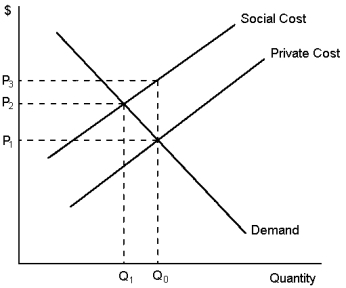 Identify the social optimum and explain how Pigovian taxes could be used to achieve this outcome.
 (Essay)
4.8/5 (69)
(69) 
Filters
- Essay(0)
- Multiple Choice(0)
- Short Answer(0)
- True False(0)
- Matching(0)