



 Chat with AI
Exam 10: Externalities

Exam 1: Ten Lessons From Economics149 Questions
Exam 2: Thinking Like an Economist147 Questions
Exam 3: Interdependence and the Gains From Trade153 Questions
Exam 4: The Market Forces of Supply and Demand222 Questions
Exam 5: Elasticity and Its Application181 Questions
Exam 6: Supply, Demand and Government Policies148 Questions
Exam 7: Consumers, Producers and the Efficiency of Markets177 Questions
Exam 8: Application: The Costs of Taxation141 Questions
Exam 9: Application: International Trade161 Questions
Exam 10: Externalities199 Questions
Exam 11: Public Goods and Common Resources182 Questions
Exam 12: The Design of the Tax System154 Questions
Exam 13: The Costs of Production191 Questions
Exam 14: Firms in Competitive Markets200 Questions
Exam 15: Monopoly214 Questions
Exam 16: Business Strategy184 Questions
Exam 17: Competition Policy104 Questions
Exam 18: Monopolistic Competition214 Questions
Exam 19: The Markets for the Factors of Production215 Questions
Exam 20: Earnings, Unions and Discrimination206 Questions
Exam 21: Income Inequity and Poverty111 Questions
Exam 22: The Theory of Consumer Choice161 Questions
Exam 23: Frontiers of Microeconomics120 Questions
Exam 24: Measuring a Nations Income51 Questions
Exam 25: Measuring the Cost of Living52 Questions
Exam 26: Production and Growth62 Questions
Exam 27: Saving, Investment and the Financial System62 Questions
Exam 28: The Natural Rate of Unemployment59 Questions
Exam 29: The Monetary System66 Questions
Exam 30: Inflation: Its Causes and Costs74 Questions
Exam 31: Open-Economy Macroeconomics: Basic Concepts68 Questions
Exam 32: A Macroeconomic Theory of the Open Economy64 Questions
Exam 33: Aggregate Demand and Aggregate Supply82 Questions
Exam 34: The Influence of Monetary and Fiscal Policy on Aggregate Demand73 Questions
Exam 35: The Short-Run Trade-Off Between Inflation and Unemployment58 Questions
Exam 36: Five Debates Over Macroeconomic Policy38 Questions
Select questions type


Restored historic buildings convey a positive externality because people who walk or ride by them can enjoy their beauty and the sense of history they provide.
(True/False)
5.0/5  (84)
(84) Often parties affected by an externality are unable to reach a private solution due to negotiation and enforcement costs. These costs are known as
(Multiple Choice)
4.9/5 (68)
(68) It is generally difficult or impossible for private markets to take externalities into account because:
(Multiple Choice)
4.8/5 (65)
(65) To produce honey, beekeepers place hives of bees in the fields of farmers. As bees gather nectar, they pollinate the crops in the fields, increasing the yields of these fields at no additional cost to the farmer. What might be a reasonable private solution to this externality and how might the solution be reached.
(Essay)
4.8/5 (57)
(57) The government attempts to resolve negative externalities caused by automobile exhaust by: (i) taxing gasoline to reduce the amount that people drive
(ii) building safer highways
(iii) setting emission standards for automobiles
(Multiple Choice)
4.9/5 (78)
(78) To produce honey, beekeepers place hives of bees in orchards and crop fields. As bees gather nectar that they use to produce honey, they pollinate the orchards and fields increasing their yields of fruit and grain. This arrangement results in:
(Multiple Choice)
4.9/5 (76)
(76) Graph 10-3
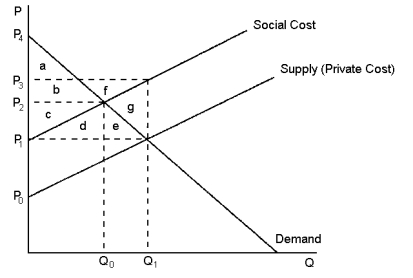 This graph reflects the market for kiwifruit, where pesticide used by kiwifruit orchardists also unintentionally kills honey bees.
-Refer to Graph 10-3. The social cost curve is above the supply curve because:
This graph reflects the market for kiwifruit, where pesticide used by kiwifruit orchardists also unintentionally kills honey bees.
-Refer to Graph 10-3. The social cost curve is above the supply curve because: (Multiple Choice)
4.8/5 (74)
(74) Inventors in developing countries are usually unable to capture the full benefit of their innovations. They therefore tend to devote too few resources to research. Government can address this problem of under-investment in research by: (i) increasing restrictions on trade
(ii) establishing a patent system to provide inventors with exclusive control over their inventions for a period of time
(iii) subsidising the purchase of technology from other countries.
(Multiple Choice)
4.8/5 (66)
(66) Externalities tend to keep markets from reaching a socially optimal equilibrium. Therefore, government action:
(Multiple Choice)
4.9/5 (105)
(105) Once tradeable pollution permits have been allocated to firms:
(Multiple Choice)
4.9/5 (89)
(89) Pigovian taxes enhance efficiency but the cost of administering such taxes frequently exceeds the revenue they raise for the government.
(True/False)
4.9/5 (78)
(78) Graph 10-1
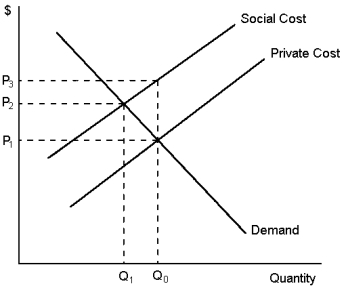 -Refer to Graph 10-1. Which price and quantity combination represents the social optimum?
 (Multiple Choice)
4.7/5 (87)
(87) If the social cost of producing robots is less than the private cost of producing robots, the private market produces too few robots.
(True/False)
4.9/5 (84)
(84) According to the Coase theorem, private parties are likely to solve the problem of externalities if:
(Multiple Choice)
4.8/5 (74)
(74) Government policies to encourage technology spillovers may go to industries with the most political clout rather than industries with the largest spillovers.
(True/False)
4.8/5 (89)
(89) In a market characterised by externalities, the market equilibrium fails to maximise the total benefit to society as a whole.
(True/False)
4.9/5 (83)
(83) The ability of individuals to arrive at a private solution to an externality is dependent on the initial distribution of rights.
(True/False)
4.9/5 (82)
(82) 
Filters
- Essay(0)
- Multiple Choice(0)
- Short Answer(0)
- True False(0)
- Matching(0)