



 Chat with AI
Exam 6: Perfectly Competitive Supply

Exam 1: Thinking Like an Economist142 Questions
Exam 2: Comparative Advantage163 Questions
Exam 3: Supply and Demand181 Questions
Exam 4: Elasticity154 Questions
Exam 5: Demand144 Questions
Exam 6: Perfectly Competitive Supply159 Questions
Exam 7: Efficiency, Exchange, and the Invisible Hand in Action159 Questions
Exam 8: Monopoly, Oligopoly, and Monopolistic Competition147 Questions
Exam 9: Games and Strategic Behavior150 Questions
Exam 10: An Introduction to Behavioral Economics111 Questions
Exam 11: Externalities, Property Rights, and the Environment184 Questions
Exam 12: The Economics of Information127 Questions
Exam 13: Labor Markets, Poverty, and Income Distribution138 Questions
Exam 14: Public Goods and Tax Policy142 Questions
Exam 15: International Trade and Trade Policy164 Questions
Exam 16: Macroeconomics: The Birds Eye View of the Economy154 Questions
Exam 17: Measuring Economic Activity: GDP and Unemployment210 Questions
Exam 18: Measuring the Price Level and Inflation160 Questions
Exam 19: Economic Growth, Productivity, and Living Standards158 Questions
Exam 20: The Labor Market: Workers, Wages, and Unemployment121 Questions
Exam 21: Saving and Capital Formation144 Questions
Exam 22: Money Prices and the Federal Reserve107 Questions
Exam 23: Financial Markets and International Capital Flows104 Questions
Exam 24: Short-Term Economic Fluctuations: An Introduction124 Questions
Exam 25: Spending and Output in the Short Run146 Questions
Exam 26: Stabilizing the Economy: The Role of the Fed162 Questions
Exam 27: Aggregate Demand, Aggregate Supply, and Inflation159 Questions
Exam 28: Exchange Rates and the Open Economy157 Questions
Select questions type


The accompanying graph shows the cost curves for Moe's mushroom gathering business, which is perfectly competitive. 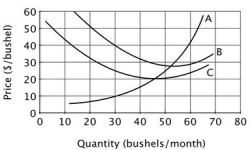 The curve labeled A is upward sloping because:
 (Multiple Choice)
4.8/5  (70)
(70) Suppose that when a perfectly competitive firm produces 1,000 units of output, its total variable cost is $1,900. If the marginal cost of producing the 1,000ᵗʰ unit is $1.70, and if the market price of each unit of output is $1.70, then the firm should:
(Multiple Choice)
4.7/5 (63)
(63) Suppose that at a firm's profit-maximizing level of output, its total revenue is $1,250, the total cost of its variable factors of production is $1,000, and its total fixed cost is $500. This firm will ________ in the short run, and will ________ in the long run.
(Multiple Choice)
4.9/5 (84)
(84) Suppose a firm uses workers and office space to produce output. The firm is locked into a year-long lease on its office space, but it can easily vary the number of employee-hours it uses each day. The accompanying table describes the relationship between the number of employee-hours the firm uses each day and the firm's daily output. Each unit of output sells for $2, the hourly wage rate is $14, and the rent on the office space is $50 per day. 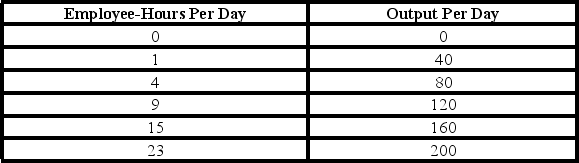 When the firm uses 9 employee-hours per day, its total variable cost each day is:
 (Multiple Choice)
4.9/5 (80)
(80) Suppose a profit-maximizing firm in a perfectly competitive market is collecting $1,999 in total revenues. If the total cost of its fixed factors of production falls from $500 to $400, the firm will:
(Multiple Choice)
4.9/5 (80)
(80) Refer to the accompanying figure. At quantities less than 50 doughnuts per day: 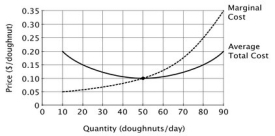
(Multiple Choice)
4.9/5 (73)
(73) The most important challenge facing a firm in a perfectly competitive market is deciding:
(Multiple Choice)
4.9/5 (81)
(81) When the price of a perfectly competitive firm's output rises:
(Multiple Choice)
4.9/5 (76)
(76) According to the law of diminishing returns, when some factors of production are fixed, in order to increase production by a given amount, a firm will eventually need to add successively:
(Multiple Choice)
4.8/5 (71)
(71) Suppose Sarah owns a small company that makes wedding cakes. The accompanying table shows how Sarah's total cost varies depending on the number of wedding cakes she makes each day. Number of Cales Per Day Tatal Cast Per Day 0 \ 100 1 \ 180 2 \ 220 3 \ 300 4 \ 400 5 \ 520 6 \ 660
If Sarah's fixed costs double, then in the short run, her profit-maximizing level of output:
(Multiple Choice)
4.9/5 (72)
(72) A profit-maximizing firm will only produce a positive amount of output if:
(Multiple Choice)
4.9/5 (65)
(65) Suppose Ben owns a small company that makes kites. The market for kites is perfectly competitive, and kites sell for $25 each. Ben's total production costs vary depending on the number of kites he makes each day, as shown in the accompanying table.
When Ben makes 2 kites per day, what is his average variable cost?
(Multiple Choice)
4.8/5 (83)
(83) Which of the following is NOT a characteristic of a perfectly competitive market?
(Multiple Choice)
4.9/5 (79)
(79) Last year, Casey grew fresh vegetables, which she sold at her local farmers market, but this year, Casey did not plant any vegetables and went to work at a bank instead. Which of the following best explains Casey's career change?
(Multiple Choice)
4.8/5 (91)
(91) Which of the following is NOT true of a perfectly competitive firm?
(Multiple Choice)
4.9/5 (80)
(80) Refer to the accompanying table. To increase output from 99 to 132 units requires ________ extra employees per day; to increase output from 132 to 165 units requires ________ extra employees per day. 
(Multiple Choice)
4.8/5 (71)
(71) Suppose Chris is a potter who makes mugs. His total costs depend on the number of mugs he makes each day, as shown in the accompanying table. Number d Mugs Per Day Tatal Cast Per Day 0 \ 10 1 \ 14 2 \ 19 3 \ 25 4 \ 32 5 \ 40 6 \ 49
If the market for mugs is perfectly competitive, and mugs sell for $7.50 each, then at his profit-maximizing level of output, Chris will earn a ________ of ________ per day.
(Multiple Choice)
4.8/5 (66)
(66) If the market for butter is perfectly competitive, then the demand curve facing a firm that produces butter will be:
(Multiple Choice)
4.9/5 (73)
(73) 
Filters
- Essay(0)
- Multiple Choice(0)
- Short Answer(0)
- True False(0)
- Matching(0)