



 Chat with AI
Exam 6: Perfectly Competitive Supply

Exam 1: Thinking Like an Economist142 Questions
Exam 2: Comparative Advantage163 Questions
Exam 3: Supply and Demand181 Questions
Exam 4: Elasticity154 Questions
Exam 5: Demand144 Questions
Exam 6: Perfectly Competitive Supply159 Questions
Exam 7: Efficiency, Exchange, and the Invisible Hand in Action159 Questions
Exam 8: Monopoly, Oligopoly, and Monopolistic Competition147 Questions
Exam 9: Games and Strategic Behavior150 Questions
Exam 10: An Introduction to Behavioral Economics111 Questions
Exam 11: Externalities, Property Rights, and the Environment184 Questions
Exam 12: The Economics of Information127 Questions
Exam 13: Labor Markets, Poverty, and Income Distribution138 Questions
Exam 14: Public Goods and Tax Policy142 Questions
Exam 15: International Trade and Trade Policy164 Questions
Exam 16: Macroeconomics: The Birds Eye View of the Economy154 Questions
Exam 17: Measuring Economic Activity: GDP and Unemployment210 Questions
Exam 18: Measuring the Price Level and Inflation160 Questions
Exam 19: Economic Growth, Productivity, and Living Standards158 Questions
Exam 20: The Labor Market: Workers, Wages, and Unemployment121 Questions
Exam 21: Saving and Capital Formation144 Questions
Exam 22: Money Prices and the Federal Reserve107 Questions
Exam 23: Financial Markets and International Capital Flows104 Questions
Exam 24: Short-Term Economic Fluctuations: An Introduction124 Questions
Exam 25: Spending and Output in the Short Run146 Questions
Exam 26: Stabilizing the Economy: The Role of the Fed162 Questions
Exam 27: Aggregate Demand, Aggregate Supply, and Inflation159 Questions
Exam 28: Exchange Rates and the Open Economy157 Questions
Select questions type


Individual supply curves generally slope ________ because ________.
(Multiple Choice)
4.7/5  (85)
(85) Suppose Chris is a potter who makes mugs. His total costs depend on the number of mugs he makes each day, as shown in the accompanying table. Number d Mugs Per Day Tatal Cast Per Day 0 \ 10 1 \ 14 2 \ 19 3 \ 25 4 \ 32 5 \ 40 6 \ 49
The marginal cost if the 4ᵗʰ mug per day is ________.
(Multiple Choice)
4.8/5 (81)
(81) Refer to the accompanying figure. Suppose a law is passed requiring restaurants to charge no more than $25 per meal. This law would: 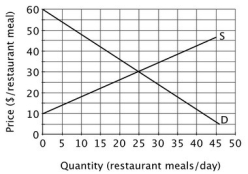
(Multiple Choice)
4.9/5 (86)
(86) If a firm spends $400 to produce 20 units of output and spends $880 to produce 40 units, then between 20 and 40 units of output, the marginal cost of production is:
(Multiple Choice)
4.9/5 (75)
(75) Suppose Ben owns a small company that makes kites. The market for kites is perfectly competitive, and kites sell for $25 each. Ben's total production costs vary depending on the number of kites he makes each day, as shown in the accompanying table.
Should Ben shut down?
(Multiple Choice)
4.9/5 (89)
(89) In general, when the price of a variable factor of production increases:
(Multiple Choice)
4.9/5 (87)
(87) Which of the following is the most likely to be a fixed factor of production at a pizza restaurant?
(Multiple Choice)
4.8/5 (62)
(62) Suppose Ben owns a small company that makes kites. The market for kites is perfectly competitive, and kites sell for $25 each. Ben's total production costs vary depending on the number of kites he makes each day, as shown in the accompanying table.
What is Ben's economic profit at his profit-maximizing level of output?
(Multiple Choice)
4.8/5 (70)
(70) Total revenue minus both explicit and implicit costs defines a firm's:
(Multiple Choice)
4.8/5 (90)
(90) The difference between the price a seller actually receives for a good and the seller's reservation price is:
(Multiple Choice)
4.7/5 (69)
(69) Suppose 30 employees per day can produce 50 units of output. Assuming the law of diminishing marginal returns is present, to produce 100 units of output would require:
(Multiple Choice)
4.8/5 (70)
(70) For a given seller, the accompanying figure shows the relationship between the number of units produced and the opportunity cost of producing an additional unit of output. As the market price of this good increases, the quantity produced by this seller will ________. 
(Multiple Choice)
4.9/5 (79)
(79) John is trying to decide how to divide his time between his job as a stocker in the local grocery store, which pays $7 per hour for as many hours as he chooses to work, and cleaning windows for the businesses downtown. He makes $2 for every window he cleans. John is indifferent between the two tasks, and the number of windows he can clean depends on how many hours he spends cleaning in a day, as shown in the accompanying table. 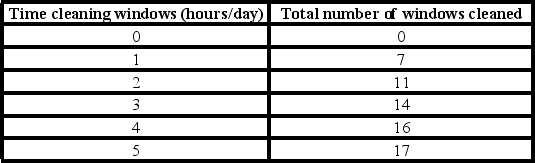 What is the lowest price per window that would induce John to spend at least one hour per day cleaning windows?
 (Multiple Choice)
4.8/5 (83)
(83) Suppose Sarah owns a small company that makes wedding cakes. The accompanying table shows how Sarah's total cost varies depending on the number of wedding cakes she makes each day. Number of Cales Per Day Tatal Cast Per Day 0 \ 100 1 \ 180 2 \ 220 3 \ 300 4 \ 400 5 \ 520 6 \ 660
If the market for wedding cakes is perfectly competitive, and wedding cakes sell for $125 each, then at her profit-maximizing level of output, Sarah's profit will be ________ per day.
(Multiple Choice)
5.0/5 (74)
(74) Suppose a profit-maximizing firm in a perfectly competitive market is earning an economic profit of $1,345. If the firm's fixed cost increases from $200 to $300, the firm will:
(Multiple Choice)
4.8/5 (70)
(70) John is trying to decide how to divide his time between his job as a stocker in the local grocery store, which pays $7 per hour for as many hours as he chooses to work, and cleaning windows for the businesses downtown. He makes $2 for every window he cleans. John is indifferent between the two tasks, and the number of windows he can clean depends on how many hours he spends cleaning in a day, as shown in the accompanying table. 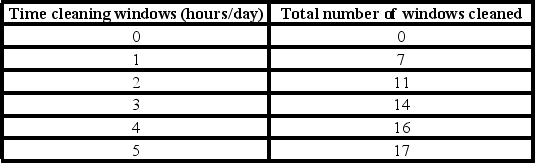 How many hours a day should John spend cleaning windows?
 (Multiple Choice)
4.9/5 (74)
(74) John is trying to decide how to divide his time between his job as a stocker in the local grocery store, which pays $7 per hour for as many hours as he chooses to work, and cleaning windows for the businesses downtown. He makes $2 for every window he cleans. John is indifferent between the two tasks, and the number of windows he can clean depends on how many hours he spends cleaning in a day, as shown in the accompanying table. 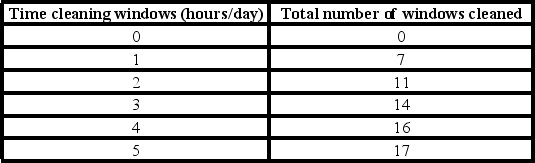 What is the lowest price per window that John would be willing to accept to spend 4 hours per day cleaning windows?
 (Multiple Choice)
4.7/5 (79)
(79) Assume that the production technology required to produce goods X and Y is very similar. If a firm that is producing good X notices that the market price of good Y is rising, it will:
(Multiple Choice)
4.8/5 (64)
(64) 
Filters
- Essay(0)
- Multiple Choice(0)
- Short Answer(0)
- True False(0)
- Matching(0)