



 Chat with AI
Exam 6: Perfectly Competitive Supply

Exam 1: Thinking Like an Economist142 Questions
Exam 2: Comparative Advantage163 Questions
Exam 3: Supply and Demand181 Questions
Exam 4: Elasticity154 Questions
Exam 5: Demand144 Questions
Exam 6: Perfectly Competitive Supply159 Questions
Exam 7: Efficiency, Exchange, and the Invisible Hand in Action159 Questions
Exam 8: Monopoly, Oligopoly, and Monopolistic Competition147 Questions
Exam 9: Games and Strategic Behavior150 Questions
Exam 10: An Introduction to Behavioral Economics111 Questions
Exam 11: Externalities, Property Rights, and the Environment184 Questions
Exam 12: The Economics of Information127 Questions
Exam 13: Labor Markets, Poverty, and Income Distribution138 Questions
Exam 14: Public Goods and Tax Policy142 Questions
Exam 15: International Trade and Trade Policy164 Questions
Exam 16: Macroeconomics: The Birds Eye View of the Economy154 Questions
Exam 17: Measuring Economic Activity: GDP and Unemployment210 Questions
Exam 18: Measuring the Price Level and Inflation160 Questions
Exam 19: Economic Growth, Productivity, and Living Standards158 Questions
Exam 20: The Labor Market: Workers, Wages, and Unemployment121 Questions
Exam 21: Saving and Capital Formation144 Questions
Exam 22: Money Prices and the Federal Reserve107 Questions
Exam 23: Financial Markets and International Capital Flows104 Questions
Exam 24: Short-Term Economic Fluctuations: An Introduction124 Questions
Exam 25: Spending and Output in the Short Run146 Questions
Exam 26: Stabilizing the Economy: The Role of the Fed162 Questions
Exam 27: Aggregate Demand, Aggregate Supply, and Inflation159 Questions
Exam 28: Exchange Rates and the Open Economy157 Questions
Select questions type


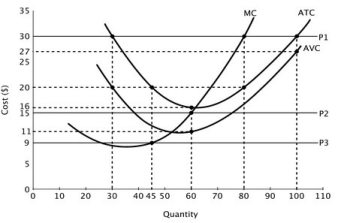
Refer to the accompanying graph. If this firm is a price taker and the price of each unit of output is $15, then at this firm's profit-maximizing level of output, it will earn a ________ of ________.
(Multiple Choice)
4.9/5  (80)
(80) Refer to the accompanying graph. If this firm is a price taker and the price of each unit of output is $15, then this firm should: 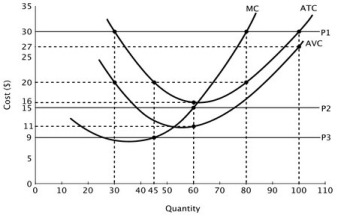
(Multiple Choice)
4.9/5 (84)
(84) Which of the following best explains why you are more likely to see a poor person than a wealthy person picking up aluminum cans to sell?
(Multiple Choice)
4.8/5 (83)
(83) Suppose a firm uses workers and office space to produce output. The firm is locked into a year-long lease on its office space, but it can easily vary the number of employee-hours it uses each day. The accompanying table describes the relationship between the number of employee-hours the firm uses each day and the firm's daily output. Each unit of output sells for $2, the hourly wage rate is $14, and the rent on the office space is $50 per day. 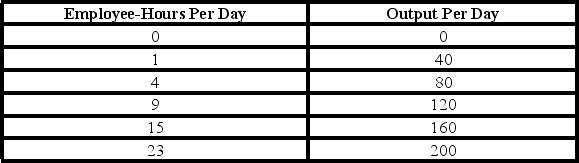 This firm's fixed cost each day is:
 (Multiple Choice)
4.9/5 (93)
(93) Which of the following will cause a decrease in the supply of jeans?
(Multiple Choice)
4.8/5 (84)
(84) The accompanying table describes the relationship between the number of workers hired by a call center each hour and the number of calls the call center can make each hour. The call center has only 1 telephone. The telephone costs the firm $5/hour (regardless of how many calls are made), and each worker is paid $10 per hour. 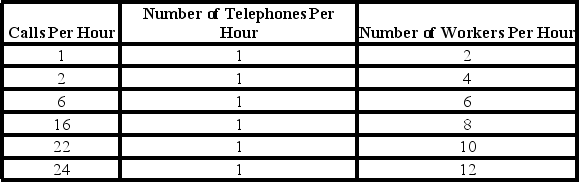 Average variable cost is minimized when output is approximately:
 (Multiple Choice)
4.9/5 (69)
(69) In general, perfectly competitive firms maximize their profit by producing the level of output at which:
(Multiple Choice)
5.0/5 (93)
(93) Refer to the accompanying figure. In this market, equilibrium price is ________ and equilibrium quantity is ________. 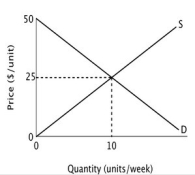
(Multiple Choice)
4.9/5 (89)
(89) Even when a firm produces the level of output at which price equals marginal cost, it should shut down if its total revenue is less than its:
(Multiple Choice)
4.9/5 (84)
(84) The accompanying graph shows the cost curves for Moe's mushroom gathering business, which is perfectly competitive. 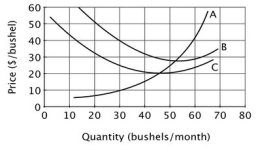 If mushrooms sell for $10 per bushel, and Moe chooses the profit-maximizing quantity, he will gather:
 (Multiple Choice)
4.8/5 (80)
(80) Refer to the accompanying graph. If this firm is a price taker, then when the price of each unit of output is $30, this firm's total cost at its profit-maximizing level of output is ________. 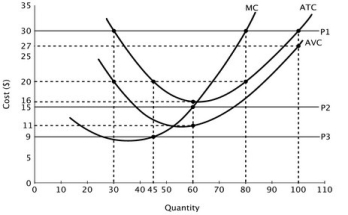
(Multiple Choice)
4.8/5 (81)
(81) Refer to the accompanying graph. If this firm is a price taker and the price of each unit of output is $9, then this firm should: 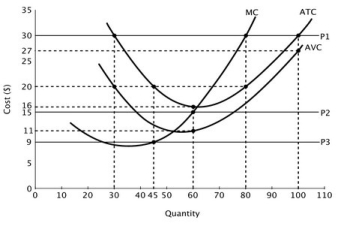
(Multiple Choice)
4.9/5 (78)
(78) A decrease in the price a firm receives for its output will lead the firm to:
(Multiple Choice)
4.9/5 (80)
(80) Refer to the accompanying table. The law of diminishing marginal returns becomes evident after ________ units of output are produced.

(Multiple Choice)
4.9/5 (81)
(81) If a perfectly competitive firm produces an output level at which price is less than marginal costs, then the firm should:
(Multiple Choice)
4.9/5 (86)
(86) Jenny sells lemonade in front of her house in the summer. Several other kids in Jenny's neighborhood also run lemonade stands in the summer. Suppose that the first week of summer, Jenny charged 25 cents for an 8-ounce cup of lemonade, her next-door neighbor Sam charged 50 cents for an 8-ounce cup of lemonade, and Alex across the street charged 15 cents for an 8-ounce cup of lemonade. Assuming the market for lemonade is perfectly competitive, what is most likely to happen?
(Multiple Choice)
4.8/5 (83)
(83) A profit-maximizing perfectly competitive firm must decide:
(Multiple Choice)
4.9/5 (76)
(76) The accompanying graph shows the cost curves for Moe's mushroom gathering business, which is perfectly competitive. 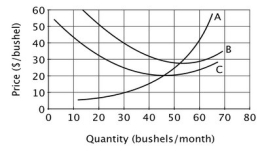 Moe's short run supply curve is:
 (Multiple Choice)
4.8/5 (94)
(94) 
Filters
- Essay(0)
- Multiple Choice(0)
- Short Answer(0)
- True False(0)
- Matching(0)