



 Chat with AI
Exam 6: Perfectly Competitive Supply

Exam 1: Thinking Like an Economist142 Questions
Exam 2: Comparative Advantage163 Questions
Exam 3: Supply and Demand181 Questions
Exam 4: Elasticity154 Questions
Exam 5: Demand144 Questions
Exam 6: Perfectly Competitive Supply159 Questions
Exam 7: Efficiency, Exchange, and the Invisible Hand in Action159 Questions
Exam 8: Monopoly, Oligopoly, and Monopolistic Competition147 Questions
Exam 9: Games and Strategic Behavior150 Questions
Exam 10: An Introduction to Behavioral Economics111 Questions
Exam 11: Externalities, Property Rights, and the Environment184 Questions
Exam 12: The Economics of Information127 Questions
Exam 13: Labor Markets, Poverty, and Income Distribution138 Questions
Exam 14: Public Goods and Tax Policy142 Questions
Exam 15: International Trade and Trade Policy164 Questions
Exam 16: Macroeconomics: The Birds Eye View of the Economy154 Questions
Exam 17: Measuring Economic Activity: GDP and Unemployment210 Questions
Exam 18: Measuring the Price Level and Inflation160 Questions
Exam 19: Economic Growth, Productivity, and Living Standards158 Questions
Exam 20: The Labor Market: Workers, Wages, and Unemployment121 Questions
Exam 21: Saving and Capital Formation144 Questions
Exam 22: Money Prices and the Federal Reserve107 Questions
Exam 23: Financial Markets and International Capital Flows104 Questions
Exam 24: Short-Term Economic Fluctuations: An Introduction124 Questions
Exam 25: Spending and Output in the Short Run146 Questions
Exam 26: Stabilizing the Economy: The Role of the Fed162 Questions
Exam 27: Aggregate Demand, Aggregate Supply, and Inflation159 Questions
Exam 28: Exchange Rates and the Open Economy157 Questions
Select questions type


One reason that variable factors of production tend to show diminishing returns in the short run is that:
(Multiple Choice)
4.9/5  (80)
(80) Suppose Sarah owns a small company that makes wedding cakes. The accompanying table shows how Sarah's total cost varies depending on the number of wedding cakes she makes each day. Number of Cales Per Day Tatal Cast Per Day 0 \ 100 1 \ 180 2 \ 220 3 \ 300 4 \ 400 5 \ 520 6 \ 660
If the market for wedding cakes is perfectly competitive, and wedding cakes sell for $95 each, then at her profit-maximizing level of output, Sarah will earn a ________ of ________ per day.
(Multiple Choice)
4.7/5 (77)
(77) Refer to the accompanying figure. When this market is in equilibrium, total producer surplus in the market is ________ per day. 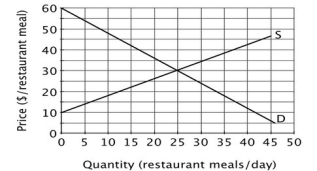
(Multiple Choice)
4.8/5 (78)
(78) Suppose that when a firm produces the level of output at which price equals marginal cost, the firm's total revenue is less than its variable cost. In this case, the firm should:
(Multiple Choice)
4.7/5 (77)
(77) Refer to the accompanying graph. If this firm is a price taker and the price of each unit of output is $9, then at its profit-maximizing level of output, this firm will earn a ________ of ________. 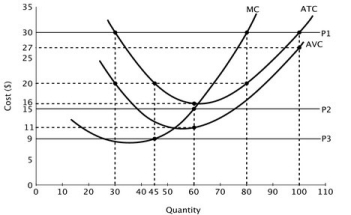
(Multiple Choice)
4.7/5 (78)
(78) Refer to the accompanying graph. If this firm is a price taker, then when the price of each unit of output is $30, how much profit does this firm earn at its profit-maximizing level of output? 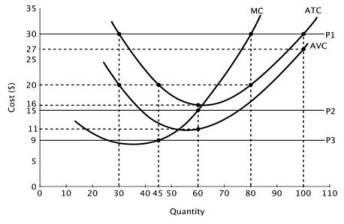
(Multiple Choice)
4.7/5 (80)
(80) One implication of the shape of the demand curve facing a perfectly competitive firm is that:
(Multiple Choice)
4.7/5 (76)
(76) When Acme Dynamite produces 250 units of output, its variable cost is $2,000, and its fixed cost is $500. It sells each unit of output for $25.When Acme Dynamite produces 250 units of output, its average variable cost is ________ and its average total cost is ________.
(Multiple Choice)
4.7/5 (79)
(79) The accompanying table shows a pizzeria's fixed cost and variable cost at different levels of output. Pizzas sell for $20 each. 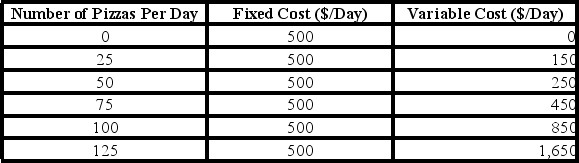 When the pizzeria makes 100 pizzas per day, it earns an economic ________ of ________.
 (Multiple Choice)
4.9/5 (78)
(78) When plotting marginal and average cost curves, the ________ cost curve always crosses the ________ cost curve at its ________.
(Multiple Choice)
4.9/5 (84)
(84) Suppose that when a perfectly competitive firm produces 500 units of output a day, it earns an economic loss. If the price of each unit of output is $1.50, then, in the short run, it's clear that this firm:
(Multiple Choice)
4.8/5 (79)
(79) Refer to the accompanying table. It is clear that diminishing returns sets in after ________ workers per day. 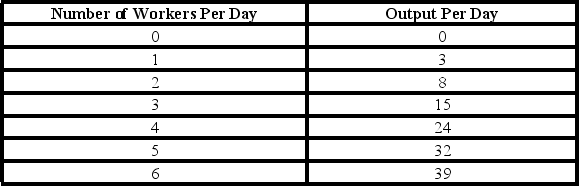
(Multiple Choice)
4.7/5 (64)
(64) John is trying to decide how to divide his time between his job as a stocker in the local grocery store, which pays $7 per hour for as many hours as he chooses to work, and cleaning windows for the businesses downtown. He makes $2 for every window he cleans. John is indifferent between the two tasks, and the number of windows he can clean depends on how many hours he spends cleaning in a day, as shown in the accompanying table. 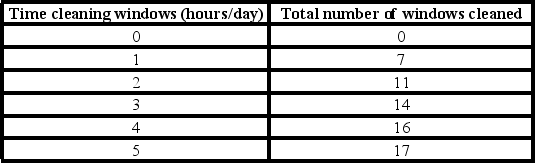 If we plot John's opportunity cost per window on the vertical axis and the number of windows cleaned each day on the horizontal axis, we will have John's ________ curve for window-cleaning services.
 (Multiple Choice)
4.8/5 (77)
(77) For a given seller, the accompanying figure shows the relationship between the number of units produced and the opportunity cost of producing an additional unit of output. What is this seller's reservation price for the 250ᵗʰ unit? 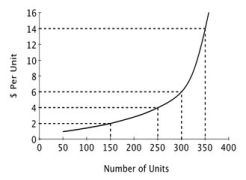
(Multiple Choice)
4.9/5 (80)
(80) John is trying to decide how to divide his time between his job as a stocker in the local grocery store, which pays $7 per hour for as many hours as he chooses to work, and cleaning windows for the businesses downtown. He makes $2 for every window he cleans. John is indifferent between the two tasks, and the number of windows he can clean depends on how many hours he spends cleaning in a day, as shown in the accompanying table. 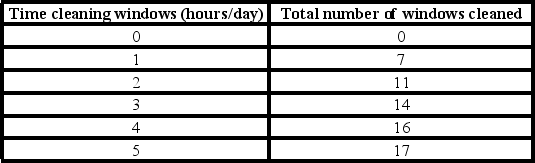 The first hour John spends cleaning windows costs him ________ that he could have earned in the grocery store.
 (Multiple Choice)
4.7/5 (90)
(90) The accompanying graph shows the cost curves for Moe's mushroom gathering business, which is perfectly competitive. 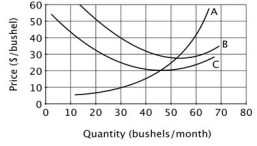 In the graph above, the average variable cost curve is labeled ________, the average total cost curve is labeled ________, and the marginal cost curve is labeled ________.
 (Multiple Choice)
5.0/5 (74)
(74) Suppose Sarah owns a small company that makes wedding cakes. The accompanying table shows how Sarah's total cost varies depending on the number of wedding cakes she makes each day. Number of Cales Per Day Tatal Cast Per Day 0 \ 100 1 \ 180 2 \ 220 3 \ 300 4 \ 400 5 \ 520 6 \ 660
Sarah's fixed cost is ________ per day.
(Multiple Choice)
4.8/5 (71)
(71) In general, when the price of a fixed factor of production increases:
(Multiple Choice)
5.0/5 (76)
(76) In which of the following markets do firms sell the same standardized product?
(Multiple Choice)
4.8/5 (76)
(76) 
Filters
- Essay(0)
- Multiple Choice(0)
- Short Answer(0)
- True False(0)
- Matching(0)