



 Chat with AI
Exam 6: Perfectly Competitive Supply

Exam 1: Thinking Like an Economist142 Questions
Exam 2: Comparative Advantage163 Questions
Exam 3: Supply and Demand181 Questions
Exam 4: Elasticity154 Questions
Exam 5: Demand144 Questions
Exam 6: Perfectly Competitive Supply159 Questions
Exam 7: Efficiency, Exchange, and the Invisible Hand in Action159 Questions
Exam 8: Monopoly, Oligopoly, and Monopolistic Competition147 Questions
Exam 9: Games and Strategic Behavior150 Questions
Exam 10: An Introduction to Behavioral Economics111 Questions
Exam 11: Externalities, Property Rights, and the Environment184 Questions
Exam 12: The Economics of Information127 Questions
Exam 13: Labor Markets, Poverty, and Income Distribution138 Questions
Exam 14: Public Goods and Tax Policy142 Questions
Exam 15: International Trade and Trade Policy164 Questions
Exam 16: Macroeconomics: The Birds Eye View of the Economy154 Questions
Exam 17: Measuring Economic Activity: GDP and Unemployment210 Questions
Exam 18: Measuring the Price Level and Inflation160 Questions
Exam 19: Economic Growth, Productivity, and Living Standards158 Questions
Exam 20: The Labor Market: Workers, Wages, and Unemployment121 Questions
Exam 21: Saving and Capital Formation144 Questions
Exam 22: Money Prices and the Federal Reserve107 Questions
Exam 23: Financial Markets and International Capital Flows104 Questions
Exam 24: Short-Term Economic Fluctuations: An Introduction124 Questions
Exam 25: Spending and Output in the Short Run146 Questions
Exam 26: Stabilizing the Economy: The Role of the Fed162 Questions
Exam 27: Aggregate Demand, Aggregate Supply, and Inflation159 Questions
Exam 28: Exchange Rates and the Open Economy157 Questions
Select questions type


Which of the following is the most likely to be a fixed factor of production at a farm?
(Multiple Choice)
4.7/5  (70)
(70) Suppose a firm produces the level of output at which the marginal cost of the last unit produced equals the price of the good. Which of the following statements is always true?
(Multiple Choice)
4.7/5 (77)
(77) The accompanying table shows a pizzeria's fixed cost and variable cost at different levels of output. Pizzas sell for $20 each. 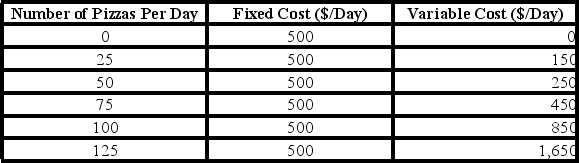 Between 25 and 50 pizzas per day, the pizzeria's marginal cost is ________.
 (Multiple Choice)
4.8/5 (89)
(89) The accompanying table describes the relationship between the number of workers hired by a call center each hour and the number of calls the call center can make each hour. The call center has only 1 telephone. The telephone costs the firm $5/hour (regardless of how many calls are made), and each worker is paid $10 per hour. 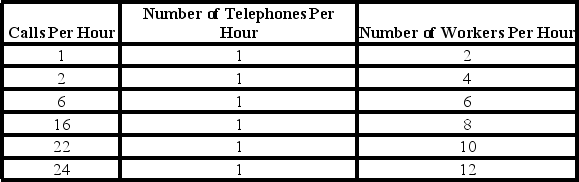 If the price of a telephone increases to from $5 to $10 an hour and nothing else changes, then:
 (Multiple Choice)
4.8/5 (84)
(84) Refer to the accompanying figure. The equilibrium price in this market is ________ and the equilibrium quantity is ________. 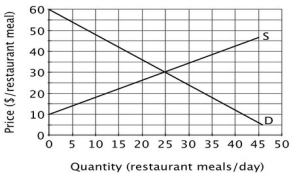
(Multiple Choice)
4.8/5 (74)
(74) As price increases, firms in a perfectly competitive market find that it is:
(Multiple Choice)
4.9/5 (82)
(82) Refer to the accompanying graph. If this firm is a price taker, then when the price of each unit of output is $30, this firm's profit-maximizing level of output is ________. 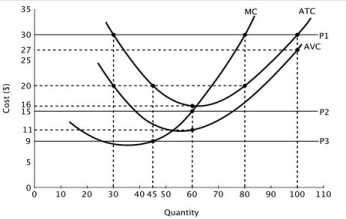
(Multiple Choice)
5.0/5 (76)
(76) John is trying to decide how to divide his time between his job as a stocker in the local grocery store, which pays $7 per hour for as many hours as he chooses to work, and cleaning windows for the businesses downtown. He makes $2 for every window he cleans. John is indifferent between the two tasks, and the number of windows he can clean depends on how many hours he spends cleaning in a day, as shown in the accompanying table. 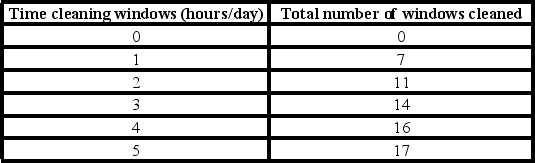 What is John's opportunity cost of cleaning windows for an hour?
 (Multiple Choice)
4.8/5 (84)
(84) For a given seller, the accompanying figure shows the relationship between the number of units produced and the opportunity cost of producing an additional unit of output. If the market price of this good is $6, how many units would this seller produce? 
(Multiple Choice)
4.9/5 (81)
(81) Refer to the accompanying figure. If the market for doughnuts is perfectly competitive, and the price of a doughnut is 10 cents, then this firm: 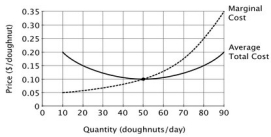
(Multiple Choice)
4.8/5 (74)
(74) A technological innovation that reduces a firm's cost of producing additional units of output will lead to:
(Multiple Choice)
4.9/5 (70)
(70) If crude oil is a variable factor of production for a firm, then an increase in the price of crude oil will lead to:
(Multiple Choice)
4.8/5 (84)
(84) Suppose Chris is a potter who makes mugs. His total costs depend on the number of mugs he makes each day, as shown in the accompanying table. Number d Mugs Per Day Tatal Cast Per Day 0 \ 10 1 \ 14 2 \ 19 3 \ 25 4 \ 32 5 \ 40 6 \ 49
If the market for mugs is perfectly competitive, and mugs sell for $7.50 each, then Chris should make ________ mugs per day.
(Multiple Choice)
4.7/5 (82)
(82) Suppose a firm uses workers and office space to produce output. The firm is locked into a year-long lease on its office space, but it can easily vary the number of employee-hours it uses each day. The accompanying table describes the relationship between the number of employee-hours the firm uses each day and the firm's daily output. Each unit of output sells for $2, the hourly wage rate is $14, and the rent on the office space is $50 per day. 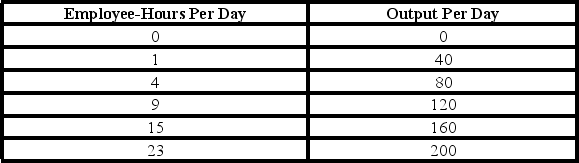 When the firm uses 9 employee-hours per day, its total revenue each day is:
 (Multiple Choice)
4.8/5 (84)
(84) Your neighbors have offered to pay you to look after their dog while they are on vacation. It will take you one hour per day to feed, walk, and care for the dog, which you can do either before or after you go to work. Your regular job pays $10 per hour, and you can work up to eight hours per day. The smallest amount of money you would accept to look after your neighbor's dog each day is equal to:
(Multiple Choice)
4.9/5 (79)
(79) When Acme Dynamite produces 250 units of output, its variable cost is $2,000, and its fixed cost is $500. It sells each unit of output for $25. If the price of dynamite drops to $10, should Acme Dynamite continue to operate in the short run?
(Multiple Choice)
4.8/5 (90)
(90) Which of the following statements is true for both Microsoft and a locally owned restaurant?
(Multiple Choice)
4.8/5 (75)
(75) Suppose a firm uses workers and office space to produce output. The firm is locked into a year-long lease on its office space, but it can easily vary the number of employee-hours it uses each day. The accompanying table describes the relationship between the number of employee-hours the firm uses each day and the firm's daily output. Each unit of output sells for $2, the hourly wage rate is $14, and the rent on the office space is $50 per day. 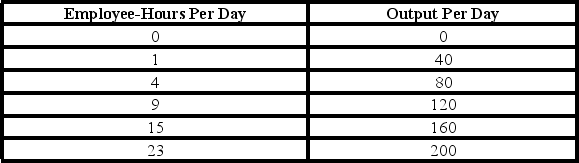 When the firm uses 9 employee-hours per day, it earns a daily ________ of ________.
 (Multiple Choice)
5.0/5 (89)
(89) John is trying to decide how to divide his time between his job as a stocker in the local grocery store, which pays $7 per hour for as many hours as he chooses to work, and cleaning windows for the businesses downtown. He makes $2 for every window he cleans. John is indifferent between the two tasks, and the number of windows he can clean depends on how many hours he spends cleaning in a day, as shown in the accompanying table. 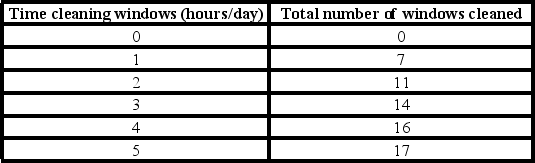 Should John spend a third hour cleaning windows?
 (Multiple Choice)
4.9/5 (82)
(82) 
Filters
- Essay(0)
- Multiple Choice(0)
- Short Answer(0)
- True False(0)
- Matching(0)