



 Chat with AI
Exam 9: Noninvasive Monitoring in Neonatal and Pediatric Care

Exam 1: Fetal Lung Development6 Questions
Exam 2: Fetal Gas Exchange and Circulation7 Questions
Exam 3: Antenatal Assessment and High Risk Delivery24 Questions
Exam 4: Exam and Assessment of the Neonatal and Pediatric Patient33 Questions
Exam 5: Pulmonary Function Testing and Bedside Pulmonary Mechanics18 Questions
Exam 6: Radiographic Assessment19 Questions
Exam 7: Bronchoscopy20 Questions
Exam 8: Invasive Blood Gas Analysis and Monitoring21 Questions
Exam 9: Noninvasive Monitoring in Neonatal and Pediatric Care18 Questions
Exam 10: Oxygen Administration17 Questions
Exam 11: Aerosols and Administration of Medication22 Questions
Exam 12: Airway Clearance Techniques and Lung Volume Expansion20 Questions
Exam 13: Airway Management25 Questions
Exam 14: Surfactant Replacement14 Questions
Exam 15: Non-Invasive Mechanical Ventilation and Continuous Positive Pressure of the Neonate19 Questions
Exam 16: Noninvasive Mechanical Ventilation of the Child21 Questions
Exam 17: Mechanical Ventilation of the Neonate and Pediatric Patient28 Questions
Exam 18: Administration of Gas Mixtures24 Questions
Exam 19: Extracorporeal Life Support25 Questions
Exam 20: Pharmacology20 Questions
Exam 21: Thoracic Organ Transplantation19 Questions
Exam 22: Neonatal Complications and Pulmonary Disorders26 Questions
Exam 23: Congenital and Surgical Disorders That Affect Respiratory Care20 Questions
Exam 24: Congenital Cardiac Defects24 Questions
Exam 25: Sudden Infant Death Syndrome Sleep Disorders16 Questions
Exam 26: Pediatric Airway Disorders and Pulmonary Infections24 Questions
Exam 27: Asthma22 Questions
Exam 28: Cystic Fibrosis18 Questions
Exam 29: Acute Respiratory Distress Syndrome19 Questions
Exam 30: Shock, Sepsis and Anaphylaxis21 Questions
Exam 31: Pediatric Trauma53 Questions
Exam 32: Disorders of the Pleura14 Questions
Exam 33: Neurologic and Neuromuscular Disorders15 Questions
Exam 34: Transport of Infants and Children14 Questions
Exam 35: Home Care16 Questions
Exam 36: Quality and Safety11 Questions
Select questions type


Which of the following is the main physiologic factor responsible for deriving accurate transcutaneous data?

Free
(Multiple Choice)
4.8/5  (76)
(76) Correct Answer: Verified
C
A therapist is monitoring a child on the mechanical ventilator who is hemodynamically stable.The PetCO₂ is 48 mm Hg.If accurate,what should be the PaCO₂?
Free
(Multiple Choice)
4.8/5 (70)
(70) Correct Answer:Verified
VerifiedC
What clinical parameter is critically important to monitor when mechanical ventilation is administered?
Free
(Multiple Choice)
5.0/5 (86)
(86) Correct Answer:Verified
VerifiedA
What is volumetric capnography able to determine?
I.Airway dead space
II.Alveolar tidal volume
III.Shunt fraction
IV.Alveolar minute volume
(Multiple Choice)
4.7/5 (79)
(79) How is the percentage of functional hemoglobin that is saturated with oxygen determined via pulse oximetry?
(Multiple Choice)
4.8/5 (72)
(72) Which of the following conditions will preclude the use of indirect calorimetry?
I.Cuffed endotracheal tubes
II.Circuit leaks
III.FiO₂ 40%
IV.HFOV
(Multiple Choice)
4.9/5 (74)
(74) As the therapist applies a pulse oximeter finger probe to a neonate who is receiving supplemental oxygen,she notices that the SpO₂ reading is 100%.What should the therapist do in this situation?
(Multiple Choice)
4.7/5 (79)
(79) Why do transcutaneous oxygen tension (PO₂)and carbon dioxide tension (PCO₂)values differ from PaO₂ and PaCO₂ measurements?
(Multiple Choice)
4.9/5 (78)
(78) The therapist has applied a bandage-type pulse oximetry probe too tightly to an infant's finger.What problem can be expected to occur in this situation?
(Multiple Choice)
4.9/5 (78)
(78) Where on the following normal capnogram is the end-tidal carbon dioxide (PetCO₂)represented?
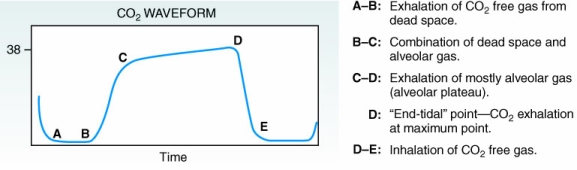
(Multiple Choice)
4.8/5 (77)
(77) While attending to a neonatal patient in the neonatal intensive care unit (NICU),the therapist notices that a transcutaneous electrode is affixed to the upper chest of the neonate.What should the therapist do at this time?
(Multiple Choice)
4.8/5 (90)
(90) Which of the following features or characteristics apply to mainstream capnography?
I.The mainstream capnograph contains narrow tubing that can become occluded with mucus.
II.Mainstream capnography generally employs infrared spectrometers.
III.The mainstream capnograph does not add much weight to the breathing circuit.
IV.The mainstream capnograph is placed at the proximal end of the endotracheal tube.
(Multiple Choice)
4.8/5 (81)
(81) The therapist has been asked to measure preductal oxygen saturation.Where could the therapist place the pulse oximeter probe?
(Multiple Choice)
4.9/5 (84)
(84) The therapist is assessing a mechanically ventilated infant and observes that the transcutaneous electrode temperature is set between 41° C and 44° C.What action does the therapist need to take at this time?
(Multiple Choice)
4.8/5 (81)
(81) The following capnogram was obtained from a newborn infant receiving mechanical ventilation.
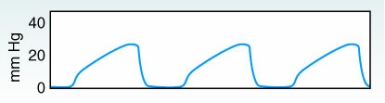 How should the therapist evaluate this capnogram?
 (Multiple Choice)
4.7/5 (76)
(76) An infant demonstrates the following capnogram while being mechanically ventilated.
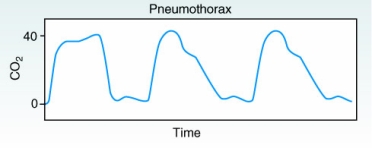 How should the therapist interpret this capnogram?
 (Multiple Choice)
4.9/5 (80)
(80) While working in the NICU with a mechanically ventilated newborn who is being monitored for PetCO₂,the therapist observes the following capnogram: 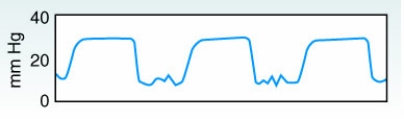 What interpretation should the therapist make of this capnogram?
 (Multiple Choice)
4.8/5 (86)
(86) 
Filters
- Essay(0)
- Multiple Choice(0)
- Short Answer(0)
- True False(0)
- Matching(0)