



 Chat with AI
Exam 17: Mechanical Ventilation of the Neonate and Pediatric Patient

Exam 1: Fetal Lung Development6 Questions
Exam 2: Fetal Gas Exchange and Circulation7 Questions
Exam 3: Antenatal Assessment and High Risk Delivery24 Questions
Exam 4: Exam and Assessment of the Neonatal and Pediatric Patient33 Questions
Exam 5: Pulmonary Function Testing and Bedside Pulmonary Mechanics18 Questions
Exam 6: Radiographic Assessment19 Questions
Exam 7: Bronchoscopy20 Questions
Exam 8: Invasive Blood Gas Analysis and Monitoring21 Questions
Exam 9: Noninvasive Monitoring in Neonatal and Pediatric Care18 Questions
Exam 10: Oxygen Administration17 Questions
Exam 11: Aerosols and Administration of Medication22 Questions
Exam 12: Airway Clearance Techniques and Lung Volume Expansion20 Questions
Exam 13: Airway Management25 Questions
Exam 14: Surfactant Replacement14 Questions
Exam 15: Non-Invasive Mechanical Ventilation and Continuous Positive Pressure of the Neonate19 Questions
Exam 16: Noninvasive Mechanical Ventilation of the Child21 Questions
Exam 17: Mechanical Ventilation of the Neonate and Pediatric Patient28 Questions
Exam 18: Administration of Gas Mixtures24 Questions
Exam 19: Extracorporeal Life Support25 Questions
Exam 20: Pharmacology20 Questions
Exam 21: Thoracic Organ Transplantation19 Questions
Exam 22: Neonatal Complications and Pulmonary Disorders26 Questions
Exam 23: Congenital and Surgical Disorders That Affect Respiratory Care20 Questions
Exam 24: Congenital Cardiac Defects24 Questions
Exam 25: Sudden Infant Death Syndrome Sleep Disorders16 Questions
Exam 26: Pediatric Airway Disorders and Pulmonary Infections24 Questions
Exam 27: Asthma22 Questions
Exam 28: Cystic Fibrosis18 Questions
Exam 29: Acute Respiratory Distress Syndrome19 Questions
Exam 30: Shock, Sepsis and Anaphylaxis21 Questions
Exam 31: Pediatric Trauma53 Questions
Exam 32: Disorders of the Pleura14 Questions
Exam 33: Neurologic and Neuromuscular Disorders15 Questions
Exam 34: Transport of Infants and Children14 Questions
Exam 35: Home Care16 Questions
Exam 36: Quality and Safety11 Questions
Select questions type


Over the last 90 minutes,the therapist has obtained three arterial blood samples from an arterial line inserted in a neonate receiving mechanical ventilation and being monitored by capnometry.The PaCO? values were as follows: (1)47 mm Hg,(2)46 mm Hg,and (3)47 mm Hg.How should the therapist evaluate the following capnogram?
B 

Free
(Multiple Choice)
4.9/5  (81)
(81) Correct Answer: Verified
C
Which of the following factors need to be considered for HFV ventilator circuits?
I.Time for gas egress during exhalation
II.Circuit compliance
III.Endotracheal tube size
IV.Intrinsic timing mechanisms
Free
(Multiple Choice)
5.0/5 (80)
(80) Correct Answer:Verified
VerifiedC
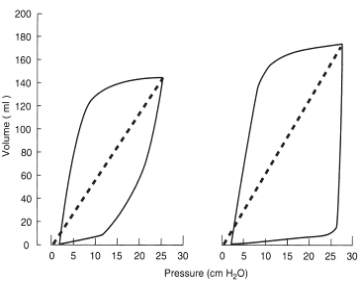
The following pressure-volume loop was obtained from a patient receiving mechanical ventilation in the pressure support mode.What type of problem does this ventilator graphic represent?
Free
(Multiple Choice)
5.0/5 (86)
(86) Correct Answer:Verified
VerifiedA
During high-frequency ventilation,as the diameter of the ETT increases,what happens to the delivered tidal volume under the same pressure settings?
(Multiple Choice)
4.9/5 (88)
(88) How is the minute ventilation decreased when a patient is being weaned from HFOV?
(Multiple Choice)
4.7/5 (85)
(85) The therapist is conducting a ventilator check for a neonate and makes the following notations on the ventilator flow sheet:
•PEEP: 5 cm H₂O
•Peak inspiratory pressure (PIP): 25 cm H₂O
•Mandatory rate: 15 breaths/minute
•FiO₂: 0.35
On the basis of these observations,what should the therapist recommend for this neonate?
(Multiple Choice)
4.8/5 (84)
(84) How is the radiographic assessment of neonatal lung volume performed?
(Multiple Choice)
4.7/5 (81)
(81) Which of the following modes of ventilation attempts to maintain a minimum target tidal volume with a constant pressure by manipulating the inspiratory flow?
(Multiple Choice)
4.8/5 (89)
(89) What is a frequent requirement when employing the low-volume strategy while ventilating a neonatal patient with pulmonary interstitial emphysema by HFV?
(Multiple Choice)
4.8/5 (98)
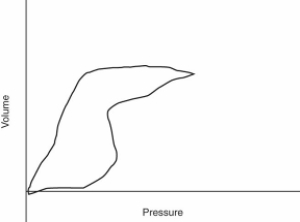
(98) On the basis of the following pressure-volume loop,what ventilator setting change should the therapist make?
(Multiple Choice)
4.9/5 (93)
(93) Enhanced diffusion in HFV is a function of which of the following factors?
(Multiple Choice)
4.9/5 (84)
(84) During HFOV,which of the following factors has a direct influence on a neonate's delivered tidal volume?
(Multiple Choice)
5.0/5 (84)
(84) During HFOV manipulation of which of the following components establishes the continuous distending pressure?
(Multiple Choice)
4.9/5 (90)
(90) Which of the following adjustments should the therapist consider to improve ventilation on a patient undergoing HFV?
(Multiple Choice)
4.9/5 (68)
(68) The therapist notices that gas exchange has dramatically improved in a neonate undergoing HFOV.However,weaning has not been implemented accordingly.What are the consequences of failing to quickly wean a neonatal patient from HFV?
(Multiple Choice)
4.9/5 (85)
(85) When airway pressure release ventilation is used,what physiologic process occurs as the higher pressure is released and the lower is achieved?
(Multiple Choice)
4.9/5 (87)
(87) During volume-controlled ventilation,which of the following factors influences the peak inspiratory pressure?
(Multiple Choice)
4.9/5 (83)
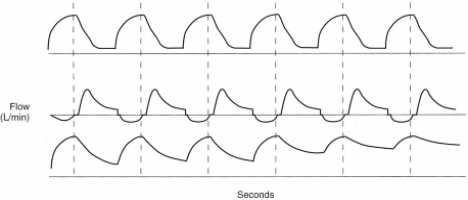
(83) On the basis of the following flow/time scalar,which of the following conditions has developed?
(Multiple Choice)
4.8/5 (91)
(91) Which of the following factors influences the gas volume compressed in the ventilator circuit?
(Multiple Choice)
4.8/5 (81)
(81) 
Filters
- Essay(0)
- Multiple Choice(0)
- Short Answer(0)
- True False(0)
- Matching(0)