



 Chat with AI
Exam 5: Pulmonary Function Testing and Bedside Pulmonary Mechanics

Exam 1: Fetal Lung Development6 Questions
Exam 2: Fetal Gas Exchange and Circulation7 Questions
Exam 3: Antenatal Assessment and High Risk Delivery24 Questions
Exam 4: Exam and Assessment of the Neonatal and Pediatric Patient33 Questions
Exam 5: Pulmonary Function Testing and Bedside Pulmonary Mechanics18 Questions
Exam 6: Radiographic Assessment19 Questions
Exam 7: Bronchoscopy20 Questions
Exam 8: Invasive Blood Gas Analysis and Monitoring21 Questions
Exam 9: Noninvasive Monitoring in Neonatal and Pediatric Care18 Questions
Exam 10: Oxygen Administration17 Questions
Exam 11: Aerosols and Administration of Medication22 Questions
Exam 12: Airway Clearance Techniques and Lung Volume Expansion20 Questions
Exam 13: Airway Management25 Questions
Exam 14: Surfactant Replacement14 Questions
Exam 15: Non-Invasive Mechanical Ventilation and Continuous Positive Pressure of the Neonate19 Questions
Exam 16: Noninvasive Mechanical Ventilation of the Child21 Questions
Exam 17: Mechanical Ventilation of the Neonate and Pediatric Patient28 Questions
Exam 18: Administration of Gas Mixtures24 Questions
Exam 19: Extracorporeal Life Support25 Questions
Exam 20: Pharmacology20 Questions
Exam 21: Thoracic Organ Transplantation19 Questions
Exam 22: Neonatal Complications and Pulmonary Disorders26 Questions
Exam 23: Congenital and Surgical Disorders That Affect Respiratory Care20 Questions
Exam 24: Congenital Cardiac Defects24 Questions
Exam 25: Sudden Infant Death Syndrome Sleep Disorders16 Questions
Exam 26: Pediatric Airway Disorders and Pulmonary Infections24 Questions
Exam 27: Asthma22 Questions
Exam 28: Cystic Fibrosis18 Questions
Exam 29: Acute Respiratory Distress Syndrome19 Questions
Exam 30: Shock, Sepsis and Anaphylaxis21 Questions
Exam 31: Pediatric Trauma53 Questions
Exam 32: Disorders of the Pleura14 Questions
Exam 33: Neurologic and Neuromuscular Disorders15 Questions
Exam 34: Transport of Infants and Children14 Questions
Exam 35: Home Care16 Questions
Exam 36: Quality and Safety11 Questions
Select questions type


Which of the following pulmonary function values characterize an obstructive lung defect?
I.The forced vital capacity (FVC)may remain normal.
II.The forced expiratory volume in 1 second (FEV₁)is decreased.
III.The ratio of residual volume to total lung capacity (RV/TLC)may be normal.
IV.The FEV₁ is decreased.

Free
(Multiple Choice)
4.9/5  (77)
(77) Correct Answer: Verified
C
Why must caution be exercised when using a face mask while performing pulmonary function testing on neonates?
Free
(Multiple Choice)
4.8/5 (73)
(73) Correct Answer:Verified
VerifiedA
What is the clinical purpose for measuring the maximal inspiratory pressure (MIP)?
Free
(Multiple Choice)
4.9/5 (79)
(79) Correct Answer:Verified
VerifiedC
The therapist is reviewing a flow-volume loop obtained from a pediatric patient and observes decreased volume and normal flows.On the basis of this observation,how should the therapist interpret this finding?
(Multiple Choice)
5.0/5 (86)
(86) Which of the following factors is the most important determinant of high airway resistance and air trapping in small infants?
(Multiple Choice)
4.8/5 (94)
(94) A child has been diagnosed with vocal cord dysfunction.Which of the following flow-volume loops demonstrates this condition?
(Multiple Choice)
4.8/5 (79)
(79) Pulmonary function testing has been ordered in an infant.Which of the following represents a real risk to this infant?
(Multiple Choice)
4.8/5 (84)
(84) A pre- and postbronchodilator,partial expiratory pressure-volume maneuver was performed on a 9-month-old boy.The child's prebronchodilator mₐₓFRC was 67 mL/second and the postbronchodilator mₐₓFRC was 94 mL/second.How should the therapist interpret these data?
(Multiple Choice)
4.8/5 (82)
(82) According to the ATS-ERS acceptability criteria for an FVC maneuver performed on a 9-year-old child,what is considered a satisfactory exhalation time?
(Multiple Choice)
4.8/5 (81)
(81) A reduction in the DLCO may indicate the presence of which of the following conditions?
I.Pulmonary fibrosis
II.Pulmonary edema
III.Hematologic disorders
IV.Bronchiolitis obliterans
(Multiple Choice)
4.8/5 (82)
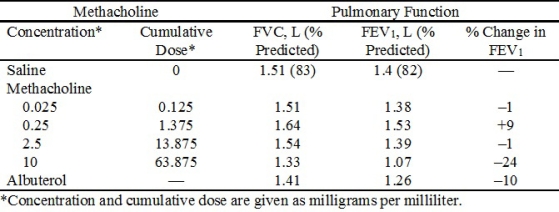
(82) On the basis of the bronchial provocation data presented in the following table,identify the PD₂₀ (provocative dose that produces a 20% fall in FEV₁).
(Multiple Choice)
4.9/5 (96)
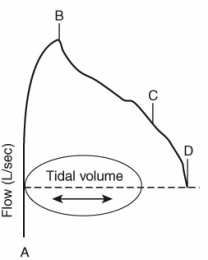
(96) On the partial expiratory flow-volume loop shown here,identify the point depicting the "maximal expiratory flow at FRC."
(Multiple Choice)
4.7/5 (60)
(60) On the basis of the data presented below,calculate the time constant.
•Tidal volume (VT),600 mL
•Respiratory rate (RR),12 breaths/minute
•Lung compliance (C),0.2 L/cm H₂O
•Airway resistance (Raw),2.5 cm H₂O/L/second
•Peak inspiratory pressure (PIP),30 cm H₂O
•Inspiratory time (TI),2 seconds
•Expiratory time (TE),1 second
(Multiple Choice)
4.8/5 (68)
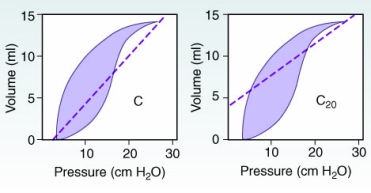
(68) How should the therapist interpret the following pressure-volume loop obtained from a mechanically ventilated infant?
(Multiple Choice)
4.8/5 (86)
(86) The respiratory therapist is looking at a flow-volume curve that displays a concave shape on the expiratory tracing.What is this change most consistent with?
(Multiple Choice)
4.8/5 (80)
(80) The respiratory therapist places a face mask on an infant to measure FRC.What should the therapist do to minimize the presence of air leaks and improve accuracy of the test?
(Multiple Choice)
4.7/5 (66)
(66) 
Filters
- Essay(0)
- Multiple Choice(0)
- Short Answer(0)
- True False(0)
- Matching(0)