



 Chat with AI
Exam 24: Congenital Cardiac Defects

Exam 1: Fetal Lung Development6 Questions
Exam 2: Fetal Gas Exchange and Circulation7 Questions
Exam 3: Antenatal Assessment and High Risk Delivery24 Questions
Exam 4: Exam and Assessment of the Neonatal and Pediatric Patient33 Questions
Exam 5: Pulmonary Function Testing and Bedside Pulmonary Mechanics18 Questions
Exam 6: Radiographic Assessment19 Questions
Exam 7: Bronchoscopy20 Questions
Exam 8: Invasive Blood Gas Analysis and Monitoring21 Questions
Exam 9: Noninvasive Monitoring in Neonatal and Pediatric Care18 Questions
Exam 10: Oxygen Administration17 Questions
Exam 11: Aerosols and Administration of Medication22 Questions
Exam 12: Airway Clearance Techniques and Lung Volume Expansion20 Questions
Exam 13: Airway Management25 Questions
Exam 14: Surfactant Replacement14 Questions
Exam 15: Non-Invasive Mechanical Ventilation and Continuous Positive Pressure of the Neonate19 Questions
Exam 16: Noninvasive Mechanical Ventilation of the Child21 Questions
Exam 17: Mechanical Ventilation of the Neonate and Pediatric Patient28 Questions
Exam 18: Administration of Gas Mixtures24 Questions
Exam 19: Extracorporeal Life Support25 Questions
Exam 20: Pharmacology20 Questions
Exam 21: Thoracic Organ Transplantation19 Questions
Exam 22: Neonatal Complications and Pulmonary Disorders26 Questions
Exam 23: Congenital and Surgical Disorders That Affect Respiratory Care20 Questions
Exam 24: Congenital Cardiac Defects24 Questions
Exam 25: Sudden Infant Death Syndrome Sleep Disorders16 Questions
Exam 26: Pediatric Airway Disorders and Pulmonary Infections24 Questions
Exam 27: Asthma22 Questions
Exam 28: Cystic Fibrosis18 Questions
Exam 29: Acute Respiratory Distress Syndrome19 Questions
Exam 30: Shock, Sepsis and Anaphylaxis21 Questions
Exam 31: Pediatric Trauma53 Questions
Exam 32: Disorders of the Pleura14 Questions
Exam 33: Neurologic and Neuromuscular Disorders15 Questions
Exam 34: Transport of Infants and Children14 Questions
Exam 35: Home Care16 Questions
Exam 36: Quality and Safety11 Questions
Select questions type


Which of the following methods is involved in the management of a PDA?

Free
(Multiple Choice)
4.9/5  (71)
(71) Correct Answer: Verified
C
What factor is responsible for closure of the foramen ovale?
Free
(Multiple Choice)
4.7/5 (83)
(83) Correct Answer:Verified
VerifiedB
At birth,what factor causes dilation of the pulmonary vascular bed and a decrease in the pulmonary vascular resistance?
Free
(Multiple Choice)
4.7/5 (75)
(75) Correct Answer:Verified
VerifiedA
Which of the following blood flow patterns occurs in complete transposition of the great arteries?
(Multiple Choice)
4.8/5 (89)
(89) Which of the following physiologic mechanisms need to be in place to ensure adequate systemic perfusion in infants with HLHS?
(Multiple Choice)
4.8/5 (76)
(76) Which of the following medications is the most common preoperative treatment to minimize preductal constriction until surgical correction of coarctation of the aorta can be achieved?
(Multiple Choice)
4.7/5 (73)
(73) Which of the following congenital cardiac anomalies is classified as conotruncal,associated with a "boot-shaped" appearance of the heart?
(Multiple Choice)
4.9/5 (87)
(87) When using subambient oxygen therapy,what range of oxygen saturations should the therapist target?
(Multiple Choice)
4.9/5 (72)
(72) Which of the following strategies can be used to increase PVR in infants with HLHS?
(Multiple Choice)
4.7/5 (68)
(68) What should the therapist select as target gas exchange parameters after surgical intervention for infants with hypoplastic left ventricular syndrome HLHS?
(Multiple Choice)
4.9/5 (84)
(84) The therapist is setting pulse oximetry to determine the presence of right-to-left shunt in an infant suspected of having a heart defect.Where should the therapist place the pulse ox probe to obtain the most accurate measure of preductal oxygen saturation?
(Multiple Choice)
4.9/5 (74)
(74) Which of the following vessels return blood to the right ventricle?
I.Pulmonary vein
II.Inferior vena cava
III.Superior vena cava
IV.Coronary sinus
(Multiple Choice)
4.7/5 (80)
(80) 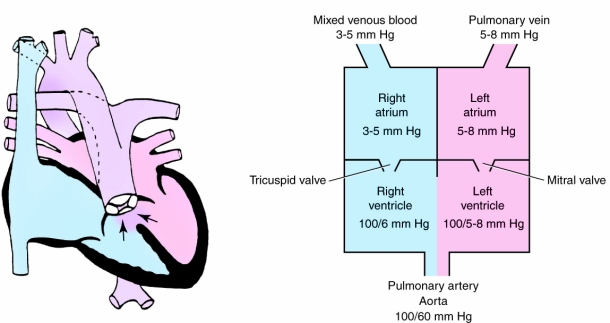
The therapist is treating a child with TOF who appears to be having a "tet" spell.What should the therapist suggest to treat this event?
I.Beta blockers
II.Knee-chest position to increase SVR
III.Morphine sulfate
IV.Oxygen
(Multiple Choice)
4.9/5 (80)
(80) A therapist monitoring an infant after a Blalock-Tausig shunt placement notices a significant drop in the end-tidal carbon dioxide (ETCO₂)despite no changes in the infant's respiratory rate.How should the therapist interpret this change?
(Multiple Choice)
4.7/5 (88)
(88) Which of the following clinical manifestations is consistent with an atrial septal defect (ASD)?
(Multiple Choice)
4.9/5 (79)
(79) For which of the following congenital cardiac defects may spontaneous closure of the ductus arteriosus be catastrophic?
I.Tetralogy of Fallot with pulmonary atresia
II.Atrial septal defect
III.Severe coarctation of the aorta
IV.Hypoplastic left heart syndrome
(Multiple Choice)
4.9/5 (84)
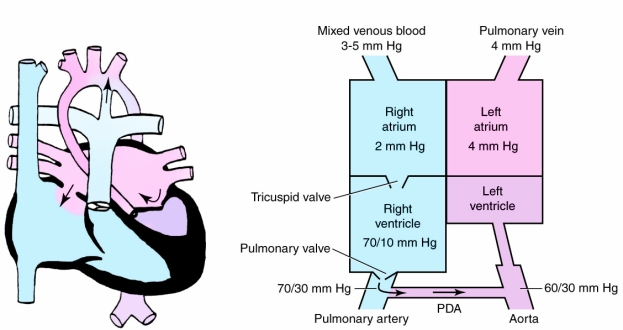
(84) Identify the congenital cardiac defect depicted in the following illustration:
(Multiple Choice)
4.9/5 (84)
(84) Which of the following statements describe truncus arteriosus?
I.The pulmonary artery arises from the left ventricle,and the aorta stems from the right ventricle.
II.If PVR increases relative to systemic vascular resistance (SVR),more blood flows to the lungs through the truncus,decreasing systemic cardiac output.
III.If SVR decreases relative to PVR,blood flow will be shunted from right to left,bypassing the lungs.
IV.A large VSD allows total mixing of blood from the two ventricles.
(Multiple Choice)
4.9/5 (73)
(73) The therapist is treating a child with a congenital heart defect who is unresponsive to oxygen therapy.Although the chest X-ray is relatively normal,the heart is described as "egg-shaped." Which of the following heart defects is more consistent with this description?
(Multiple Choice)
4.8/5 (89)
(89) 
Filters
- Essay(0)
- Multiple Choice(0)
- Short Answer(0)
- True False(0)
- Matching(0)