



 Chat with AI
Exam 26: Pediatric Airway Disorders and Pulmonary Infections

Exam 1: Fetal Lung Development6 Questions
Exam 2: Fetal Gas Exchange and Circulation7 Questions
Exam 3: Antenatal Assessment and High Risk Delivery24 Questions
Exam 4: Exam and Assessment of the Neonatal and Pediatric Patient33 Questions
Exam 5: Pulmonary Function Testing and Bedside Pulmonary Mechanics18 Questions
Exam 6: Radiographic Assessment19 Questions
Exam 7: Bronchoscopy20 Questions
Exam 8: Invasive Blood Gas Analysis and Monitoring21 Questions
Exam 9: Noninvasive Monitoring in Neonatal and Pediatric Care18 Questions
Exam 10: Oxygen Administration17 Questions
Exam 11: Aerosols and Administration of Medication22 Questions
Exam 12: Airway Clearance Techniques and Lung Volume Expansion20 Questions
Exam 13: Airway Management25 Questions
Exam 14: Surfactant Replacement14 Questions
Exam 15: Non-Invasive Mechanical Ventilation and Continuous Positive Pressure of the Neonate19 Questions
Exam 16: Noninvasive Mechanical Ventilation of the Child21 Questions
Exam 17: Mechanical Ventilation of the Neonate and Pediatric Patient28 Questions
Exam 18: Administration of Gas Mixtures24 Questions
Exam 19: Extracorporeal Life Support25 Questions
Exam 20: Pharmacology20 Questions
Exam 21: Thoracic Organ Transplantation19 Questions
Exam 22: Neonatal Complications and Pulmonary Disorders26 Questions
Exam 23: Congenital and Surgical Disorders That Affect Respiratory Care20 Questions
Exam 24: Congenital Cardiac Defects24 Questions
Exam 25: Sudden Infant Death Syndrome Sleep Disorders16 Questions
Exam 26: Pediatric Airway Disorders and Pulmonary Infections24 Questions
Exam 27: Asthma22 Questions
Exam 28: Cystic Fibrosis18 Questions
Exam 29: Acute Respiratory Distress Syndrome19 Questions
Exam 30: Shock, Sepsis and Anaphylaxis21 Questions
Exam 31: Pediatric Trauma53 Questions
Exam 32: Disorders of the Pleura14 Questions
Exam 33: Neurologic and Neuromuscular Disorders15 Questions
Exam 34: Transport of Infants and Children14 Questions
Exam 35: Home Care16 Questions
Exam 36: Quality and Safety11 Questions
Select questions type


A child presents to the emergency department with fever,tachypnea,nasal flaring,and shallow breathing.The physical exam of the chest reveals the presence of crackles,increased tactile fremitus,and dullness to percussion.What should the therapist suspect the diagnosis is?

Free
(Multiple Choice)
4.8/5  (80)
(80) Correct Answer: Verified
D
The therapist is evaluating a child in the emergency department who displays the following signs: inability to cry,ineffective cough,high-pitched inspiratory sound,and cyanosis.What should the therapist suspect?
Free
(Multiple Choice)
4.9/5 (84)
(84) Correct Answer:Verified
VerifiedB
Which of the following lateral neck radiographic presentations is characteristic of laryngotracheobronchitis?
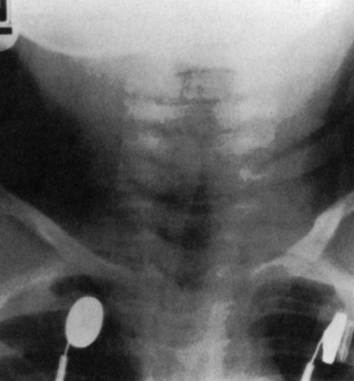
Free
(Multiple Choice)
4.8/5 (87)
(87) Correct Answer:Verified
VerifiedC
In the ER,a chest radiograph reveals dilation of the segmental and subsegmental bronchi.The patient complains of expectorating copious amounts of thick mucus and frequent lung infections over the last year.Which of the following conditions does this child likely have?
(Multiple Choice)
4.8/5 (86)
(86) A therapist has been asked to evaluate a child suspected of having foreign body aspiration.Which of the following clinical conditions would guide the therapist to the diagnosis?
(Multiple Choice)
4.8/5 (77)
(77) An 11-month-old child has been treated with bronchodilators for persistent wheezing without a positive clinical response.Which of the following conditions should the therapist suspect?
(Multiple Choice)
4.8/5 (81)
(81) A 10-month-old child has been brought into the emergency room (ER)by her parents,who state that after few days with low-grade fever,malaise,and rhinorrhea,their child presented with a "barking" cough and increased work of breathing.What condition is this child likely exhibiting?
(Multiple Choice)
4.8/5 (85)
(85) Diagnosis of TB in children requires which of the following special considerations?
(Multiple Choice)
4.9/5 (76)
(76) Why does a respiratory syncytial viral infection have little adverse effect on an older child but is often life threatening to a younger child?
(Multiple Choice)
4.7/5 (71)
(71) As the therapist auscultates over an infant's larynx,he hears a very low-pitched sound.On the basis of this finding,what impression is he likely to have regarding the nature of the upper airway obstruction?
(Multiple Choice)
5.0/5 (67)
(67) A 3-year-old child has the following clinical presentations in the ER:
Profound nasal congestion and productive cough
Chest auscultation revealing diffuse coarse,"sticky" crackles (sounding like Velcro)
Chest radiograph revealing lung hyperinflation with flattened hemidiaphragms
What pulmonary condition does this infant likely have?
(Multiple Choice)
4.8/5 (72)
(72) Relative to an adult's larynx,where is an infant's larynx situated?
(Multiple Choice)
4.8/5 (88)
(88) The therapist has been asked to evaluate the chest radiograph of a 3-month-old boy with atelectasis.Which pulmonary lobe has the greatest tendency to collapse in young infants?
(Multiple Choice)
4.9/5 (84)
(84) Why does an infant's respiratory distress from choanal atresia seem to lessen when the infant cries?
(Multiple Choice)
5.0/5 (83)
(83) Which of the following clinical interventions are used to treat complications of sickle cell anemia?
I.Supplemental oxygen
II.Bronchodilators
III.Diuretics
IV.Red blood cell transfusions
(Multiple Choice)
4.7/5 (95)
(95) A 3-year-old child has been diagnosed with epiglottitis and was intubated due to severe respiratory distress.After 24 hours of antibiotics the therapist is considering extubation.What will be an acceptable leak before considering extubation?
(Multiple Choice)
4.7/5 (82)
(82) A 4-year-old child is brought into the emergency room (ER)by her parents,who state that an abrupt high fever developed along with a severe sore throat,dysphagia with drooling,and cough.In the ER the girl exhibits stridor,muffled voice without hoarseness,air hunger,and cyanosis.She also has suprasternal,substernal,and intercostal retractions,with nasal flaring,bradypnea,and dyspnea.The child is sitting upright with her chin thrust forward and her neck hyperextended in a tripod position.What condition is she likely exhibiting?
(Multiple Choice)
4.8/5 (78)
(78) Tracheomalacia is a condition of dynamic tracheal collapse.Which of the following injurious events can be associated with this condition?
(Multiple Choice)
4.8/5 (81)
(81) Which of the following medications should be administered to a 4-year-old child who develops postextubation stridor?
(Multiple Choice)
4.9/5 (76)
(76) Which of the following agents has been shown to significantly reduce bronchiolitis scores?
(Multiple Choice)
4.8/5 (75)
(75) 
Filters
- Essay(0)
- Multiple Choice(0)
- Short Answer(0)
- True False(0)
- Matching(0)