



 Chat with AI
Exam 23: Plant Physiology

Exam 1: The Nature of Science66 Questions
Exam 2: Chemistry of Life78 Questions
Exam 3: Life Is Cellular72 Questions
Exam 4: How Cells Work64 Questions
Exam 5: Cell Division62 Questions
Exam 6: Patterns of Inheritance67 Questions
Exam 7: Chromosomes and Human Genetics68 Questions
Exam 8: What Genes Are64 Questions
Exam 9: How Genes Work64 Questions
Exam 10: Evidence for Evolution64 Questions
Exam 11: Mechanisms of Evolution64 Questions
Exam 12: Adaptation and Species64 Questions
Exam 13: The History of Life71 Questions
Exam 14: Human Evolution66 Questions
Exam 15: General Principles of Ecology64 Questions
Exam 16: Growth of Populations65 Questions
Exam 17: Communities of Organisms64 Questions
Exam 18: Ecosystems66 Questions
Exam 19: Homeostasis, Reproduction, and Development67 Questions
Exam 20: Digestive, Muscular, and Skeletal Systems66 Questions
Exam 21: Circulatory, Respiratory, Urinary, and Nervous Systems72 Questions
Exam 22: Endocrine and Immune Systems66 Questions
Exam 23: Plant Physiology64 Questions
Exam 24: Applying the Science67 Questions
Select questions type


Which of the following helps a plant deter herbivores, insects, or bacteria?
(Multiple Choice)
4.9/5  (61)
(61) A plant's physiological response to day length is called ________.
(Short Answer)
4.9/5 (79)
(79) Contrast how the growth patterns of plants and animals help each type of organism respond to predators.
(Essay)
4.8/5 (85)
(85) Match each plant structure to the function that the structure performs.
-ground tissue
(Multiple Choice)
4.8/5 (74)
(74) The hormone ________ is a gas produced by ripening fruit, and it can induce other fruits nearby to ripen.
(Short Answer)
4.9/5 (65)
(65) At what point in the plant life cycle does cell division convert diploid cells into haploid cells?
(Multiple Choice)
4.8/5 (76)
(76) After a particularly hot and dry summer, plants are likely to contain elevated levels of
(Multiple Choice)
4.9/5 (68)
(68) Match each plant structure to the function that the structure performs.
-phloem
(Multiple Choice)
4.9/5 (84)
(84) While walking in the forest, you come across a plant that has a flower with three petals and leaves with parallel veins. You would classify this plant as a
(Multiple Choice)
4.8/5 (84)
(84) Horticulturists often remove the anthers from flowers. The purpose of this technique is to
(Multiple Choice)
4.7/5 (98)
(98) Fertilizers generally have three numbers on the label (for example, 20:10:20). These numbers refer to the three most essential plant nutrients, which are
(Multiple Choice)
4.9/5 (88)
(88) Match each plant structure to the function that the structure performs.
-stomata
(Multiple Choice)
5.0/5 (67)
(67) Increases in length as a result of cell divisions at apical meristems are called ________ growth.
(Short Answer)
4.9/5 (75)
(75) Examine the plant in this figure. The plant is most likely a dicot, because of the presence of 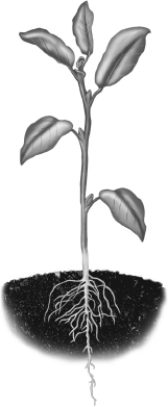
(Multiple Choice)
4.8/5 (76)
(76) Which of the following plant types undergoes secondary growth?
(Multiple Choice)
4.9/5 (79)
(79) 
Filters
- Essay(0)
- Multiple Choice(0)
- Short Answer(0)
- True False(0)
- Matching(0)