



 Chat with AI
Exam 18: Ecosystems

Exam 1: The Nature of Science66 Questions
Exam 2: Chemistry of Life78 Questions
Exam 3: Life Is Cellular72 Questions
Exam 4: How Cells Work64 Questions
Exam 5: Cell Division62 Questions
Exam 6: Patterns of Inheritance67 Questions
Exam 7: Chromosomes and Human Genetics68 Questions
Exam 8: What Genes Are64 Questions
Exam 9: How Genes Work64 Questions
Exam 10: Evidence for Evolution64 Questions
Exam 11: Mechanisms of Evolution64 Questions
Exam 12: Adaptation and Species64 Questions
Exam 13: The History of Life71 Questions
Exam 14: Human Evolution66 Questions
Exam 15: General Principles of Ecology64 Questions
Exam 16: Growth of Populations65 Questions
Exam 17: Communities of Organisms64 Questions
Exam 18: Ecosystems66 Questions
Exam 19: Homeostasis, Reproduction, and Development67 Questions
Exam 20: Digestive, Muscular, and Skeletal Systems66 Questions
Exam 21: Circulatory, Respiratory, Urinary, and Nervous Systems72 Questions
Exam 22: Endocrine and Immune Systems66 Questions
Exam 23: Plant Physiology64 Questions
Exam 24: Applying the Science67 Questions
Select questions type


On average, what percentage of the energy from one trophic level of an energy pyramid is transferred to the next trophic level?
(Multiple Choice)
4.9/5  (78)
(78) Describe how chemical nutrients enter and are recycled through an ecosystem.
(Essay)
4.9/5 (82)
(82) Match each term to its correct description below.
-Dominated by coniferous trees that grow in northern or high-altitude regions with cold, dry winters and mild summers, this biome also has nutrient-poor soils and therefore a relatively low plant diversity. Large herbivores such as elk and moose live alongside smaller carnivores like weasels, wolverines, and martens. Larger carnivores include lynx and wolves.
(Multiple Choice)
4.8/5 (80)
(80) Tuna are predatory fish that consume smaller, carnivorous fish that have fed on zooplankton. The zooplankton had fed on phytoplankton. When you eat tuna, you are consuming what level of the food chain?
(Multiple Choice)
4.8/5 (74)
(74) In the absence of ________, nutrient recycling within the ecosystem would completely stop.
(Multiple Choice)
4.8/5 (71)
(71) Other than the polar tundra, the LEAST productive terrestrial biomes tend to be
(Multiple Choice)
4.9/5 (89)
(89) The primary contribution of decomposers to an ecosystem occurs when they
(Multiple Choice)
4.9/5 (85)
(85) Match each term to its correct description below.
-This biome is dominated by dense growths of drought-resistant plants that thrive through the alternating cool, rainy winters and hot, dry summers. The vegetation includes scrub oak, pines, mountain mahogany, and manzanita. It is inhabited by jackrabbits, gophers, lizards, and snakes.
(Multiple Choice)
4.8/5 (91)
(91) The figure below shows the net primary productivity (NPP) in terrestrial biomes around the world. The pattern of NPP in terrestrial ecosystems as shown suggest that 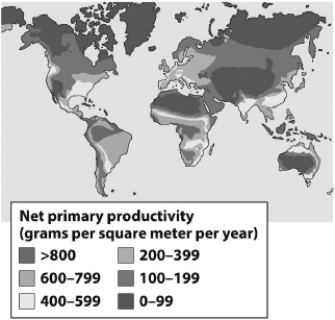
(Multiple Choice)
4.9/5 (68)
(68) Which of the following is NOT an easily testable hypothesis regarding net primary productivity?
(Multiple Choice)
4.8/5 (85)
(85) To best use the Earth's net primary productivity to feed the most people, diets should be modified to include ________, and gathering the maximum amount of energy available from a given biomass of producers.
(Multiple Choice)
4.9/5 (91)
(91) Each level of an energy pyramid corresponds to a step in a food chain and is called a(n) ________ level.
(Short Answer)
5.0/5 (80)
(80) If a person needs to consume 100 kcal of energy and he chooses to do that by eating soybeans, at least how many kcal of soybeans would have to grow to provide that 100 kcal for the human?
(Multiple Choice)
4.8/5 (98)
(98) An ecosystem that experiences a small increase in nutrients available to primary producers is likely to show
(Multiple Choice)
4.8/5 (77)
(77) Between late 1997 and mid-2008, satellites observed that warmer-than-average ocean temperatures led to below-average chlorophyll concentrations in the oceans. This finding suggests that continued warming of the Earth's oceans could lead to
(Multiple Choice)
4.9/5 (91)
(91) Match each term to its correct description below.
-This biome is dominated by trees and shrubs adapted to relatively rich soil, snowy winters, and moist, warm summers. With oak, maple, hickory, beech, and elm, this biome displays good diversity. Squirrels, rabbits, deer, raccoons, beavers, bobcats, mountain lions, bears, and many amphibians and reptiles constitute the consumer community.
(Multiple Choice)
4.8/5 (86)
(86) Which of the following would be abiotic components of an arctic, marine ecosystem?
(Multiple Choice)
4.8/5 (94)
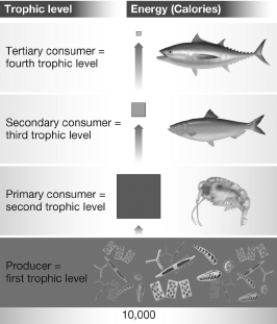
(94) Considering this food chain, explain how many calories are available in the consumer trophic levels and why.
(Essay)
4.8/5 (98)
(98) 
Filters
- Essay(0)
- Multiple Choice(0)
- Short Answer(0)
- True False(0)
- Matching(0)