



 Chat with AI
Exam 13: The History of Life

Exam 1: The Nature of Science66 Questions
Exam 2: Chemistry of Life78 Questions
Exam 3: Life Is Cellular72 Questions
Exam 4: How Cells Work64 Questions
Exam 5: Cell Division62 Questions
Exam 6: Patterns of Inheritance67 Questions
Exam 7: Chromosomes and Human Genetics68 Questions
Exam 8: What Genes Are64 Questions
Exam 9: How Genes Work64 Questions
Exam 10: Evidence for Evolution64 Questions
Exam 11: Mechanisms of Evolution64 Questions
Exam 12: Adaptation and Species64 Questions
Exam 13: The History of Life71 Questions
Exam 14: Human Evolution66 Questions
Exam 15: General Principles of Ecology64 Questions
Exam 16: Growth of Populations65 Questions
Exam 17: Communities of Organisms64 Questions
Exam 18: Ecosystems66 Questions
Exam 19: Homeostasis, Reproduction, and Development67 Questions
Exam 20: Digestive, Muscular, and Skeletal Systems66 Questions
Exam 21: Circulatory, Respiratory, Urinary, and Nervous Systems72 Questions
Exam 22: Endocrine and Immune Systems66 Questions
Exam 23: Plant Physiology64 Questions
Exam 24: Applying the Science67 Questions
Select questions type


The following numbered sets each represent a distinct group of organisms: (1) three toes per foot, feathers, cold-blooded, no finger adaptations
(2) three toes per foot, body hair, warm-blooded, opposable thumbs
(3) three toes per foot, feathers, warm-blooded, no finger adaptation
(4) three toes per foot, body hair, warm-blooded, no finger adaptations
Which of the following choices is the most likely to represent the order in which these groups would appear on an evolutionary tree, from oldest to youngest?
(Multiple Choice)
4.7/5  (85)
(85) Explain two ways that mass extinctions can have a profound impact on evolved biodiversity in the ecosystem.
(Essay)
4.9/5 (78)
(78) The evolutionary history of the protists remains unresolved, but it is being refined with the addition of DNA evidence. This is an example of
(Multiple Choice)
4.8/5 (74)
(74) In the evolutionary tree below, which of the nodes corresponds to the most recent common ancestor of Troodontids, Dromaeosaurids, and Archaeopteryx? 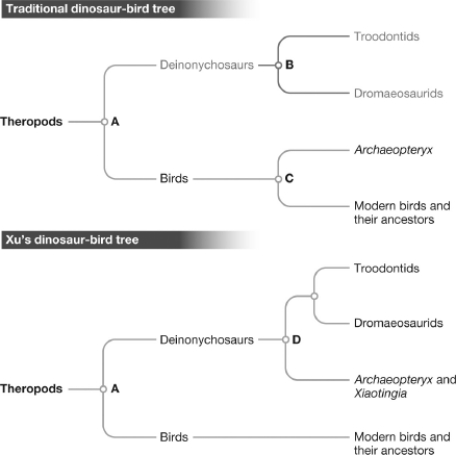
(Multiple Choice)
4.8/5 (86)
(86) The first eukaryotes evolved approximately ________ years ago.
(Multiple Choice)
4.8/5 (74)
(74) Correctly match the definition with the correct geologic time period.
-Paleogene/Neogene
(Multiple Choice)
4.8/5 (87)
(87) According to the tree below, which of the following combinations of organisms are most closely related? 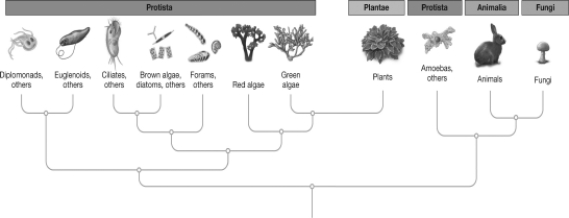
(Multiple Choice)
4.8/5 (80)
(80) Because there is always new information to discover and interpret, scientists must be prepared to revise their ________ when there is evidence to suggest it is not correct.
(Short Answer)
4.8/5 (74)
(74) Monotremes, like the duck-billed platypus, are egg-laying mammals (oviparous), covered in hair, have mammary and skin glands, three ear ossicles, are diphyodont (their permanent teeth replace their "baby" teeth), and possess dentary-squamosal jaw articulation (the jaw bone hinges with the squamosal bone of the skull). Marsupials, such as kangaroos and koalas, are pouched mammals that have a vertical tympanic membrane in addition to being covered in hair, have mammary and skin glands, three ear ossicles, are diphyodont, and possess dentary-squamosal jaw articulation. Eutherians are the placental mammals that most people easily recognize as mammals. They are covered in hair, have mammary and skin glands, three ear ossicles, are diphyodont, possess dentary-squamosal jaw articulation, and have a vertical tympanic membrane. What traits are shared derived traits for monotremes, marsupials, and eutherians?
(Multiple Choice)
4.8/5 (84)
(84) Correctly match the definition with the correct geologic time period.
-Permian
(Multiple Choice)
4.7/5 (83)
(83) 
Filters
- Essay(0)
- Multiple Choice(0)
- Short Answer(0)
- True False(0)
- Matching(0)