



 Chat with AI
Exam 2: Chemistry of Life

Exam 1: The Nature of Science66 Questions
Exam 2: Chemistry of Life78 Questions
Exam 3: Life Is Cellular72 Questions
Exam 4: How Cells Work64 Questions
Exam 5: Cell Division62 Questions
Exam 6: Patterns of Inheritance67 Questions
Exam 7: Chromosomes and Human Genetics68 Questions
Exam 8: What Genes Are64 Questions
Exam 9: How Genes Work64 Questions
Exam 10: Evidence for Evolution64 Questions
Exam 11: Mechanisms of Evolution64 Questions
Exam 12: Adaptation and Species64 Questions
Exam 13: The History of Life71 Questions
Exam 14: Human Evolution66 Questions
Exam 15: General Principles of Ecology64 Questions
Exam 16: Growth of Populations65 Questions
Exam 17: Communities of Organisms64 Questions
Exam 18: Ecosystems66 Questions
Exam 19: Homeostasis, Reproduction, and Development67 Questions
Exam 20: Digestive, Muscular, and Skeletal Systems66 Questions
Exam 21: Circulatory, Respiratory, Urinary, and Nervous Systems72 Questions
Exam 22: Endocrine and Immune Systems66 Questions
Exam 23: Plant Physiology64 Questions
Exam 24: Applying the Science67 Questions
Select questions type


The element ________ makes up the chemical backbone of most molecules on planet Earth.
(Short Answer)
4.8/5  (92)
(92) Using the answer choices below (a through d), match the characteristic with its macromolecule class.
-speed chemical reactions
(Multiple Choice)
4.9/5 (89)
(89) Using the answer choices below (a through d), match the characteristic with its macromolecule class.
-participate in nearly every chemical reaction in living systems
(Multiple Choice)
4.7/5 (77)
(77) O₂, also termed atmospheric oxygen, is considered to be a molecule but not a compound. Why not?
(Multiple Choice)
4.8/5 (79)
(79) Nitrogen has seven protons, seven neutrons, and seven electrons. What is the atomic mass of nitrogen?
(Multiple Choice)
4.9/5 (79)
(79) Which of the following most commonly represents the shape associated with functional proteins?
(Multiple Choice)
4.9/5 (80)
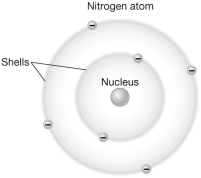
(80) Nitrogen has an atomic number of 7 and an atomic mass number of 14. Using the image provided, diagram the location and number of protons, neutrons, and electrons in nitrogen.
(Essay)
4.8/5 (76)
(76) Which of the following statements is true of proteins, carbohydrates, and nucleic acids?
(Multiple Choice)
4.8/5 (85)
(85) An atom that becomes charged due to the gain or loss of an electron is called a(n) ________.
(Short Answer)
4.9/5 (66)
(66) Of the following values, which indicates the most basic pH?
(Multiple Choice)
4.9/5 (74)
(74) Which of the following distinguishes ionic bonds from covalent bonds?
(Multiple Choice)
4.9/5 (80)
(80) An instrument that identifies chemicals based upon their weights is the ________.
(Short Answer)
4.9/5 (78)
(78) The positively charged subatomic particle is located in the ________.
(Short Answer)
4.8/5 (77)
(77) During a study session, a Biology classmate holds up a bottle of water and mentions that there are both hydrogen bonds and covalent bonds found within the liquid. Explain your classmate's statement by describing the types of bonds that are found within your bottle of water.
(Essay)
4.9/5 (76)
(76) One of the symptoms of kidney disease is the presence of proteins in a patient's urine. To quickly test for kidney disease using a urine sample, a doctor might add a chemical that causes a color change when
(Multiple Choice)
4.8/5 (84)
(84) Individual water molecules orient toward each other because of the ________ bonds that form between them.
(Multiple Choice)
4.7/5 (66)
(66) The subatomic particles that possess a single negative charge and surround the nucleus are the
(Multiple Choice)
4.7/5 (66)
(66) In the laboratory you identify protein in a food item that you've tested. Which of the following must the food item also contain?
(Multiple Choice)
4.8/5 (63)
(63) 
Filters
- Essay(0)
- Multiple Choice(0)
- Short Answer(0)
- True False(0)
- Matching(0)