



 Chat with AI
Exam 12: Monopoly

Exam 1: Getting Started337 Questions
Exam 2: The Us and Global Economies201 Questions
Exam 3: The Economic Problem273 Questions
Exam 4: Demand and Supply322 Questions
Exam 5: Elasticities of Demand and Supply335 Questions
Exam 6: Efficiency and Fairness of Markets352 Questions
Exam 7: Government Actions in Markets349 Questions
Exam 8: Global Markets in Action276 Questions
Exam 9: Externalities: Pollution, Education, and Health Care290 Questions
Exam 10: Production and Cost266 Questions
Exam 11: Perfect Competition275 Questions
Exam 12: Monopoly377 Questions
Exam 13: Monopolistic Competition and Oligopoly316 Questions
Exam 14: Gdp: a Measure of Total Production and Income253 Questions
Exam 15: Jobs and Unemployment283 Questions
Exam 16: The Cpi and the Cost of Living263 Questions
Exam 17: Potential Gdp and Economic Growth328 Questions
Exam 18: Money and the Monetary System360 Questions
Exam 19: Aggregate Supply and Aggregate Demand301 Questions
Exam 20: Fiscal Policy and Monetary Policy223 Questions
Select questions type


For a single-price monopolist, why is marginal revenue less than price?
(Multiple Choice)
4.8/5  (68)
(68) Quantity (units) Price (dollars) Marginal revenue (dollars) Marginal cost (dollars) 1 22 20 6 2 20 16 8 3 18 12 12 4 16 8 18 5 14 4 28 6 12 0 40 7 10 -4 54 8 8 -8 70
-A single-price monopoly has the demand and marginal cost schedules given in the above table. What is the profit-maximizing level of output and price?
(Essay)
4.9/5 (97)
(97) Compared to a single-price monopoly, when a monopoly can perfectly price discriminate, the deadweight loss
(Multiple Choice)
4.9/5 (84)
(84) One way a monopoly can convert additional consumer surplus into economic profit is to
(Multiple Choice)
4.9/5 (93)
(93)  -The above figure represents the market for cable television in Oakland, Florida. Time Warner Communications (TWC)is the sole provider of cable television to the residents of this Central Florida community. Compared to a marginal cost pricing rule, under an average cost pricing rule, TWC ________ output by ________ households.
 (Multiple Choice)
4.7/5 (86)
(86) Gene's Car Wash is a natural monopoly. To wash 100 cars a week, if Gene is unregulated, he would charge a price of $10. Gene's average total cost for washing 100 cars is $8, his average variable cost is $6, and his marginal cost is $4. If Gene is regulated using an average cost pricing rule, the price he is allowed to charge to wash 100 cars is
(Multiple Choice)
4.9/5 (68)
(68) 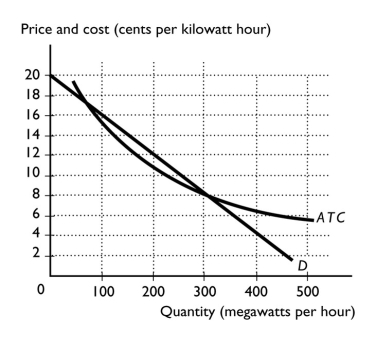 -In the figure above, complete the graph of the electric utility company by adding the marginal revenue and marginal cost curves. Assume the marginal cost is constant at 4¢ per kilowatt-hour. Now discuss the marginal cost pricing rule and the average cost pricing rule regulators might use to regulate the firm. Be sure to state the price and quantity that are selected for each option. Also, what price and quantity does the firm select if it is not regulated?
 (Essay)
4.9/5 (75)
(75) Which of the following industries is most likely closest to achieving perfect price discrimination?
(Multiple Choice)
4.8/5 (84)
(84) What is an average cost pricing rule?
Why do regulatory agencies use it for natural monopolies?
(Essay)
4.9/5 (79)
(79)
-The above figure represents the market for cable television in Oakland, Florida. Time Warner Communications (TWC)is the sole provider of cable television to the residents of this Central Florida community. If TWC is left unregulated, what is the price of cable television in Oakland?
-The above figure represents the market for cable television in Oakland, Florida. Time Warner Communications (TWC)is the sole provider of cable television to the residents of this Central Florida community. If TWC is left unregulated, what is the price of cable television in Oakland? (Multiple Choice)
4.9/5 (79)
(79) Explain how a single-price monopoly determines its output and price. Compare this process to how a perfectly competitive firm determines its output and price.
(Essay)
4.8/5 (84)
(84) If a producer wants a monopoly with a legal barrier to entry, how can this be done?
I. The producer can spend funds lobbying to attain passage of the legal barrier to entry.
Ii. The producer can purchase an existing monopoly.
Iii. The producer can make rent seeking expenditures.
(Multiple Choice)
4.8/5 (80)
(80) Today, you might be buying from a regulated natural monopoly when you purchase
(Multiple Choice)
4.8/5 (88)
(88) Quantity (units) Price (dollars per unit) 1 8 2 7 3 6 4 5 5 4 6 3
-The table above gives the demand for a monopolist's output. Between which two quantities is demand elastic?
(Multiple Choice)
4.9/5 (70)
(70) If we compare a perfectly competitive market to a single-price monopoly with the same costs, the monopoly sells
(Multiple Choice)
4.7/5 (86)
(86) 
Filters
- Essay(0)
- Multiple Choice(0)
- Short Answer(0)
- True False(0)
- Matching(0)