



 Chat with AI
Exam 12: Monopoly

Exam 1: Getting Started337 Questions
Exam 2: The Us and Global Economies201 Questions
Exam 3: The Economic Problem273 Questions
Exam 4: Demand and Supply322 Questions
Exam 5: Elasticities of Demand and Supply335 Questions
Exam 6: Efficiency and Fairness of Markets352 Questions
Exam 7: Government Actions in Markets349 Questions
Exam 8: Global Markets in Action276 Questions
Exam 9: Externalities: Pollution, Education, and Health Care290 Questions
Exam 10: Production and Cost266 Questions
Exam 11: Perfect Competition275 Questions
Exam 12: Monopoly377 Questions
Exam 13: Monopolistic Competition and Oligopoly316 Questions
Exam 14: Gdp: a Measure of Total Production and Income253 Questions
Exam 15: Jobs and Unemployment283 Questions
Exam 16: The Cpi and the Cost of Living263 Questions
Exam 17: Potential Gdp and Economic Growth328 Questions
Exam 18: Money and the Monetary System360 Questions
Exam 19: Aggregate Supply and Aggregate Demand301 Questions
Exam 20: Fiscal Policy and Monetary Policy223 Questions
Select questions type


 The figure above shows a natural monopoly.
-In the figure above, if the firm is regulated using an average cost pricing rule, the firm
The figure above shows a natural monopoly.
-In the figure above, if the firm is regulated using an average cost pricing rule, the firm (Multiple Choice)
4.8/5  (85)
(85) What does the marginal revenue equal when a monopoly's total revenue is maximized?
What is the elasticity of demand when the total revenue is maximized?
(Essay)
5.0/5 (86)
(86)  The above figure shows a market.
-If the market in the figure above is perfectly competitive, consumer surplus is the area ________.
The above figure shows a market.
-If the market in the figure above is perfectly competitive, consumer surplus is the area ________. (Multiple Choice)
4.9/5 (92)
(92) A monopoly, unlike a perfect competitor, has total control in its market because it is the single producer. Why, then, must a single-price monopoly decrease its price if it wants to increase its output?
(Essay)
4.8/5 (65)
(65) 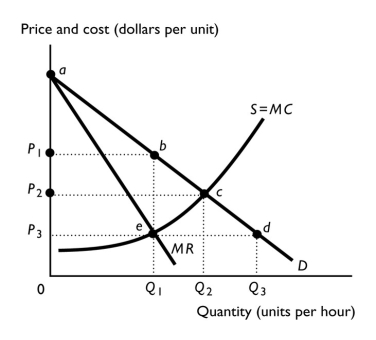 -In the above figure, for a single-price monopoly the consumer surplus is equal to the area
 (Multiple Choice)
5.0/5 (85)
(85) Two types of barriers to entry are called ________ barriers to entry and ________ barriers to entry.
(Multiple Choice)
4.7/5 (86)
(86) Which produces more output: a perfectly price discriminating monopoly or a single-price monopoly?
(Essay)
4.7/5 (86)
(86)
The figure above shows a natural monopoly.
-In the figure above, if the firm is regulated using an average cost pricing rule, the deadweight loss created is equal to the area of
The figure above shows a natural monopoly.
-In the figure above, if the firm is regulated using an average cost pricing rule, the deadweight loss created is equal to the area of (Multiple Choice)
5.0/5 (61)
(61) "Under the social interest theory of regulation, regulators attempt to maximize profits for the owners of the firms being regulated." Is the previous statement correct or incorrect?
(Essay)
4.9/5 (82)
(82)
The figure above shows a natural monopoly.
-In the figure above, if the firm is regulated using an average cost pricing rule, the consumer surplus created is equal to the area of
The figure above shows a natural monopoly.
-In the figure above, if the firm is regulated using an average cost pricing rule, the consumer surplus created is equal to the area of (Multiple Choice)
4.9/5 (63)
(63) The marginal revenue for a single-price monopoly with a downward-sloping demand curve
(Multiple Choice)
4.8/5 (76)
(76) 
Filters
- Essay(0)
- Multiple Choice(0)
- Short Answer(0)
- True False(0)
- Matching(0)