



 Chat with AI
Exam 20: Fiscal Policy and Monetary Policy

Exam 1: Getting Started337 Questions
Exam 2: The Us and Global Economies201 Questions
Exam 3: The Economic Problem273 Questions
Exam 4: Demand and Supply322 Questions
Exam 5: Elasticities of Demand and Supply335 Questions
Exam 6: Efficiency and Fairness of Markets352 Questions
Exam 7: Government Actions in Markets349 Questions
Exam 8: Global Markets in Action276 Questions
Exam 9: Externalities: Pollution, Education, and Health Care290 Questions
Exam 10: Production and Cost266 Questions
Exam 11: Perfect Competition275 Questions
Exam 12: Monopoly377 Questions
Exam 13: Monopolistic Competition and Oligopoly316 Questions
Exam 14: Gdp: a Measure of Total Production and Income253 Questions
Exam 15: Jobs and Unemployment283 Questions
Exam 16: The Cpi and the Cost of Living263 Questions
Exam 17: Potential Gdp and Economic Growth328 Questions
Exam 18: Money and the Monetary System360 Questions
Exam 19: Aggregate Supply and Aggregate Demand301 Questions
Exam 20: Fiscal Policy and Monetary Policy223 Questions
Select questions type


Which of the following is true?

Free
(Multiple Choice)
4.9/5  (79)
(79) Correct Answer: Verified
C
The Federal Reserve fears that the United States economy is growing too slowly and is stuck in a recession. To move the economy back to its potential GDP, the most likely policy action for the Fed is to ________ the federal funds and thus ________ .
(Multiple Choice)
4.9/5 (80)
(80) If the government reduces expenditure on goods and services by $30 billion, then aggregate demand
(Multiple Choice)
4.9/5 (75)
(75) Taxes that change with the level of real GDP and income are called
(Multiple Choice)
4.8/5 (89)
(89) When tax revenues equal government outlays, the situation is referred to as
(Multiple Choice)
4.8/5 (71)
(71) If the federal government has a budget deficit, then it is definitely the case that
(Multiple Choice)
4.7/5 (80)
(80) Discuss the federal budget history of the United States since 1970. Make sure to note specifically the budget position of the United States during the last of the 1990s and compare it to the situation in 2012.
(Essay)
4.8/5 (92)
(92) An economy is experiencing a recession and policy makers are considering using discretionary fiscal policy to eliminate the recessionary gap. What are the four limitations that policymakers face when using discretionary fiscal policy?
Briefly discuss each.
(Essay)
5.0/5 (72)
(72) 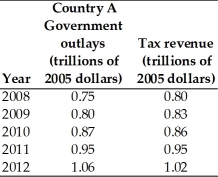
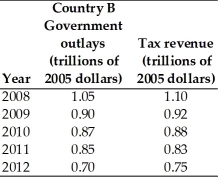 -The national debt is
If the Fed is concerned about a possible recession, it ________ the federal funds rate and, in response, long-term interest rates ________ by a ________ amount than the change in short-term rates.
(Multiple Choice)
4.9/5 (70)
(70) Automatic stabilizers decrease the impact of a recession on the level of economic activity because they
(Multiple Choice)
4.8/5 (67)
(67) When tax revenue ________ outlays is negative, then the government has a budget ________.
(Multiple Choice)
4.8/5 (81)
(81) In an expansion, federal tax receipts increase proportionally more than real GDP without the need for any government policy. This increase is an example of
(Multiple Choice)
4.7/5 (70)
(70) 
Filters
- Essay(0)
- Multiple Choice(0)
- Short Answer(0)
- True False(0)
- Matching(0)