



 Chat with AI
Exam 20: Fiscal Policy and Monetary Policy

Exam 1: Getting Started337 Questions
Exam 2: The Us and Global Economies201 Questions
Exam 3: The Economic Problem273 Questions
Exam 4: Demand and Supply322 Questions
Exam 5: Elasticities of Demand and Supply335 Questions
Exam 6: Efficiency and Fairness of Markets352 Questions
Exam 7: Government Actions in Markets349 Questions
Exam 8: Global Markets in Action276 Questions
Exam 9: Externalities: Pollution, Education, and Health Care290 Questions
Exam 10: Production and Cost266 Questions
Exam 11: Perfect Competition275 Questions
Exam 12: Monopoly377 Questions
Exam 13: Monopolistic Competition and Oligopoly316 Questions
Exam 14: Gdp: a Measure of Total Production and Income253 Questions
Exam 15: Jobs and Unemployment283 Questions
Exam 16: The Cpi and the Cost of Living263 Questions
Exam 17: Potential Gdp and Economic Growth328 Questions
Exam 18: Money and the Monetary System360 Questions
Exam 19: Aggregate Supply and Aggregate Demand301 Questions
Exam 20: Fiscal Policy and Monetary Policy223 Questions
Select questions type


Which of the following is an example of a fiscal stimulus?
(Multiple Choice)
4.7/5  (82)
(82) Which of the following is a problem in pursuing monetary policy?
(Multiple Choice)
4.9/5 (85)
(85) In the United States for the year 2012, the federal government had a ________ so the national debt was ________.
(Multiple Choice)
4.9/5 (70)
(70) The balanced budget multiplier applies when a $50 billion increase in government expenditure is financed by a $50 billion ________ in tax revenue and the balanced budget multiplier shows that in this case there is ________ effect on aggregate demand.
(Multiple Choice)
4.9/5 (75)
(75) 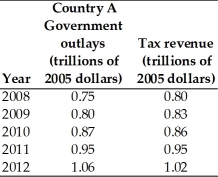
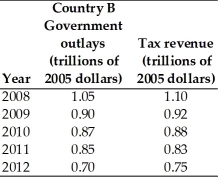 -The above table gives the government outlays and tax revenues from 2008 through 2012 for two countries. In 2011 country A had a ________ and country B had a ________.
 (Multiple Choice)
4.7/5 (82)
(82) If the government uses fiscal policy to close a recessionary gap, government
(Multiple Choice)
4.7/5 (87)
(87) The Fed is concerned about inflation. Its policy will ________ U.S. short-term interest rates and, in the foreign exchange market, lead to the value of the U.S. dollar ________.
(Multiple Choice)
4.7/5 (68)
(68) If government expenditures on goods and services increases by $20 billion, then aggregate demand
(Multiple Choice)
4.8/5 (97)
(97) When would the Fed want to carry out a monetary policy that decreases aggregate demand?
(Essay)
4.9/5 (83)
(83) Government tax revenues ________ during an expansion and ________ during a recession, which leads to larger budget deficits during the ________ phase of the business cycle.
(Multiple Choice)
4.9/5 (87)
(87) Which of the following statements are correct?
I. Congress does not play a role in making monetary policy decisions.
Ii. The FOMC meets eight times a year to make monetary policy decisions.
Iii. The President of the United States appoints members and the Chairman of the Board of governors but has little other formal authority over monetary policy.
(Multiple Choice)
4.9/5 (79)
(79) If the Fed lowers the federal funds rate, which of the following occurs?
(Multiple Choice)
4.8/5 (88)
(88) When tax revenues minus outlays is i. positive, the government has a budget surplus.
Ii. negative, the government has a budget deficit.
Iii. zero, the government has a balanced budget.
(Multiple Choice)
5.0/5 (80)
(80) When the Federal Reserve increases the federal funds rate, bank loans ________, the supply of loanable funds ________, and the real interest rate ________.
(Multiple Choice)
4.9/5 (80)
(80) Explain how a tax cut effects employment, labor productivity, and potential GDP.
(Essay)
5.0/5 (72)
(72) During the late 1960s, real GDP increased, unemployment fell, and the inflation rate started to rise. Which would have been the appropriate federal government policy combination to improve economic performance by lowering the inflation rate?
(Multiple Choice)
4.8/5 (81)
(81) 
Filters
- Essay(0)
- Multiple Choice(0)
- Short Answer(0)
- True False(0)
- Matching(0)