



 Chat with AI
Exam 8: Global Markets in Action

Exam 1: Getting Started337 Questions
Exam 2: The Us and Global Economies201 Questions
Exam 3: The Economic Problem273 Questions
Exam 4: Demand and Supply322 Questions
Exam 5: Elasticities of Demand and Supply335 Questions
Exam 6: Efficiency and Fairness of Markets352 Questions
Exam 7: Government Actions in Markets349 Questions
Exam 8: Global Markets in Action276 Questions
Exam 9: Externalities: Pollution, Education, and Health Care290 Questions
Exam 10: Production and Cost266 Questions
Exam 11: Perfect Competition275 Questions
Exam 12: Monopoly377 Questions
Exam 13: Monopolistic Competition and Oligopoly316 Questions
Exam 14: Gdp: a Measure of Total Production and Income253 Questions
Exam 15: Jobs and Unemployment283 Questions
Exam 16: The Cpi and the Cost of Living263 Questions
Exam 17: Potential Gdp and Economic Growth328 Questions
Exam 18: Money and the Monetary System360 Questions
Exam 19: Aggregate Supply and Aggregate Demand301 Questions
Exam 20: Fiscal Policy and Monetary Policy223 Questions
Select questions type


Currently, the United States has a quota on the amount of sugar that is allowed to be imported into the United States. What would happen to the price of sugar in the United States if the quota was removed?
What would happen to U.S. consumption and U.S. production of sugar?

Free
(Essay)
5.0/5  (81)
(81) Correct Answer: Verified
If the quota is removed, the price of sugar in the United States would fall, U.S. consumption of sugar would increase, and U.S. production of sugar would decrease.
8.5 Chapter Figures
 The figure above shows the U.S. market for T-shirts, where SUS is the domestic supply curve and DUS is the domestic demand curve. The United States trades freely with the rest of the world. The world price of a T-shirt is $5.
-In the figure above, with international trade U.S. consumers buy ________ million T-shirts per year at ________ per T-shirt.
The figure above shows the U.S. market for T-shirts, where SUS is the domestic supply curve and DUS is the domestic demand curve. The United States trades freely with the rest of the world. The world price of a T-shirt is $5.
-In the figure above, with international trade U.S. consumers buy ________ million T-shirts per year at ________ per T-shirt.Free
(Multiple Choice)
4.9/5 (84)
(84) Correct Answer:Verified
VerifiedA
Which of the following parties benefits from an import quota but not from a tariff?
Free
(Multiple Choice)
4.7/5 (83)
(83) Correct Answer:Verified
VerifiedD
Suppose the world price of a shirt is $10. If the United States imposes a tariff of $5 a shirt, then the price of a shirt in the
(Multiple Choice)
4.8/5 (78)
(78)  -The above figure shows the U.S. market for replacement cell phone batteries. Area B + area D is the
 (Multiple Choice)
4.9/5 (79)
(79) Who gains from imports?
How do they gain?
Who loses?
How do they lose?
Does the overall economy gain or lose from imports?
(Essay)
4.8/5 (78)
(78) Price (dollars per unit) Quantity demanded Quantity supplied (units per day) (units per day) 2 20 14 4 19 16 6 18 18 8 17 20 10 16 22 12 15 24
-According to the above table, the country will import the good if the world price is less than ________ and will export the good if the world price is more than ________.
(Multiple Choice)
4.8/5 (73)
(73) 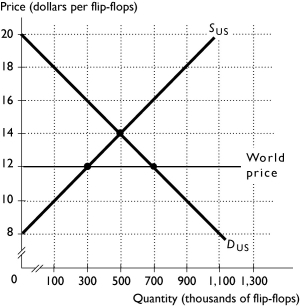 -The above figure shows the U.S. market for flip-flops. With no international trade, the price in the United States for flip-flops is ________. With international trade, the price in the United States for flip-flops is ________.
 (Multiple Choice)
4.9/5 (86)
(86) As a result of U.S. tariffs on fishnets produced in other nations, the quantity of fishnets purchased in the United States has
(Multiple Choice)
4.9/5 (78)
(78) Which of the following is true?
I. When the world price of a good is lower than the price that balances domestic supply and demand, a country gains from exporting the good.
Ii. Compared to a no-trade situation, in a market with imports, consumer surplus is larger.
Iii. Quotas raise the domestic price of imported goods.
(Multiple Choice)
4.9/5 (78)
(78) Suppose the United States subsidizes domestic chicken production and then sells surpluses on the world market at a price below the cost of production. In foreign countries, the argument that would made to restrict chicken trade with the United States would be the
(Multiple Choice)
4.8/5 (85)
(85)  The figure above shows the U.S. market for airplanes, where SUS is the domestic supply curve and DUS is the domestic demand curve. The United States trades freely with the rest of the world. The world price of an airplane is $150 million.
-In the figure above, the United States ________ airplanes per year.
The figure above shows the U.S. market for airplanes, where SUS is the domestic supply curve and DUS is the domestic demand curve. The United States trades freely with the rest of the world. The world price of an airplane is $150 million.
-In the figure above, the United States ________ airplanes per year. (Multiple Choice)
4.8/5 (82)
(82) Imposing a tariff on a good leads to a ________ in the price of the product and ________ in imports.
(Multiple Choice)
4.7/5 (84)
(84) 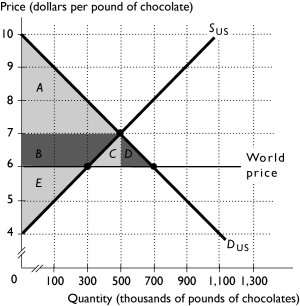 -The above figure shows the U.S. market for chocolate. With no international trade, producer surplus is equal to
 (Multiple Choice)
4.9/5 (77)
(77) 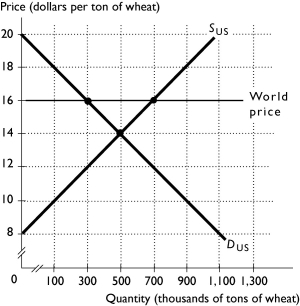 -The above figure shows the U.S. market for wheat. With no international trade, the price of wheat in the United States is ________ per ton. With international trade, the price of wheat in the United States is ________ per ton.
 (Multiple Choice)
4.9/5 (80)
(80) What is an effective counter against the argument that international trade should be restricted to protect domestic jobs?
(Multiple Choice)
4.8/5 (67)
(67) If a tariff is imposed on imports of shrimp into the United States, U.S. producer surplus from shrimp will ________ and U.S. total surplus from shrimp will ________.
(Multiple Choice)
4.9/5 (96)
(96) 
Filters
- Essay(0)
- Multiple Choice(0)
- Short Answer(0)
- True False(0)
- Matching(0)