



 Chat with AI
Exam 8: Global Markets in Action

Exam 1: Getting Started337 Questions
Exam 2: The Us and Global Economies201 Questions
Exam 3: The Economic Problem273 Questions
Exam 4: Demand and Supply322 Questions
Exam 5: Elasticities of Demand and Supply335 Questions
Exam 6: Efficiency and Fairness of Markets352 Questions
Exam 7: Government Actions in Markets349 Questions
Exam 8: Global Markets in Action276 Questions
Exam 9: Externalities: Pollution, Education, and Health Care290 Questions
Exam 10: Production and Cost266 Questions
Exam 11: Perfect Competition275 Questions
Exam 12: Monopoly377 Questions
Exam 13: Monopolistic Competition and Oligopoly316 Questions
Exam 14: Gdp: a Measure of Total Production and Income253 Questions
Exam 15: Jobs and Unemployment283 Questions
Exam 16: The Cpi and the Cost of Living263 Questions
Exam 17: Potential Gdp and Economic Growth328 Questions
Exam 18: Money and the Monetary System360 Questions
Exam 19: Aggregate Supply and Aggregate Demand301 Questions
Exam 20: Fiscal Policy and Monetary Policy223 Questions
Select questions type


How can a nation and its producers determine whether or not it has a comparative advantage in producing a particular good or service?
(Essay)
4.7/5  (93)
(93) If the world price of a good is below the no-trade domestic price, a country
(Multiple Choice)
4.8/5 (81)
(81) When politicians debated the North American Free Trade Agreement (NAFTA), some told stories of U.S. workers whose jobs would be moved to Mexico. Which of the following arguments in favor of protection was being used?
(Multiple Choice)
4.9/5 (84)
(84) Suppose that elimination of tariffs on agricultural products means that 1,000 farm workers lose jobs that pay an average of $20,000 per year. At the same time, because of the importation of relatively cheaper foreign vegetables, 150 million consumers save $2 per year on their grocery bills.
a. What is the total income lost by farm workers because of the free trade?
b. What is the total dollar amount saved by all consumers combined?
c. Which is greater, the lost income or the consumer savings?
Do the benefits of free trade outweigh the costs in this simple example?
d. Which group is most likely to become politically involved over the issue of removing the tariffs, the farm workers or the consumers?
Why?
(Essay)
4.9/5 (80)
(80) When a nation exports a good, its ________ surplus decreases and its ________ surplus increases.
(Multiple Choice)
4.8/5 (86)
(86) The imposition of tariffs on Korean steel has led to ________ in imports of Korean steel to the United States and ________ the price of steel in the United States.
(Multiple Choice)
4.8/5 (91)
(91) 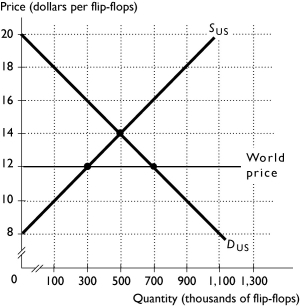 -The above figure shows the U.S. market for flip-flops. With international trade, the equilibrium price in the United States is ________ and the United States ________ flip-flops.
 (Multiple Choice)
4.8/5 (89)
(89) A tax on a good that is imposed when it is imported is called
(Multiple Choice)
4.9/5 (83)
(83) Why are the losers from free international trade not fully compensated for their losses?
(Multiple Choice)
4.9/5 (81)
(81) A quota ________ a deadweight loss and a tariff ________ a deadweight loss.
(Multiple Choice)
4.7/5 (77)
(77) 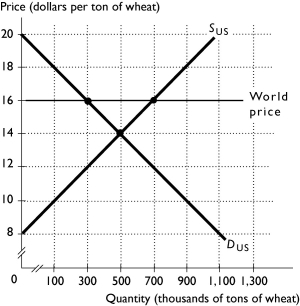 -The above figure shows the U.S. market for wheat. With international trade, the price of wheat in the United States is ________ per ton and the United States ________ wheat.
 (Multiple Choice)
4.8/5 (87)
(87)  -The above figure shows the U.S. market for replacement cell phone batteries. When there is no international trade, the equilibrium price is ________ per battery and when there is international trade the equilibrium price is ________ per battery.
 (Multiple Choice)
4.7/5 (75)
(75) If supporters of restrictions on imports argue that protection is needed to preserve a strategic industry; which of the following is being used?
(Multiple Choice)
4.9/5 (87)
(87) 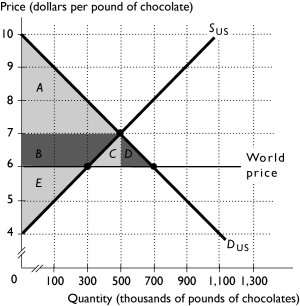 -The above figure shows the U.S. market for chocolate. With international trade, ________ is the transfer of surplus from producers to consumers.
 (Multiple Choice)
4.9/5 (67)
(67) If a tariff is imposed on imports of shrimp into the United States, U.S. consumer surplus from shrimp will ________ and U.S. producer surplus from shrimp will ________.
(Multiple Choice)
4.9/5 (73)
(73)
-The above figure shows the U.S. market for wheat. When there no international trade, the U.S. price of wheat is ________ per ton and the U.S. equilibrium quantity is ________ tons.
-The above figure shows the U.S. market for wheat. When there no international trade, the U.S. price of wheat is ________ per ton and the U.S. equilibrium quantity is ________ tons. (Multiple Choice)
4.9/5 (72)
(72) When a nation exports a good or service in which it has a comparative advantage, employment in that industry
(Multiple Choice)
4.8/5 (69)
(69) 
Filters
- Essay(0)
- Multiple Choice(0)
- Short Answer(0)
- True False(0)
- Matching(0)