



 Chat with AI
Exam 8: Global Markets in Action

Exam 1: Getting Started337 Questions
Exam 2: The Us and Global Economies201 Questions
Exam 3: The Economic Problem273 Questions
Exam 4: Demand and Supply322 Questions
Exam 5: Elasticities of Demand and Supply335 Questions
Exam 6: Efficiency and Fairness of Markets352 Questions
Exam 7: Government Actions in Markets349 Questions
Exam 8: Global Markets in Action276 Questions
Exam 9: Externalities: Pollution, Education, and Health Care290 Questions
Exam 10: Production and Cost266 Questions
Exam 11: Perfect Competition275 Questions
Exam 12: Monopoly377 Questions
Exam 13: Monopolistic Competition and Oligopoly316 Questions
Exam 14: Gdp: a Measure of Total Production and Income253 Questions
Exam 15: Jobs and Unemployment283 Questions
Exam 16: The Cpi and the Cost of Living263 Questions
Exam 17: Potential Gdp and Economic Growth328 Questions
Exam 18: Money and the Monetary System360 Questions
Exam 19: Aggregate Supply and Aggregate Demand301 Questions
Exam 20: Fiscal Policy and Monetary Policy223 Questions
Select questions type


What is the national security argument for restricting international trade?
What is its flaw?
(Essay)
4.9/5  (85)
(85) 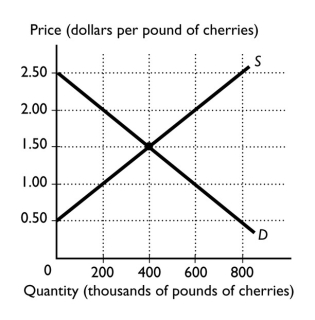 -The figure above shows the U.S. demand and U.S. supply curves for cherries. At a world price of $2 per pound once international trade occurs, the total imports of cherries to the United States from other nations equals
 (Multiple Choice)
4.8/5 (82)
(82) When a tariff is imposed on a good, domestic consumers of the good ________ and domestic producers of the good ________.
(Multiple Choice)
4.8/5 (82)
(82) Which of the following is an argument that is used for protection from free trade?
I. the national security argument
Ii. the infant-industry argument
Iii. the dumping argument
(Multiple Choice)
4.8/5 (80)
(80)  -The above figure shows the U.S. market for 1 carat diamonds. With free trade, U.S. production of diamonds is equal to ________ diamonds. When the quota illustrated in the figure is in place, U.S. production is equal to ________ diamonds.
 (Multiple Choice)
4.7/5 (80)
(80) A specified maximum amount of the good that may be imported in a given period of time is a
(Multiple Choice)
4.9/5 (85)
(85) When a nation exports a good, its ________ surplus decreases, and when it imports a good, its ________ surplus decreases.
(Multiple Choice)
4.8/5 (78)
(78) When a nation exports a good, its ________ surplus increases, and when it imports a good, its ________ surplus increases.
(Multiple Choice)
4.9/5 (91)
(91) When a tariff is imposed on a good, the ________ increases.
(Multiple Choice)
4.8/5 (79)
(79)  -The above figure shows the U.S. market for wheat. With no international trade, consumer surplus is equal to ________ and producer surplus is equal to ________.
 (Multiple Choice)
4.8/5 (78)
(78) If an import quota is imposed on imports of shrimp into the United States, U.S. consumer surplus from shrimp will ________ and U.S. total surplus from shrimp will ________.
(Multiple Choice)
4.8/5 (84)
(84)
-The above figure shows the U.S. market for 1 carat diamonds. With free trade, Americans buy ________ diamonds and pay a price of ________ per diamond.
-The above figure shows the U.S. market for 1 carat diamonds. With free trade, Americans buy ________ diamonds and pay a price of ________ per diamond. (Multiple Choice)
4.8/5 (82)
(82) With no international trade, the U.S. price of wheat is lower than the world price of wheat. This indicates that the United States ________ a comparative advantage in the production of wheat and with international trade, the United States will ________ wheat.
(Multiple Choice)
4.8/5 (81)
(81) When a nation imports a good, its ________ surplus decreases and its ________ surplus increases.
(Multiple Choice)
4.8/5 (73)
(73) 
Filters
- Essay(0)
- Multiple Choice(0)
- Short Answer(0)
- True False(0)
- Matching(0)