



 Chat with AI
Exam 8: Global Markets in Action

Exam 1: Getting Started337 Questions
Exam 2: The Us and Global Economies201 Questions
Exam 3: The Economic Problem273 Questions
Exam 4: Demand and Supply322 Questions
Exam 5: Elasticities of Demand and Supply335 Questions
Exam 6: Efficiency and Fairness of Markets352 Questions
Exam 7: Government Actions in Markets349 Questions
Exam 8: Global Markets in Action276 Questions
Exam 9: Externalities: Pollution, Education, and Health Care290 Questions
Exam 10: Production and Cost266 Questions
Exam 11: Perfect Competition275 Questions
Exam 12: Monopoly377 Questions
Exam 13: Monopolistic Competition and Oligopoly316 Questions
Exam 14: Gdp: a Measure of Total Production and Income253 Questions
Exam 15: Jobs and Unemployment283 Questions
Exam 16: The Cpi and the Cost of Living263 Questions
Exam 17: Potential Gdp and Economic Growth328 Questions
Exam 18: Money and the Monetary System360 Questions
Exam 19: Aggregate Supply and Aggregate Demand301 Questions
Exam 20: Fiscal Policy and Monetary Policy223 Questions
Select questions type


In the 1950s, crude oil and natural gas imports were restricted to keep the domestic industries viable in case of a war. The rationale for this protection is the ________ argument for protection.
(Multiple Choice)
4.8/5  (90)
(90) The national security argument is used by those who assert they want to
(Multiple Choice)
4.7/5 (79)
(79) After NAFTA was signed, the United States allowed more tomatoes to be imported from Mexico. What happened to the price of tomatoes in the United States when the United States allowed more tomatoes to be imported?
(Short Answer)
4.8/5 (75)
(75) How does a quota affect the consumer surplus and the producer surplus from the imported good?
Is the overall economy helped or harmed by quotas?
Briefly explain your answers.
(Essay)
4.8/5 (70)
(70) 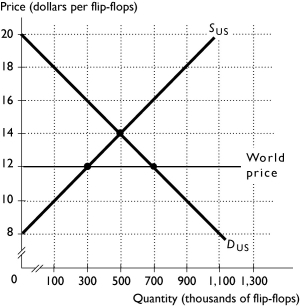 -The above figure shows the U.S. market for flip-flops. When there is no international trade, the U.S. price is ________ per flip-flop and the U.S. quantity is ________ flip-flops.
 (Multiple Choice)
4.8/5 (90)
(90) Price Quantity supplied (thousands of Quantity demanded (thousands of (dollars per pound) pounds per year) pounds per year) 21 120 60 18 100 100 15 80 140 12 60 180 9 40 220
-The United States imports cheese from a variety of countries. The table above gives the domestic supply of, and demand for, cheese in the United States. The world price of cheese is $12 per pound, and trade is unrestricted.
a. How many pounds of cheese are consumed in the United States?
b. How many pounds of cheese are produced in the United States?
c. How many pounds of cheese are imported into the United States?
If a $3 per pound tariff is imposed,
d. How many pounds of cheese are consumed in the United States?
e. How many pounds of cheese are produced in the United States?
f. How many pounds of cheese are imported into the United States?
g. How much will the U.S. government collect in tariff revenue?
h. Who benefits from the tariff?
Who loses?
(Essay)
4.7/5 (74)
(74) When a tariff supporter argues that foreign producers are selling their products for prices below the costs of production, which of the following is being used?
(Multiple Choice)
4.9/5 (76)
(76) The United States imports t-shirts from Asia. As a result, U.S. consumers pay ________ otherwise and Asian producers receive ________ otherwise.
(Multiple Choice)
4.9/5 (76)
(76)  -The above figure shows the U.S. market for 1 carat diamonds. Area B + area D is the
 (Multiple Choice)
4.8/5 (86)
(86) What is the infant-industry argument for protection from international trade?
(Multiple Choice)
4.8/5 (80)
(80) The imposition of a quota ________ domestic production, ________ imports, and ________ domestic purchases.
(Multiple Choice)
4.8/5 (86)
(86) When a good is imported, the domestic production of it ________ and the domestic consumption of it ________.
(Multiple Choice)
4.7/5 (81)
(81) When a nation imports a good, its ________ surplus decreases and its ________ surplus increases.
(Multiple Choice)
4.7/5 (67)
(67) During the past 70 years, the peak average tariff rate in the United States stemmed from the
(Multiple Choice)
4.8/5 (93)
(93)
-The above figure shows the U.S. market for flip-flops. With international trade, U.S. consumers buy ________ flip-flops and U.S. producers produce ________ flip-flops.
-The above figure shows the U.S. market for flip-flops. With international trade, U.S. consumers buy ________ flip-flops and U.S. producers produce ________ flip-flops. (Multiple Choice)
5.0/5 (80)
(80) While high-paid American workers fear competition with low-paid foreign workers, low-paid foreign workers fear competition with high-paid American workers. Why?
(Multiple Choice)
4.7/5 (74)
(74) 
Filters
- Essay(0)
- Multiple Choice(0)
- Short Answer(0)
- True False(0)
- Matching(0)