



 Chat with AI
Exam 8: Global Markets in Action

Exam 1: Getting Started337 Questions
Exam 2: The Us and Global Economies201 Questions
Exam 3: The Economic Problem273 Questions
Exam 4: Demand and Supply322 Questions
Exam 5: Elasticities of Demand and Supply335 Questions
Exam 6: Efficiency and Fairness of Markets352 Questions
Exam 7: Government Actions in Markets349 Questions
Exam 8: Global Markets in Action276 Questions
Exam 9: Externalities: Pollution, Education, and Health Care290 Questions
Exam 10: Production and Cost266 Questions
Exam 11: Perfect Competition275 Questions
Exam 12: Monopoly377 Questions
Exam 13: Monopolistic Competition and Oligopoly316 Questions
Exam 14: Gdp: a Measure of Total Production and Income253 Questions
Exam 15: Jobs and Unemployment283 Questions
Exam 16: The Cpi and the Cost of Living263 Questions
Exam 17: Potential Gdp and Economic Growth328 Questions
Exam 18: Money and the Monetary System360 Questions
Exam 19: Aggregate Supply and Aggregate Demand301 Questions
Exam 20: Fiscal Policy and Monetary Policy223 Questions
Select questions type


Suevania opens its doors to trade with Barvania. Barvania has a comparative advantage in the production of machinery. Hence, once trade occurs Suevania's consumers will buy ________ machinery and pay ________ before.
(Multiple Choice)
5.0/5  (87)
(87) When the United States imports goods from the rest of the world, which of the following parties is harmed?
I. domestic producers of the good
Ii. domestic consumers of the good
Iii. foreign producers of the good
(Multiple Choice)
4.9/5 (91)
(91) When a nation exports a good, its ________ surplus increases and its ________ surplus increases.
(Multiple Choice)
4.9/5 (88)
(88) If a nation imports a good that can be domestically produced, what happens to the quantity consumed of the good and why?
(Multiple Choice)
4.8/5 (72)
(72) Country A imports 1,000 cars per month. After imposing a $50 per car tariff, imports fall to 800 cars per month. How much does Country A's government collect in tariff revenue?
(Multiple Choice)
5.0/5 (92)
(92)  -The above figure shows the U.S. market for 1 carat diamonds. Suppose the United States imposes the import quota shown in the figure. With the import quota, how many diamonds can be imported?
 (Multiple Choice)
4.9/5 (89)
(89)  -The above figure shows the U.S. market for chocolate. With international trade, the gain in total surplus is equal to
 (Multiple Choice)
4.9/5 (86)
(86) 8.5 Chapter Figures
 The figure above shows the U.S. market for T-shirts, where SUS is the domestic supply curve and DUS is the domestic demand curve. The United States trades freely with the rest of the world. The world price of a T-shirt is $5.
-In the figure above, with international trade the United States ________ million T-shirts per year.
The figure above shows the U.S. market for T-shirts, where SUS is the domestic supply curve and DUS is the domestic demand curve. The United States trades freely with the rest of the world. The world price of a T-shirt is $5.
-In the figure above, with international trade the United States ________ million T-shirts per year. (Multiple Choice)
4.7/5 (74)
(74) Imports ________ consumer surplus, ________ producer surplus, and ________ total surplus.
(Multiple Choice)
4.8/5 (89)
(89) If the United States imposes a tariff on foreign chocolate, how are U.S. buyers of chocolate affected?
(Multiple Choice)
4.9/5 (82)
(82) When a nation imports a good or service, the nation's consumer surplus ________, its producer surplus ________, and its total surplus ________.
(Multiple Choice)
4.9/5 (72)
(72) Relative to free trade, domestic producers of a good are ________ off with a tariff because of the ________.
(Multiple Choice)
4.8/5 (81)
(81)  The figure above shows the U.S. market for T-shirts, where SUS is the domestic supply curve and DUS is the domestic demand curve. The world price of a T-shirt is $5. The U.S. government imposes a $2 per unit tariff on imported T-shirts.
-The figure above shows that the deadweight loss from the tariff is
The figure above shows the U.S. market for T-shirts, where SUS is the domestic supply curve and DUS is the domestic demand curve. The world price of a T-shirt is $5. The U.S. government imposes a $2 per unit tariff on imported T-shirts.
-The figure above shows that the deadweight loss from the tariff is (Multiple Choice)
4.7/5 (77)
(77) 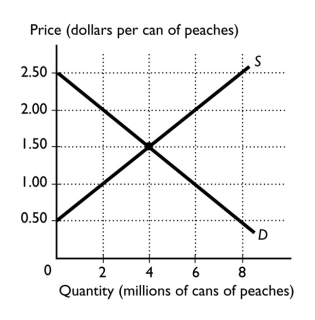 -The figure above shows the U.S. demand and the U.S. supply curves of canned peaches.
a. In the absence of trade, what is price of canned peaches in the United States?
b. In the absence of trade, what is the level of production in the United States?
c. If the world price of canned peaches is $1 a can and the United States engages in trade, does the United States import or export canned peaches?
d. If the world price of canned peaches is $1 a can and the United States engages in trade, what is the quantity produced in the United States and what is the quantity consumed?
What is the quantity imported or exported?
e. If the world price of canned peaches is $2 a can and the United States engages in trade, does the United States import or export canned peaches?
f. If the world price of canned peaches is $2 a can and the United States engages in trade, what is the quantity produced in the United States and what is the quantity consumed?
What is the quantity imported or exported?
-The figure above shows the U.S. demand and the U.S. supply curves of canned peaches.
a. In the absence of trade, what is price of canned peaches in the United States?
b. In the absence of trade, what is the level of production in the United States?
c. If the world price of canned peaches is $1 a can and the United States engages in trade, does the United States import or export canned peaches?
d. If the world price of canned peaches is $1 a can and the United States engages in trade, what is the quantity produced in the United States and what is the quantity consumed?
What is the quantity imported or exported?
e. If the world price of canned peaches is $2 a can and the United States engages in trade, does the United States import or export canned peaches?
f. If the world price of canned peaches is $2 a can and the United States engages in trade, what is the quantity produced in the United States and what is the quantity consumed?
What is the quantity imported or exported? (Essay)
5.0/5 (71)
(71) When a nation starts importing a good or service, the domestic production of the good or service
(Multiple Choice)
4.7/5 (82)
(82) 8.5 Chapter Figures
The figure above shows the U.S. market for T-shirts, where SUS is the domestic supply curve and DUS is the domestic demand curve. The United States trades freely with the rest of the world. The world price of a T-shirt is $5.
-Based on the figure above, international trade leads to
The figure above shows the U.S. market for T-shirts, where SUS is the domestic supply curve and DUS is the domestic demand curve. The United States trades freely with the rest of the world. The world price of a T-shirt is $5.
-Based on the figure above, international trade leads to (Multiple Choice)
5.0/5 (90)
(90) The United States exports a good if its no-trade U.S. price is ________ its world price. With international trade, U.S. production of the good ________ compared to the level of no-trade production.
(Multiple Choice)
4.9/5 (78)
(78)
-The above figure shows the U.S. market for chocolate. With no international trade, consumer surplus is equal to
-The above figure shows the U.S. market for chocolate. With no international trade, consumer surplus is equal to (Multiple Choice)
5.0/5 (86)
(86) Price (dollars per unit) Quantity demanded Quantity supplied (units per day) (units per day) 40 22 14 50 21 15 60 20 16 70 19 17 80 18 18 90 17 19
-The table above gives the domestic demand and supply schedules for a good. Suppose the world price of the good is $40 and the government imposes a $20 per unit tariff. How much will the government collect as tariff revenue?
(Multiple Choice)
4.9/5 (67)
(67) 
Filters
- Essay(0)
- Multiple Choice(0)
- Short Answer(0)
- True False(0)
- Matching(0)