



 Chat with AI
Exam 6: Efficiency and Fairness of Markets


 -The figure above shows Kaley's marginal benefit from swimming with manatees and Scott's marginal cost of providing manatee swimming tours. If Scott offers two swim tours per week, he incurs a marginal cost of
 (82)
 Verified
C
If an economy is allocatively efficient, it must be producing
(74) VerifiedC
What are some of the potential obstacles that can lead to market failure by preventing a market from reaching the efficient outcome?
Briefly define each obstacle.
(67) VerifiedThe obstacles basically fall into two camps: Obstacles that occur because the government does not intervene in the market and obstacles that occur because the government does intervene in the market. In the first group are the issues of externalities, public goods and common resources, and monopoly. An externality occurs when a cost or benefit from production falls upon someone other than the producer or when a cost or benefit from consumption falls upon someone other than the demander. A public good is a good or service that can be consumed simultaneously by everyone even if they didn't pay for the good or service. Public goods create the free rider problem, in which people consume the good without paying for it. A common resource is a resource that no one owns but everyone can use. A common resource is over-used. Finally, a monopoly occurs when a single producer controls the market by being the only producer. In the case of an externality, public good, or monopoly, government intervention has the possibility of increasing the market's efficiency.
The second set of obstacles occur when a market is otherwise efficient but nonetheless the government intervenes in the market. The second group is comprised of price and quantity regulations, as well as taxes and subsidies. Some price regulations make prices higher than a certain price illegal; others make prices lower than a certain price illegal. Both prevent the market from reaching its (efficient)equilibrium. Taxes increase the price paid by the buyer and decrease the price received by the seller. Subsidies have the opposite effect, decreasing the price paid by the buyer and increasing the price received by the seller.
One last reason for a market to be inefficient that does not involve the government is high transactions costs. In this case it might be too expensive to operate a market.
In a competitive market for a private good with no price or quantity regulations, no external cost nor external benefit, low transactions costs, and no taxes or subsidies,
(79) If the marginal benefit of a hot dog is greater than its marginal cost, then to increase efficiency,
(75)  The figure above shows the market for pizza.
-In the figure above, if pizza production increases to 15,000 pizzas a day, then marginal benefit ________ marginal cost, and ________ occurs.
The figure above shows the market for pizza.
-In the figure above, if pizza production increases to 15,000 pizzas a day, then marginal benefit ________ marginal cost, and ________ occurs. (93)  -In the above figure, if the quantity is equal to 2,500,000 units, the deadweight loss is equal to
 (92) Often people trying to withdraw money from their bank must wait in line, which reflects a ________ allocation method.
(73) When a product benefits people other than the buyer of the product, the product is said to have
(72) Seventy percent of Austin's chess club wanted to purchase new chess sets and thirty percent did not. The club purchased the sets. Which method of allocation best describes the choice to purchase the sets?
(76) 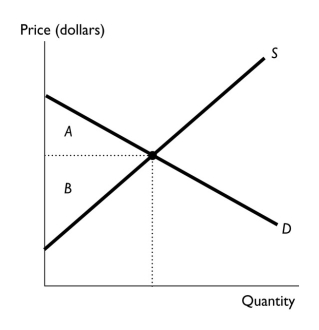 -In the figure above, suppose the market is at equilibrium. Then area B is the
 (76)  -The figure above shows the competitive market for slices of key lime pie. If the production is 40 slices per day, someone is willing to buy another slice of pie for
 (72) Assume the Nozick rules are being followed in the economy so that the distribution of income is fair. What must be true for this to create an efficient allocation of resources?
(72) If society can produce more of one good but must forgo some of another good to do so, it is definitely achieving
(80) Marginal benefit is the benefit that a person receives from consuming
(63)  -In the figure above, the equilibrium market price is $20. $20 is the
 (79) When the cost of producing a product is paid, at least in part, by someone other than the producer, the cost is referred to as
(91) 
Filters
- Essay(0)
- Multiple Choice(0)
- Short Answer(0)
- True False(0)
- Matching(0)