



 Chat with AI
Exam 6: Efficiency and Fairness of Markets

Exam 1: Getting Started337 Questions
Exam 2: The Us and Global Economies201 Questions
Exam 3: The Economic Problem273 Questions
Exam 4: Demand and Supply322 Questions
Exam 5: Elasticities of Demand and Supply335 Questions
Exam 6: Efficiency and Fairness of Markets352 Questions
Exam 7: Government Actions in Markets349 Questions
Exam 8: Global Markets in Action276 Questions
Exam 9: Externalities: Pollution, Education, and Health Care290 Questions
Exam 10: Production and Cost266 Questions
Exam 11: Perfect Competition275 Questions
Exam 12: Monopoly377 Questions
Exam 13: Monopolistic Competition and Oligopoly316 Questions
Exam 14: Gdp: a Measure of Total Production and Income253 Questions
Exam 15: Jobs and Unemployment283 Questions
Exam 16: The Cpi and the Cost of Living263 Questions
Exam 17: Potential Gdp and Economic Growth328 Questions
Exam 18: Money and the Monetary System360 Questions
Exam 19: Aggregate Supply and Aggregate Demand301 Questions
Exam 20: Fiscal Policy and Monetary Policy223 Questions
Select questions type


The maximum amount of other goods and services that people are willing to give up in order to get one more unit of a good is defined as the good's
(Multiple Choice)
4.8/5  (67)
(67) In December 2010, Kansas had a severe ice storm that caused electrical blackouts. The Fictitious Portable Generator firm of Lawrence had several portable generators that could be used by homeowners to provide electricity. Which of the following would be the fair-rules way to provide them?
(Multiple Choice)
4.9/5 (90)
(90) At a competitive equilibrium with no externalities, taxes, subsidies, public goods, common resources, or high transactions costs,which of the following occurs?
i. an efficient outcome
ii. definitely a fair outcome when judged by the fair-results approach
iii. marginal cost equals marginal benefit
iv. producer surplus equals consumer surplus
(Multiple Choice)
4.7/5 (87)
(87) In a figure that shows a supply curve and a demand curve, producer surplus is the area
(Multiple Choice)
4.8/5 (79)
(79)  -The figure above represents the competitive market for slices of key lime pie. If the production is 80 slices per day, the cost of the 80th slice is
 (Multiple Choice)
4.9/5 (79)
(79) When technology increases the supply of a good and lower prices increase the quantity demanded,
(Multiple Choice)
4.9/5 (98)
(98) Efficiency in a market occurs when the production of the good is such that
(Multiple Choice)
4.7/5 (80)
(80) In the above figure, what is the marginal cost of the 8th pizza?
(Multiple Choice)
4.8/5 (83)
(83) Suppose Jennifer derives $100 in marginal benefits from her first skiing trip and $80 from her third trip. Her marginal benefit from her second trip is likely to be
(Multiple Choice)
4.8/5 (67)
(67) The price of a cowboy hat is $100. Willie is willing to pay $130, Waylon is willing to pay $100, and Merle is willing to pay $85. All of the following statements are true EXCEPT:
(Multiple Choice)
4.9/5 (80)
(80)  -The figure above shows the market for pants. If the government subsidizes the production of pants so that production expands from 6 million pairs to 7 million pairs,
 (Multiple Choice)
4.9/5 (74)
(74) 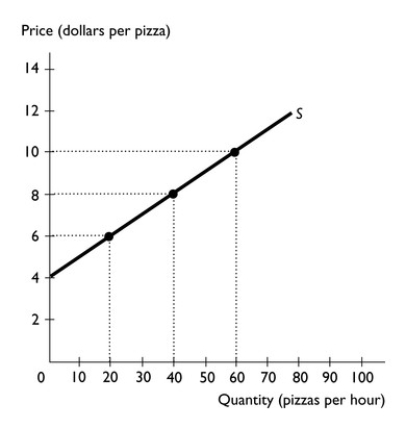 -The figure above shows the supply curve for pizzas.
a. What is the marginal cost of the 20th pizza?
b. What is the minimum supply price of the 20th pizza?
c. If the price is $6 per pizza, what is the producer surplus on the 20th pizza?
d. If the price is $6 per pizza, what is the producer surplus for the total quantity of pizzas produced?
e. If the price is $8 per pizza, what is the producer surplus for the total quantity of pizzas produced?
f. If the price is $10 per pizza, what is the producer surplus for the total quantity of pizzas produced?
-The figure above shows the supply curve for pizzas.
a. What is the marginal cost of the 20th pizza?
b. What is the minimum supply price of the 20th pizza?
c. If the price is $6 per pizza, what is the producer surplus on the 20th pizza?
d. If the price is $6 per pizza, what is the producer surplus for the total quantity of pizzas produced?
e. If the price is $8 per pizza, what is the producer surplus for the total quantity of pizzas produced?
f. If the price is $10 per pizza, what is the producer surplus for the total quantity of pizzas produced? (Essay)
4.8/5 (76)
(76) The difference between the marginal benefit from a new pair of shoes and the price of the new pair of shoes is
(Multiple Choice)
4.7/5 (67)
(67) 
Filters
- Essay(0)
- Multiple Choice(0)
- Short Answer(0)
- True False(0)
- Matching(0)