



 Chat with AI
Exam 6: Efficiency and Fairness of Markets

Exam 1: Getting Started337 Questions
Exam 2: The Us and Global Economies201 Questions
Exam 3: The Economic Problem273 Questions
Exam 4: Demand and Supply322 Questions
Exam 5: Elasticities of Demand and Supply335 Questions
Exam 6: Efficiency and Fairness of Markets352 Questions
Exam 7: Government Actions in Markets349 Questions
Exam 8: Global Markets in Action276 Questions
Exam 9: Externalities: Pollution, Education, and Health Care290 Questions
Exam 10: Production and Cost266 Questions
Exam 11: Perfect Competition275 Questions
Exam 12: Monopoly377 Questions
Exam 13: Monopolistic Competition and Oligopoly316 Questions
Exam 14: Gdp: a Measure of Total Production and Income253 Questions
Exam 15: Jobs and Unemployment283 Questions
Exam 16: The Cpi and the Cost of Living263 Questions
Exam 17: Potential Gdp and Economic Growth328 Questions
Exam 18: Money and the Monetary System360 Questions
Exam 19: Aggregate Supply and Aggregate Demand301 Questions
Exam 20: Fiscal Policy and Monetary Policy223 Questions
Select questions type


The point that each glass of lemonade consumed on a hot day brings lower and lower levels of satisfaction is known as the principle of
(Multiple Choice)
4.8/5  (75)
(75) Quantity (millions of bushels of apples) Marginal benefit (oranges per bushel) Marginal cost (oranges per bushel) 5 10 1 10 8 3 15 6 6 20 4 9 25 2 12
-Using the values for the marginal benefit and the marginal cost of a bushel of apples given in the table above, what is the allocatively efficient quantity of apples?
Suppose 10 million bushels of apples are produced. Should the quantity be increased or decreased?
What if 20 million bushels are produced; should the quantity be increased or decreased?
(Essay)
4.8/5 (71)
(71) What did Adam Smith identify as the source of the invisible hand in 1776?
(Multiple Choice)
4.9/5 (81)
(81)  The figure above shows the supply curve for pizza and the market price of pizza.
-In the figure above, the cost of producing 10,000 pizzas a day is
The figure above shows the supply curve for pizza and the market price of pizza.
-In the figure above, the cost of producing 10,000 pizzas a day is (Multiple Choice)
4.9/5 (91)
(91) According to the "fair rules" view of fairness, are taxes fair?
Explain.
(Essay)
4.9/5 (84)
(84) Shelby said to her friend, "I just bought a new pair of climbing shoes and I love them so much that I totally would have paid more for them." Shelby was describing the concept of
(Multiple Choice)
4.9/5 (84)
(84) 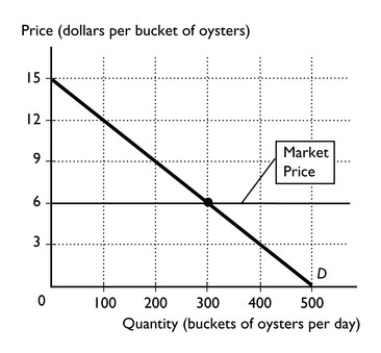 -The diagram above depicts the demand for, and market price of, buckets of raw oysters in Orlando.
a. What is the consumer surplus of the person who buys the 100th bucket of oysters?
b. What is the consumer surplus of the person who buys the 200th bucket of oysters?
c. What is the consumer surplus of the person who buys the 300th bucket of oysters?
d. What is the total consumer surplus from all the oysters consumed in the market?
-The diagram above depicts the demand for, and market price of, buckets of raw oysters in Orlando.
a. What is the consumer surplus of the person who buys the 100th bucket of oysters?
b. What is the consumer surplus of the person who buys the 200th bucket of oysters?
c. What is the consumer surplus of the person who buys the 300th bucket of oysters?
d. What is the total consumer surplus from all the oysters consumed in the market? (Essay)
4.8/5 (71)
(71) Allocative efficiency is achieved when the marginal benefit of a good
(Multiple Choice)
4.8/5 (86)
(86) Which of the following leads to a deadweight loss?
I. overproduction
Ii. underproduction
Iii. taxes
Iv. monopoly
(Multiple Choice)
4.7/5 (83)
(83) 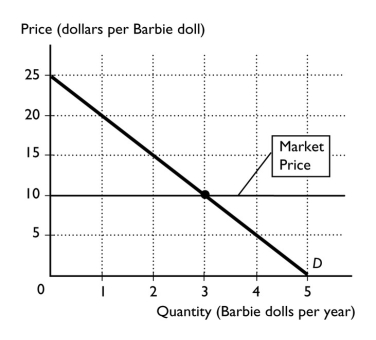 -The figure above shows Lauren's demand curve for Barbie dolls and the market price for Barbie dolls. In order for Lauren to avoid paying more for dolls than they are worth to her, she must not purchase any more than
 (Multiple Choice)
4.8/5 (77)
(77) When economists use the term "big tradeoff" when discussing efficiency they are referring to the tradeoff between
(Multiple Choice)
4.9/5 (78)
(78)  -The figure above shows the market for pants. If the efficient quantity is produced,
 (Multiple Choice)
4.9/5 (85)
(85) In 2009, tickets to a Presidential Town Hall meeting were distributed to individuals through a random selection of those who registered on a website. The tickets were allocated by which method?
(Multiple Choice)
4.8/5 (76)
(76) 
Filters
- Essay(0)
- Multiple Choice(0)
- Short Answer(0)
- True False(0)
- Matching(0)