



 Chat with AI
Exam 6: Efficiency and Fairness of Markets

Exam 1: Getting Started337 Questions
Exam 2: The Us and Global Economies201 Questions
Exam 3: The Economic Problem273 Questions
Exam 4: Demand and Supply322 Questions
Exam 5: Elasticities of Demand and Supply335 Questions
Exam 6: Efficiency and Fairness of Markets352 Questions
Exam 7: Government Actions in Markets349 Questions
Exam 8: Global Markets in Action276 Questions
Exam 9: Externalities: Pollution, Education, and Health Care290 Questions
Exam 10: Production and Cost266 Questions
Exam 11: Perfect Competition275 Questions
Exam 12: Monopoly377 Questions
Exam 13: Monopolistic Competition and Oligopoly316 Questions
Exam 14: Gdp: a Measure of Total Production and Income253 Questions
Exam 15: Jobs and Unemployment283 Questions
Exam 16: The Cpi and the Cost of Living263 Questions
Exam 17: Potential Gdp and Economic Growth328 Questions
Exam 18: Money and the Monetary System360 Questions
Exam 19: Aggregate Supply and Aggregate Demand301 Questions
Exam 20: Fiscal Policy and Monetary Policy223 Questions
Select questions type


Which of the following is part of the cost of income transfers?
(Multiple Choice)
4.8/5  (78)
(78) A supply curve shows the ________ of producing one more unit of a good or service.
(Multiple Choice)
4.8/5 (77)
(77) Samantha was willing to pay $10 for a hamburger because she was hungry but she only paid $2.50. What is the marginal benefit Samantha gained from the hamburger?
(Multiple Choice)
4.9/5 (79)
(79) Jason wants to hire Maria to tutor him in economics. Jason is willing to pay $30 for the first hour of tutoring, $25 for the second, $20 for the third, $15 for the fourth, and $10 for the fifth. Maria has an opportunity cost per hour of $6 for the first, $9 for the second, $12 for the third, $15 for the fourth, and $18 for the fifth. The initial equilibrium price for tutoring is $15 an hour and hence Maria tutors Jason for 4 hours. Now, Maria realizes that she is the only economics tutor because all the other tutors have graduated. Because she is the only tutor, she has a monopoly and, as a monopolist, Maria decides to charge a price of $25 instead of $15 an hour.
a. At the price of $25 an hour, how many hours will Maria tutor Jason?
b. At the initial equilibrium price of $15 an hour, what was Jason's total consumer surplus and Maria's total producer surplus?
c. At the price of $25 an hour, how many hours will Jason hire Maria to tutor him?
What is Jason's total consumer surplus and Maria's total producer surplus?
d. How does the sum of Jason's consumer surplus plus Maria's producer surplus compare at the initial equilibrium price of $15 an hour (part b)and at the new price of $25 an hour (part c)?
Comment on any difference.
(Essay)
4.9/5 (68)
(68) 6.7 Integrative Questions
 -The figure above shows the market for brooms. If 800 brooms are produced,
 (Multiple Choice)
4.8/5 (91)
(91) 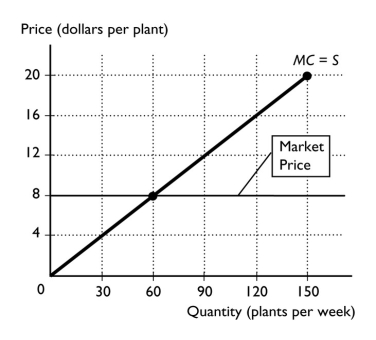 -Bill and Krista sell potted plants from a roadside stand. The figure above shows Bill and Krista's marginal cost curve and the market price. If Bill and Krista sell 60 plants per week, their producer surplus from the 60th plant will equal
 (Multiple Choice)
4.8/5 (80)
(80)  -The figure above shows the supply curve for soda. The market price is $1.00 per soda. The producer surplus from the 10,000th soda is
 (Multiple Choice)
4.8/5 (74)
(74) Moving ________ along the marginal cost curve, the ________.
(Multiple Choice)
4.9/5 (81)
(81)  The figure above shows the demand curve for pizza and the market price of pizza.
-In the figure above, how much do the consumers pay in total for the quantity of pizza they buy per day?
The figure above shows the demand curve for pizza and the market price of pizza.
-In the figure above, how much do the consumers pay in total for the quantity of pizza they buy per day? (Multiple Choice)
4.8/5 (91)
(91) What approach to fairness argues in favor of government policies that redistribute income so that there is more equality of income?
(Essay)
4.9/5 (76)
(76) Which of the following is most closely related to the "fair results" approach to fairness?
(Multiple Choice)
4.7/5 (97)
(97) Jenn is willing to pay $75 for a purse and the purse's price is $60. What is Jenn's consumer surplus on this purse?
(Essay)
4.9/5 (75)
(75) When less than the efficient amount of a good is produced, how does the marginal benefit of the last unit produced compare to its marginal cost?
(Essay)
4.9/5 (72)
(72) What must be true for a consumer to buy a good or service?
(Multiple Choice)
5.0/5 (87)
(87) The idea that unequal incomes is unfair generally uses the ________ principle of fairness.
(Multiple Choice)
4.8/5 (75)
(75) Suppose the price of a scooter is $200 and Cora Lee is willing to pay $250. Cora Lee's
(Multiple Choice)
4.8/5 (76)
(76) 
Filters
- Essay(0)
- Multiple Choice(0)
- Short Answer(0)
- True False(0)
- Matching(0)