



 Chat with AI
Exam 6: Efficiency and Fairness of Markets

Exam 1: Getting Started337 Questions
Exam 2: The Us and Global Economies201 Questions
Exam 3: The Economic Problem273 Questions
Exam 4: Demand and Supply322 Questions
Exam 5: Elasticities of Demand and Supply335 Questions
Exam 6: Efficiency and Fairness of Markets352 Questions
Exam 7: Government Actions in Markets349 Questions
Exam 8: Global Markets in Action276 Questions
Exam 9: Externalities: Pollution, Education, and Health Care290 Questions
Exam 10: Production and Cost266 Questions
Exam 11: Perfect Competition275 Questions
Exam 12: Monopoly377 Questions
Exam 13: Monopolistic Competition and Oligopoly316 Questions
Exam 14: Gdp: a Measure of Total Production and Income253 Questions
Exam 15: Jobs and Unemployment283 Questions
Exam 16: The Cpi and the Cost of Living263 Questions
Exam 17: Potential Gdp and Economic Growth328 Questions
Exam 18: Money and the Monetary System360 Questions
Exam 19: Aggregate Supply and Aggregate Demand301 Questions
Exam 20: Fiscal Policy and Monetary Policy223 Questions
Select questions type


 -The figure above shows the supply curve for soda. The market price is $1.00 per soda. The marginal cost of the 20,000th soda is
 (Multiple Choice)
4.8/5  (90)
(90) 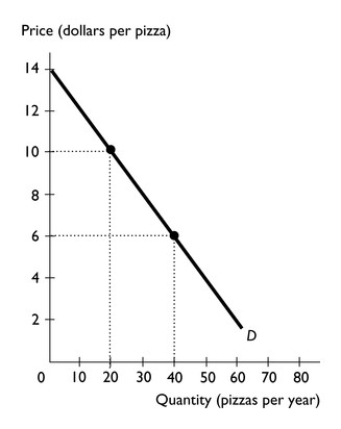 -The figure above shows the demand curve for pizza.
a. What is the marginal benefit of the 20th pizza?
b. What is the maximum price the consumer is willing to pay for the 20th pizza?
c. If the price of a pizza is $6, what is the consumer surplus of the 20th pizza?
d. If the price of a pizza is $10, what is the consumer surplus on all the pizzas consumed?
e. If the price of a pizza is $6, what is the consumer surplus on all the pizzas consumed?
-The figure above shows the demand curve for pizza.
a. What is the marginal benefit of the 20th pizza?
b. What is the maximum price the consumer is willing to pay for the 20th pizza?
c. If the price of a pizza is $6, what is the consumer surplus of the 20th pizza?
d. If the price of a pizza is $10, what is the consumer surplus on all the pizzas consumed?
e. If the price of a pizza is $6, what is the consumer surplus on all the pizzas consumed? (Essay)
4.9/5 (78)
(78) Which of the following situations describing a resource allocation method most resembles the force method?
(Multiple Choice)
4.8/5 (80)
(80) If an economy is producing on its PPF, then it is definitely achieving
(Multiple Choice)
4.8/5 (84)
(84) An unequal distribution of income is considered fair according to Robert Nozick if
(Multiple Choice)
4.7/5 (99)
(99) 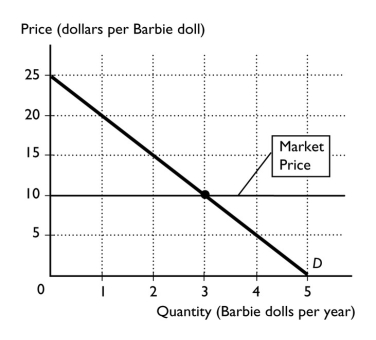 -The figure above shows Lauren's demand curve for Barbie dolls and the market price for Barbie dolls. Using the area of the consumer surplus triangle, Lauren's total consumer surplus from purchasing 3 dolls is
 (Multiple Choice)
4.8/5 (77)
(77)  -The figure above shows Diane's demand curve for soda. The price of a soda is $1.00. Diane's total benefit from consuming 15 sodas is
 (Multiple Choice)
4.8/5 (83)
(83) In general, as the consumption of a good or service increases, the marginal benefit from consuming that good or service
(Multiple Choice)
4.9/5 (72)
(72) When society must decrease the production of something in order to produce more of another good or service, society has necessarily achieved
(Multiple Choice)
4.9/5 (81)
(81) In a figure, the consumer surplus is equal to the area ________ the ________ curve and ________ the price.
(Multiple Choice)
4.8/5 (72)
(72)  -In the above figure, the market is at its equilibrium. Area A is equal to
 (Multiple Choice)
4.8/5 (69)
(69) If the price is greater than the marginal cost of producing a good, the seller has
(Multiple Choice)
4.8/5 (81)
(81) When production moves from the efficient quantity to a point of overproduction,
(Multiple Choice)
4.7/5 (93)
(93)  -The figure above shows Kaley's marginal benefit from swimming with manatees and Scott's marginal cost of providing manatee swimming tours. For Kaley and Scott, allocative efficiency is achieved at what point?
 (Multiple Choice)
4.8/5 (76)
(76) 
Filters
- Essay(0)
- Multiple Choice(0)
- Short Answer(0)
- True False(0)
- Matching(0)