



 Chat with AI
Exam 20: Fiscal Policy and Monetary Policy

Exam 1: Getting Started337 Questions
Exam 2: The Us and Global Economies201 Questions
Exam 3: The Economic Problem273 Questions
Exam 4: Demand and Supply322 Questions
Exam 5: Elasticities of Demand and Supply335 Questions
Exam 6: Efficiency and Fairness of Markets352 Questions
Exam 7: Government Actions in Markets349 Questions
Exam 8: Global Markets in Action276 Questions
Exam 9: Externalities: Pollution, Education, and Health Care290 Questions
Exam 10: Production and Cost266 Questions
Exam 11: Perfect Competition275 Questions
Exam 12: Monopoly377 Questions
Exam 13: Monopolistic Competition and Oligopoly316 Questions
Exam 14: Gdp: a Measure of Total Production and Income253 Questions
Exam 15: Jobs and Unemployment283 Questions
Exam 16: The Cpi and the Cost of Living263 Questions
Exam 17: Potential Gdp and Economic Growth328 Questions
Exam 18: Money and the Monetary System360 Questions
Exam 19: Aggregate Supply and Aggregate Demand301 Questions
Exam 20: Fiscal Policy and Monetary Policy223 Questions
Select questions type


After the Fed raises the federal funds rate, the effects on the economy can take up to two years before they occur. Is this statement accurate?
Lay out the time path of how an increase in the federal funds rate affects the economy.
(Essay)
4.8/5  (81)
(81) When the government's outlays equal its tax revenue, then the budget
(Multiple Choice)
4.7/5 (91)
(91) If the Fed increases interest rates, other things remaining the same, foreigners demand ________ dollars thereby ________ the exchange rate.
(Multiple Choice)
4.7/5 (90)
(90) Which of the following statements about the ripple effects of monetary policy is FALSE? Monetary policy can
(Multiple Choice)
4.8/5 (77)
(77) There are four limitations to the effectiveness of discretionary fiscal policy. Which item below is NOT one of these limitations?
(Multiple Choice)
4.9/5 (83)
(83) If the economy is in an equilibrium with real GDP less than potential GDP, a fiscal stimulus could move the economy toward potential GDP by simultaneously ________ taxes and ________ government expenditures on goods and services.
(Multiple Choice)
4.8/5 (88)
(88) Discretionary fiscal policy is a fiscal policy action, such as
(Multiple Choice)
4.9/5 (75)
(75) If a change in the tax laws leads to a $100 billion decrease in tax revenue, then aggregate demand
(Multiple Choice)
4.8/5 (80)
(80) 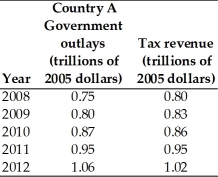
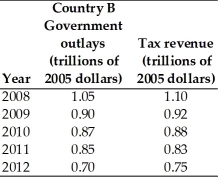 -The national debt is the amount
The government collects tax revenue of $100 million and has $105 million in outlays. The budget balance is a
(Multiple Choice)
4.8/5 (78)
(78) In a recession, needs-tested spending ________ and induced taxes ________.
(Multiple Choice)
4.8/5 (91)
(91) Ignoring any supply-side effects, how does the magnitude of the government expenditure multiplier compare to the magnitude of the tax multiplier?
Explain your answer.
(Essay)
4.9/5 (74)
(74) Suppose the economy is in an equilibrium in which real GDP is less than potential GDP. To increase real GDP, the government can use a fiscal stimulus of
(Multiple Choice)
4.7/5 (91)
(91) Fiscal policies that move the economy toward potential GDP without a change in policy are called
(Multiple Choice)
4.9/5 (88)
(88) In order for the United States to use discretionary fiscal policy to deal with a recessionary gap,
(Multiple Choice)
4.7/5 (73)
(73) 
Filters
- Essay(0)
- Multiple Choice(0)
- Short Answer(0)
- True False(0)
- Matching(0)