



 Chat with AI
Exam 12: Monopoly

Exam 1: Getting Started337 Questions
Exam 2: The Us and Global Economies201 Questions
Exam 3: The Economic Problem273 Questions
Exam 4: Demand and Supply322 Questions
Exam 5: Elasticities of Demand and Supply335 Questions
Exam 6: Efficiency and Fairness of Markets352 Questions
Exam 7: Government Actions in Markets349 Questions
Exam 8: Global Markets in Action276 Questions
Exam 9: Externalities: Pollution, Education, and Health Care290 Questions
Exam 10: Production and Cost266 Questions
Exam 11: Perfect Competition275 Questions
Exam 12: Monopoly377 Questions
Exam 13: Monopolistic Competition and Oligopoly316 Questions
Exam 14: Gdp: a Measure of Total Production and Income253 Questions
Exam 15: Jobs and Unemployment283 Questions
Exam 16: The Cpi and the Cost of Living263 Questions
Exam 17: Potential Gdp and Economic Growth328 Questions
Exam 18: Money and the Monetary System360 Questions
Exam 19: Aggregate Supply and Aggregate Demand301 Questions
Exam 20: Fiscal Policy and Monetary Policy223 Questions
Select questions type


The capture theory of regulation assumes that regulation benefits
(Multiple Choice)
5.0/5  (75)
(75) The relationship between marginal revenue and elasticity is
(Multiple Choice)
4.9/5 (72)
(72) If Microsoft is a monopoly and currently charges prices where its demand is elastic, then Microsoft's marginal revenue is
(Multiple Choice)
4.9/5 (77)
(77) 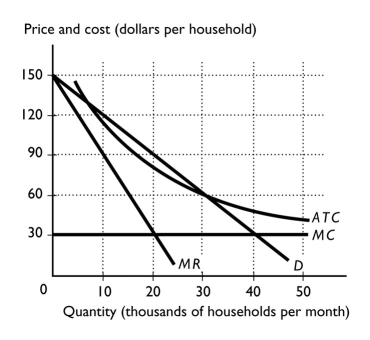 -The above figure shows the demand for cable and the cable company's cost of providing cable.
a. What price and quantity will be produced if the company is unregulated and profit maximizes?
b. What price and quantity will be produced if the company is regulated using the marginal cost pricing rule?
c. What is the advantage of the marginal cost pricing rule?
d. What price and quantity will be produced if the company is regulated using the average cost pricing rule?
e. What is the advantage of the average cost pricing rule?
-The above figure shows the demand for cable and the cable company's cost of providing cable.
a. What price and quantity will be produced if the company is unregulated and profit maximizes?
b. What price and quantity will be produced if the company is regulated using the marginal cost pricing rule?
c. What is the advantage of the marginal cost pricing rule?
d. What price and quantity will be produced if the company is regulated using the average cost pricing rule?
e. What is the advantage of the average cost pricing rule? (Essay)
4.8/5 (92)
(92) When used with a natural monopoly, an average cost pricing rule results in
(Multiple Choice)
4.9/5 (85)
(85) At a level of output when regulators require a natural monopoly to set a price that is equal to marginal cost, the firm
(Multiple Choice)
4.8/5 (83)
(83) 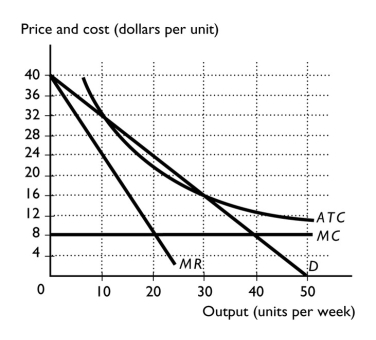 -The figure above shows a natural monopoly that the government must regulate. If the government uses ________, the firm produces ________ units per week.
 (Multiple Choice)
4.9/5 (81)
(81) 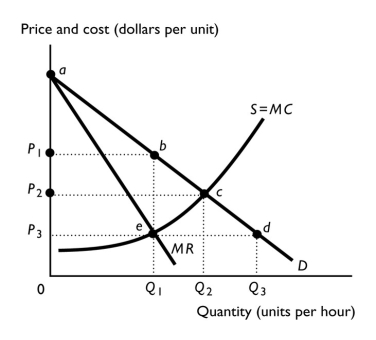 -In the above figure, for a single-price monopoly the deadweight loss is equal to the area
 (Multiple Choice)
4.8/5 (74)
(74) Why can a monopoly make an economic profit in the long run?
(Multiple Choice)
4.9/5 (88)
(88) If a monopoly wants to sell a greater quantity of output, it must
(Multiple Choice)
4.8/5 (94)
(94) "If a natural monopoly is regulated using a marginal cost pricing rule, the firm makes zero economic profit." Is the previous statement correct or incorrect?
(Essay)
4.9/5 (82)
(82) Price(dollars) Quantity(units) 8 1 6 2 5 3 4 4 3 5
-The above table gives the demand schedule for a single-price monopoly. The marginal revenue first becomes negative when going from
(Multiple Choice)
4.9/5 (71)
(71) In States where the government runs liquor stores, the monopoly results from
(Multiple Choice)
4.9/5 (81)
(81) Compared to a perfectly competitive market, a single-price monopoly sets
(Multiple Choice)
5.0/5 (65)
(65) 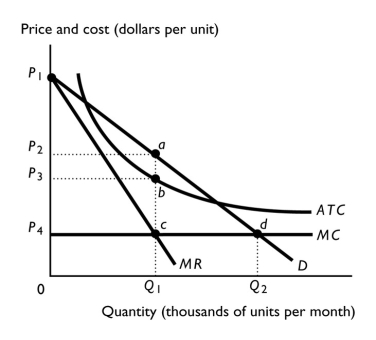 -The above figure shows the demand, marginal revenue, and cost curves for a natural monopoly.
a. Which price and quantity is set if the capture theory is correct?
b. If production is at the price and quantity specified in part (a), what area represents the economic profit?
c. If production is at the price and quantity specified in part (a), what area represents the deadweight loss?
d. If production is at the price and quantity specified in part (a), what area represents the consumer surplus?
-The above figure shows the demand, marginal revenue, and cost curves for a natural monopoly.
a. Which price and quantity is set if the capture theory is correct?
b. If production is at the price and quantity specified in part (a), what area represents the economic profit?
c. If production is at the price and quantity specified in part (a), what area represents the deadweight loss?
d. If production is at the price and quantity specified in part (a), what area represents the consumer surplus? (Essay)
4.7/5 (74)
(74) Suppose a single-price monopoly sells 3 units of a good at $20 per unit. If the monopoly sells 4 units, the total revenue increases to $72. What is the marginal revenue of the fourth unit?
(Multiple Choice)
4.8/5 (74)
(74) 
Filters
- Essay(0)
- Multiple Choice(0)
- Short Answer(0)
- True False(0)
- Matching(0)