



 Chat with AI
Exam 12: Monopoly

Exam 1: Getting Started337 Questions
Exam 2: The Us and Global Economies201 Questions
Exam 3: The Economic Problem273 Questions
Exam 4: Demand and Supply322 Questions
Exam 5: Elasticities of Demand and Supply335 Questions
Exam 6: Efficiency and Fairness of Markets352 Questions
Exam 7: Government Actions in Markets349 Questions
Exam 8: Global Markets in Action276 Questions
Exam 9: Externalities: Pollution, Education, and Health Care290 Questions
Exam 10: Production and Cost266 Questions
Exam 11: Perfect Competition275 Questions
Exam 12: Monopoly377 Questions
Exam 13: Monopolistic Competition and Oligopoly316 Questions
Exam 14: Gdp: a Measure of Total Production and Income253 Questions
Exam 15: Jobs and Unemployment283 Questions
Exam 16: The Cpi and the Cost of Living263 Questions
Exam 17: Potential Gdp and Economic Growth328 Questions
Exam 18: Money and the Monetary System360 Questions
Exam 19: Aggregate Supply and Aggregate Demand301 Questions
Exam 20: Fiscal Policy and Monetary Policy223 Questions
Select questions type


Which of the following statements about price discrimination is false?
(Multiple Choice)
4.8/5  (84)
(84) Which of the following is ALWAYS true when a single-price monopolist maximizes its profit?
(Multiple Choice)
4.8/5 (78)
(78) 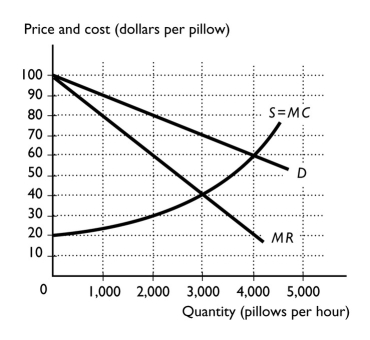 -The figure above shows the demand, marginal revenue, and marginal cost curves for Paul's Parrot pillows, a monopoly producer of pillows stuffed with parrot feathers. When Paul maximizes his profit, Paul produces ________ pillows per hour and if the market was perfectly competitive, ________ pillows per hour would be produced.
 (Multiple Choice)
4.8/5 (78)
(78) 12.6 Chapter Figures
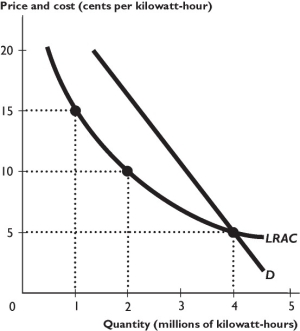 The figure above shows a firm's demand and average total cost curves.
-The situation in the figure above creates a barrier to entry for a second firm because i. a second firm that produced as many kilowatt-hours as the first firm would see the market price fall beneath its cost and would incur an economic loss.
Ii. a second firm that produced fewer kilowatt-hours than the first firm would have to charge a higher price and would not gain many customers.
Iii. the first firm's average total cost curve indicates it has been given a patent for the product.
The figure above shows a firm's demand and average total cost curves.
-The situation in the figure above creates a barrier to entry for a second firm because i. a second firm that produced as many kilowatt-hours as the first firm would see the market price fall beneath its cost and would incur an economic loss.
Ii. a second firm that produced fewer kilowatt-hours than the first firm would have to charge a higher price and would not gain many customers.
Iii. the first firm's average total cost curve indicates it has been given a patent for the product. (Multiple Choice)
4.7/5 (83)
(83) With perfect price discrimination ________, and production is expanded until marginal revenue equals ________.
(Multiple Choice)
4.9/5 (86)
(86) With an average cost pricing rule, the quantity produced by the natural monopoly is ________ the quantity produced with a marginal cost pricing rule.
(Multiple Choice)
4.8/5 (73)
(73) Quantity (units) Price (dollars) Marginal cost (dollars) 1 22 9 2 20 10 3 18 12 4 16 16 5 14 22 6 12 30 7 10 40 8 8 52
-A monopolist has the market demand and marginal cost schedules given in the above table. If the monopoly can perfectly price discriminate, what is the profit-maximizing level of output and price?
(Essay)
4.9/5 (95)
(95) "The theory that regulation seeks an efficient use of resources is called the capture theory of regulation." Is the previous statement correct or incorrect?
(Essay)
4.7/5 (75)
(75) Which of the following is NOT a requirement for a firm to be able to price discriminate?
(Multiple Choice)
4.8/5 (72)
(72)  The above figure shows a market.
-If the market was a monopoly, the quantity would be ________ and the price would be ________; if the market tis perfectly competitive, the quantity would be ________ and the price would be ________.
The above figure shows a market.
-If the market was a monopoly, the quantity would be ________ and the price would be ________; if the market tis perfectly competitive, the quantity would be ________ and the price would be ________. (Multiple Choice)
4.9/5 (84)
(84) A single-price monopoly has marginal revenue and marginal cost equal to $19 at 15 units of output where the price on the demand curve is $38. What is the firm's total revenue?
(Multiple Choice)
4.8/5 (88)
(88)
The above figure shows a market.
-If the market in the figure above is a profit-maximizing single-price monopoly, consumer surplus is the area ________.
The above figure shows a market.
-If the market in the figure above is a profit-maximizing single-price monopoly, consumer surplus is the area ________. (Multiple Choice)
4.9/5 (66)
(66) Price(dollars) Quantity(units) 6 1 5 2 4 3 3 4 2 5 1 6
-The above table gives the demand schedule for a monopoly. The demand is elastic at all prices between
(Multiple Choice)
4.9/5 (77)
(77) Compared to a perfectly competitive industry, a single-price monopoly produces
(Multiple Choice)
4.9/5 (82)
(82) "If Michigan's electric utilities were allowed to use marginal cost pricing, it would lead to economic profits for these utilities." Is the previous statement correct or incorrect?
(Essay)
4.9/5 (72)
(72) If a single firm can meet the entire market demand at a lower average total cost than a larger number of smaller firms, the single firm is
(Multiple Choice)
4.8/5 (83)
(83) 
Filters
- Essay(0)
- Multiple Choice(0)
- Short Answer(0)
- True False(0)
- Matching(0)