



 Chat with AI
Exam 12: Monopoly

Exam 1: Getting Started337 Questions
Exam 2: The Us and Global Economies201 Questions
Exam 3: The Economic Problem273 Questions
Exam 4: Demand and Supply322 Questions
Exam 5: Elasticities of Demand and Supply335 Questions
Exam 6: Efficiency and Fairness of Markets352 Questions
Exam 7: Government Actions in Markets349 Questions
Exam 8: Global Markets in Action276 Questions
Exam 9: Externalities: Pollution, Education, and Health Care290 Questions
Exam 10: Production and Cost266 Questions
Exam 11: Perfect Competition275 Questions
Exam 12: Monopoly377 Questions
Exam 13: Monopolistic Competition and Oligopoly316 Questions
Exam 14: Gdp: a Measure of Total Production and Income253 Questions
Exam 15: Jobs and Unemployment283 Questions
Exam 16: The Cpi and the Cost of Living263 Questions
Exam 17: Potential Gdp and Economic Growth328 Questions
Exam 18: Money and the Monetary System360 Questions
Exam 19: Aggregate Supply and Aggregate Demand301 Questions
Exam 20: Fiscal Policy and Monetary Policy223 Questions
Select questions type


Comparing single-price monopoly to perfect competition, monopoly
(Multiple Choice)
4.8/5  (82)
(82)  The figure above shows a natural monopoly.
-In the figure above, if the firm is regulated using a marginal cost pricing rule, the deadweight loss created is equal to the area of
The figure above shows a natural monopoly.
-In the figure above, if the firm is regulated using a marginal cost pricing rule, the deadweight loss created is equal to the area of (Multiple Choice)
5.0/5 (75)
(75) A natural monopoly's output is less if it is regulated with
(Multiple Choice)
4.9/5 (75)
(75)  The above figure shows a market.
-If the market in the figure above is a profit-maximizing single-price monopoly, the producer surplus is the area ________.
The above figure shows a market.
-If the market in the figure above is a profit-maximizing single-price monopoly, the producer surplus is the area ________. (Multiple Choice)
5.0/5 (83)
(83)  -Suppose the Busy Bee Café is the monopoly producer of hamburgers in Hugo, Oklahoma. The above figure represents the demand, marginal revenue, and marginal cost curves for this establishment. What quantity will the Busy Bee produce to maximize its profit?
 (Multiple Choice)
4.9/5 (74)
(74) Suppose that along a linear demand curve, the elasticity of demand is equal to 1 when the price is $4 and the quantity is 100 units. Then the
(Multiple Choice)
4.7/5 (75)
(75) 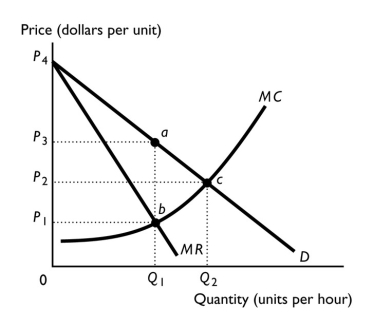 -The above figure represents a perfectly competitive industry that is taken over by a single firm and operated as a monopoly.
a. What was the competitive price and quantity?
b. What is the monopoly price and quantity?
c. What area represents consumer surplus under perfect competition?
d. What area represents consumer surplus under monopoly?
e. What area represents the deadweight loss of monopoly?
-The above figure represents a perfectly competitive industry that is taken over by a single firm and operated as a monopoly.
a. What was the competitive price and quantity?
b. What is the monopoly price and quantity?
c. What area represents consumer surplus under perfect competition?
d. What area represents consumer surplus under monopoly?
e. What area represents the deadweight loss of monopoly? (Essay)
5.0/5 (78)
(78) 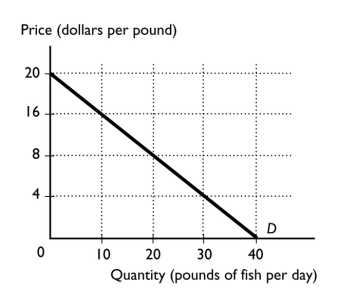 -The above figure represents the demand and marginal revenue curves for Sue's Seafood, a seller of fresh fish.
a. Over what range of output is demand elastic?
b. Over what range of output is demand inelastic?
c. What price maximizes total revenue?
d. What is the price elasticity of demand at the revenue maximizing price?
-The above figure represents the demand and marginal revenue curves for Sue's Seafood, a seller of fresh fish.
a. Over what range of output is demand elastic?
b. Over what range of output is demand inelastic?
c. What price maximizes total revenue?
d. What is the price elasticity of demand at the revenue maximizing price? (Essay)
4.9/5 (75)
(75) The U.S. Postal Service's monopoly on first-class mail service is the result of
(Multiple Choice)
4.9/5 (76)
(76) Which of the following best describes the capture theory of regulation?
I. Regulation seeks an efficient use of resources.
Ii. Regulation is aimed at keeping prices as low as possible.
Iii. Regulation helps firms maximize economic profit.
(Multiple Choice)
4.9/5 (79)
(79)
The above figure shows a market.
-If the market in the figure above is a profit-maximizing single-price monopoly, the deadweight loss is the area ________.
The above figure shows a market.
-If the market in the figure above is a profit-maximizing single-price monopoly, the deadweight loss is the area ________. (Multiple Choice)
4.8/5 (83)
(83) The theory that regulation seeks an efficient use of resources is the
(Multiple Choice)
4.8/5 (81)
(81)  The figure above shows a monopoly's total revenue and total cost curves.
-Using the figure above, which of the following statements are correct?
I. MR = MC = $42 when 3 haircuts are produced.
Ii. If the firm charges each customer the same price for a haircut, the price of a haircut is $14.
Iii. The firm's economic profit is $12.
The figure above shows a monopoly's total revenue and total cost curves.
-Using the figure above, which of the following statements are correct?
I. MR = MC = $42 when 3 haircuts are produced.
Ii. If the firm charges each customer the same price for a haircut, the price of a haircut is $14.
Iii. The firm's economic profit is $12. (Multiple Choice)
5.0/5 (85)
(85) 
Filters
- Essay(0)
- Multiple Choice(0)
- Short Answer(0)
- True False(0)
- Matching(0)