



 Chat with AI
Exam 12: Monopoly

Exam 1: Getting Started337 Questions
Exam 2: The Us and Global Economies201 Questions
Exam 3: The Economic Problem273 Questions
Exam 4: Demand and Supply322 Questions
Exam 5: Elasticities of Demand and Supply335 Questions
Exam 6: Efficiency and Fairness of Markets352 Questions
Exam 7: Government Actions in Markets349 Questions
Exam 8: Global Markets in Action276 Questions
Exam 9: Externalities: Pollution, Education, and Health Care290 Questions
Exam 10: Production and Cost266 Questions
Exam 11: Perfect Competition275 Questions
Exam 12: Monopoly377 Questions
Exam 13: Monopolistic Competition and Oligopoly316 Questions
Exam 14: Gdp: a Measure of Total Production and Income253 Questions
Exam 15: Jobs and Unemployment283 Questions
Exam 16: The Cpi and the Cost of Living263 Questions
Exam 17: Potential Gdp and Economic Growth328 Questions
Exam 18: Money and the Monetary System360 Questions
Exam 19: Aggregate Supply and Aggregate Demand301 Questions
Exam 20: Fiscal Policy and Monetary Policy223 Questions
Select questions type


Briefly describe and discuss the different ways a natural monopoly can be regulated: Marginal cost pricing, average cost pricing, rate of return regulation, and price cap regulation.
(Essay)
4.8/5  (87)
(87) 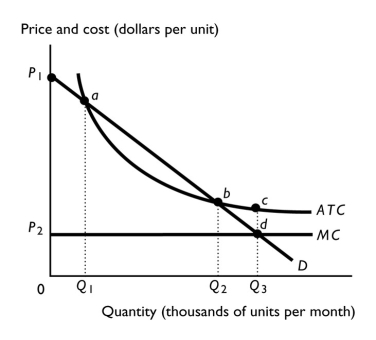 -The above figure represents the cost and demand curves for a natural monopoly that is regulated using a marginal cost pricing rule.
a. What is the quantity?
b. What price is charged?
c. What area represents the consumer surplus when the firm is regulated using a marginal cost pricing rule?
d. What distance represents the firm's loss per unit when the firm is regulated using a marginal cost pricing rule?
-The above figure represents the cost and demand curves for a natural monopoly that is regulated using a marginal cost pricing rule.
a. What is the quantity?
b. What price is charged?
c. What area represents the consumer surplus when the firm is regulated using a marginal cost pricing rule?
d. What distance represents the firm's loss per unit when the firm is regulated using a marginal cost pricing rule? (Essay)
4.8/5 (77)
(77) When marginal revenue is positive, total revenue ________ when output increases and demand is ________.
(Multiple Choice)
4.8/5 (90)
(90)  -Suppose the grocery store market in Kansas City is perfectly competitive. Then one store buys all the others and becomes a single-price monopoly. The figure above shows the relevant demand and cost curves. When the market is a monopoly, the quantity of steak is
 (Multiple Choice)
4.9/5 (83)
(83) 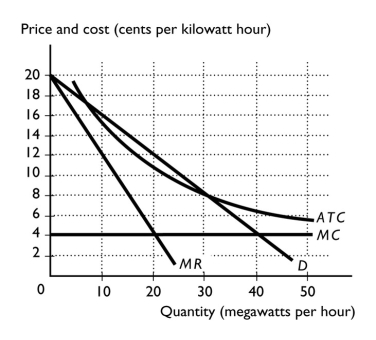 -The above figure illustrates the market for electric power that is served by the one utility in Alberta, Canada.
a. If the government did not regulate this utility, what would be the price of a kilowatt hour in this region and how much power would be generated?
b. If the government regulates the utility and chooses an average cost pricing rule, what would be the price of a kilowatt hour and how much power would be generated?
c. If the government regulates the utility and chooses a marginal cost pricing rule, what would be the price of a kilowatt hour and how much power would be generated?
-The above figure illustrates the market for electric power that is served by the one utility in Alberta, Canada.
a. If the government did not regulate this utility, what would be the price of a kilowatt hour in this region and how much power would be generated?
b. If the government regulates the utility and chooses an average cost pricing rule, what would be the price of a kilowatt hour and how much power would be generated?
c. If the government regulates the utility and chooses a marginal cost pricing rule, what would be the price of a kilowatt hour and how much power would be generated? (Essay)
4.8/5 (80)
(80) 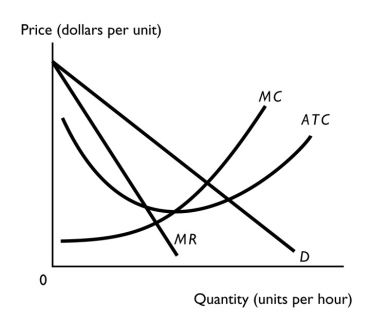 -The above figure represents the cost, market demand, and marginal revenue curves for a monopoly.
a. Indicate the price and quantity a single-price monopoly selects by labeling the price Pm and the quantity Qm.
b. In the figure, lightly shade in the area that represents the single-price monopoly's economic profit.
c. Indicate the quantity a perfectly price-discriminating monopoly selects by labeling it Qppd.
d. In the figure, more darkly shade in the area that represents the additional economic profit the monopoly earns as a result of the perfect price discrimination.
-The above figure represents the cost, market demand, and marginal revenue curves for a monopoly.
a. Indicate the price and quantity a single-price monopoly selects by labeling the price Pm and the quantity Qm.
b. In the figure, lightly shade in the area that represents the single-price monopoly's economic profit.
c. Indicate the quantity a perfectly price-discriminating monopoly selects by labeling it Qppd.
d. In the figure, more darkly shade in the area that represents the additional economic profit the monopoly earns as a result of the perfect price discrimination. (Essay)
4.9/5 (78)
(78) A single-price monopoly has marginal revenue and marginal cost equal to $19 at 15 units of output where the price on the demand curve is $38. At this output, average total cost is $15. What is the total profit earned?
(Multiple Choice)
4.8/5 (79)
(79) Suppose the government breaks up a single-price monopoly and turns it into a perfectly competitive industry. What will happen to price and the quantity produced?
What will happen to the monopoly's economic profit and the deadweight loss associated with the monopoly?
(Essay)
4.8/5 (87)
(87) If a natural monopoly is regulated using the marginal cost pricing rule, how will that affect prices, outputs, profits, and the distribution of surpluses?
What are the pros and cons to this method of regulation?
(Essay)
4.8/5 (84)
(84) If a perfectly competitive industry is taken over by a single firm that operates as a single-price monopoly, the price will ________ and the quantity will ________.
(Multiple Choice)
4.8/5 (75)
(75) Gene's Car Wash is a natural monopoly. To wash 100 cars a week, if Gene is unregulated, he would charge a price of $10. Gene's average total cost for washing 100 cars is $8, his average variable cost is $6, and his marginal cost is $4. If Gene is regulated using a marginal cost pricing rule, the price he is allowed to charge to wash 100 cars is
(Multiple Choice)
5.0/5 (88)
(88) "A single-price monopoly will always charge a price that is on the elastic range of the demand for the monopoly's output." Explain why the previous statement is correct or incorrect.
(Essay)
4.9/5 (78)
(78) 
Filters
- Essay(0)
- Multiple Choice(0)
- Short Answer(0)
- True False(0)
- Matching(0)