



 Chat with AI
Exam 12: Monopoly

Exam 1: Getting Started337 Questions
Exam 2: The Us and Global Economies201 Questions
Exam 3: The Economic Problem273 Questions
Exam 4: Demand and Supply322 Questions
Exam 5: Elasticities of Demand and Supply335 Questions
Exam 6: Efficiency and Fairness of Markets352 Questions
Exam 7: Government Actions in Markets349 Questions
Exam 8: Global Markets in Action276 Questions
Exam 9: Externalities: Pollution, Education, and Health Care290 Questions
Exam 10: Production and Cost266 Questions
Exam 11: Perfect Competition275 Questions
Exam 12: Monopoly377 Questions
Exam 13: Monopolistic Competition and Oligopoly316 Questions
Exam 14: Gdp: a Measure of Total Production and Income253 Questions
Exam 15: Jobs and Unemployment283 Questions
Exam 16: The Cpi and the Cost of Living263 Questions
Exam 17: Potential Gdp and Economic Growth328 Questions
Exam 18: Money and the Monetary System360 Questions
Exam 19: Aggregate Supply and Aggregate Demand301 Questions
Exam 20: Fiscal Policy and Monetary Policy223 Questions
Select questions type


When compared to a perfectly competitive market, a single-price monopoly with the same costs produces ________ output and charges ________ price.
(Multiple Choice)
4.8/5  (77)
(77) Under earnings-sharing regulation, if a firm's profits ________ above a certain level, they must be shared with the firm's ________.
(Multiple Choice)
4.8/5 (90)
(90) Assume someone organizes all farms in the nation into a monopoly. Which of the following occurs?
I. Consumer surplus decreases.
Ii. Economic profit increases.
Iii. A deadweight loss is created.
(Multiple Choice)
4.7/5 (87)
(87) Which of the following is NOT correct about a single-price monopoly?
(Multiple Choice)
4.9/5 (77)
(77) If the technology for producing a good enables one firm to meet the entire market demand at a lower average total cost than two or more firms could, then that firm has
(Multiple Choice)
4.9/5 (70)
(70) Suppose that along a linear demand curve, the elasticity of demand is equal to 1 when the price is $4 and the quantity is 100 units. Then the
(Multiple Choice)
4.9/5 (82)
(82) 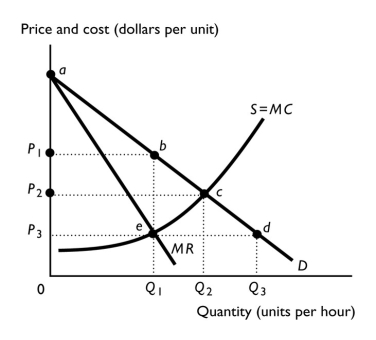 -In the above figure, a perfectly competitive market will have a price of ________ and a single-price monopoly will have a price of ________.
 (Multiple Choice)
4.9/5 (97)
(97) The table below gives a monopoly's demand schedule. Complete the table by calculating the total revenue and the marginal revenue.
Quantity (units) Price (dollars) Total revenue (dollars) Marginal revenue (dollars) 15 0 - - 13 1 - - 11 2 - - 9 3 - - 7 4 - - 5 5 - - 3 6 - - 1 7 - - 0 8 - -
(Essay)
4.8/5 (78)
(78)  -Suppose the grocery store market in Kansas City is perfectly competitive. Then one store buys all the others and becomes a single-price monopoly. The figure above shows the relevant demand and cost curves. When the market is perfectly competitive, the quantity of steak is ________ pounds and when the market is a monopoly the quantity of steak is ________ pounds.
 (Multiple Choice)
4.8/5 (74)
(74) A "buy one, get one for half price" promotion is an example of
(Multiple Choice)
4.9/5 (70)
(70) The total revenue test using the price elasticity of demand
(Multiple Choice)
4.7/5 (83)
(83) A monopoly can set any price it wants. So why does it still produce at a point where MR = MC, just like a perfectly competitive firm?
(Essay)
4.9/5 (83)
(83) Define price discrimination. What factors must be present in order for a firm to price discriminate?
Why do firms price discriminate?
(Essay)
4.9/5 (89)
(89) The demand schedule for a single-price monopoly is given in the table below. Calculate the marginal revenue.
Quantity (units) Price (dollars) Marginal revenue (dollars) 0 24 1 22 - 2 20 - 3 18 - 4 16 - 5 14 - 6 12 - 7 10 - 8 8 -
(Essay)
4.9/5 (79)
(79) When economies of scale exist so that one firm can meet the entire market demand at a lower average total cost than two or more firms,
(Multiple Choice)
4.8/5 (93)
(93) 
Filters
- Essay(0)
- Multiple Choice(0)
- Short Answer(0)
- True False(0)
- Matching(0)