



 Chat with AI
Exam 12: Metabolism and Bioenergetics

Exam 1: The Chemical Basis of Life16 Questions
Exam 2: Aqueous Chemistry31 Questions
Exam 3: Nucleic Acid Structure and Function17 Questions
Exam 4: Protein Structure26 Questions
Exam 5: Protein Function26 Questions
Exam 6: How Enzymes Work29 Questions
Exam 7: Enzyme Kinetics and Inhibition21 Questions
Exam 8: Lipids and Membranes19 Questions
Exam 9: Membrane Transport27 Questions
Exam 10: Signaling16 Questions
Exam 11: Carbohydrates22 Questions
Exam 12: Metabolism and Bioenergetics40 Questions
Exam 13: Glucose Metabolism31 Questions
Exam 14: The Citric Acid Cycle17 Questions
Exam 15: Oxidative Phosphorylation20 Questions
Exam 16: Photosynthesis18 Questions
Exam 17: Lipid Metabolism13 Questions
Exam 18: Nitrogen Metabolism21 Questions
Exam 19: Regulation of Mammalian Fuel Metabolism21 Questions
Exam 20: DNA Replication and Repair16 Questions
Exam 21: Transcription and RNA21 Questions
Exam 22: Protein Synthesis20 Questions
Select questions type


Which of the following is a lipid-soluble electron carrier in its reduced state?
(Multiple Choice)
4.9/5  (68)
(68) Which of the following factors contributes to the highly exergonic nature of ATP hydrolysis?
(Multiple Choice)
4.8/5 (72)
(72) For the following reaction, calculate the G at 37°C, given concentrations for glucose-1-phosphate of 25 mM and glucose-6-phosphate of 1 mM.
Glucose-1-phosphate  glucose-6-phosphate G°
 = -7.1 kJ/mol
glucose-6-phosphate G° = -7.1 kJ/mol (Multiple Choice)
4.8/5 (79)
(79) Metabolomics is the study of the metabolic activity of a cell or tissue by identifying and quantifying all of its metabolites.
(True/False)
4.7/5 (82)
(82) For the following reaction, calculate the Keq at 25°C.
Succinyl-CoA + acetoacetate  acetoacetyl-CoA + succinate G° = -1.25 kJ/mol
 (Multiple Choice)
4.9/5 (89)
(89) Which of the following is mobilized for energy use by a phosphorolysis reaction, not a hydrolysis?
(Multiple Choice)
4.9/5 (81)
(81) Which of the following molecules is in the most reduced state?
(Multiple Choice)
5.0/5 (86)
(86) For the following reaction, calculate the G° at 37°C.
Glucose-6-phosphate  fructose-6-phosphate Keq = 0.517
 (Multiple Choice)
4.9/5 (75)
(75) Eukaryotes evolved and developed extensive intracellular membraines enclosed in compartments called _______.
(Multiple Choice)
5.0/5 (92)
(92) If the following reactions were coupled, what would be the overall G°  Glucose + Pi
 glucose-6-phosphate G° 11ee7c69_05ae_405c_ae82_f7bc848d8fc6_TBW1044_11 = 13.8 kJ/mol
ATP + H2O
 ADP + Pi G° 11ee7c69_05ae_405c_ae82_f7bc848d8fc6_TBW1044_11 = -30.5 kJ/mol
Glucose + Pi glucose-6-phosphate G° 11ee7c69_05ae_405c_ae82_f7bc848d8fc6_TBW1044_11 = 13.8 kJ/mol
ATP + H2O ADP + Pi G° 11ee7c69_05ae_405c_ae82_f7bc848d8fc6_TBW1044_11 = -30.5 kJ/mol (Multiple Choice)
4.8/5 (71)
(71) Which of the following is correct regarding metabolic pathways?
(Multiple Choice)
4.9/5 (78)
(78) Which of the following describes the bonding of the three phosphates to adenosine in ATP? How many phosphoanhydride bonds are found in ATP?
(Multiple Choice)
4.8/5 (70)
(70) Acetylcholinesterase catalyzes the reaction in which acetylcholine is hydrolyzed into acetate and choline. This is a reversible reaction. A student incubates a 1 M solution of acetylcholine for two hours with 100uL of acetylcholinesterase. At equilibrium the concentration of acetylcholine is 3.0 × 10 mM and the concentration of acetate and choline are 5.2 × 10⁻³ M and 7.4 x 10⁻² M, respectively.
Calculate the equilibrium constant (Keq) and the standard state free energy ( G°') for this reaction at 17°C.
(Essay)
4.8/5 (81)
(81) The G° for the hydrolysis of acetyl CoA is most similar to the G° 11ee7c69_05ae_405c_ae82_f7bc848d8fc6_TBW1044_11 for the hydrolysis of _____.
for the hydrolysis of acetyl CoA is most similar to the G° 11ee7c69_05ae_405c_ae82_f7bc848d8fc6_TBW1044_11 for the hydrolysis of _____. (Multiple Choice)
4.8/5 (82)
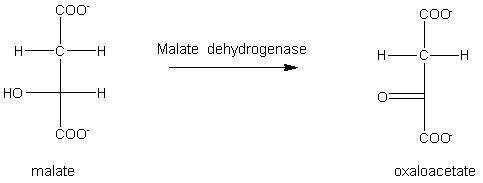
(82) 
Degradation of proteins within a cell can occur within the _____ or by use of _____.
(Multiple Choice)
4.9/5 (71)
(71) Which of the following has the most spontaneous hydrolysis?
(Multiple Choice)
4.9/5 (76)
(76) Which of the following molecules is involved with the oxidation of glucose, synthesis of fatty acids and oxidation of fatty acids?
(Multiple Choice)
4.9/5 (81)
(81) 
Filters
- Essay(0)
- Multiple Choice(0)
- Short Answer(0)
- True False(0)
- Matching(0)