



 Chat with AI
Exam 14: The Citric Acid Cycle

Exam 1: The Chemical Basis of Life16 Questions
Exam 2: Aqueous Chemistry31 Questions
Exam 3: Nucleic Acid Structure and Function17 Questions
Exam 4: Protein Structure26 Questions
Exam 5: Protein Function26 Questions
Exam 6: How Enzymes Work29 Questions
Exam 7: Enzyme Kinetics and Inhibition21 Questions
Exam 8: Lipids and Membranes19 Questions
Exam 9: Membrane Transport27 Questions
Exam 10: Signaling16 Questions
Exam 11: Carbohydrates22 Questions
Exam 12: Metabolism and Bioenergetics40 Questions
Exam 13: Glucose Metabolism31 Questions
Exam 14: The Citric Acid Cycle17 Questions
Exam 15: Oxidative Phosphorylation20 Questions
Exam 16: Photosynthesis18 Questions
Exam 17: Lipid Metabolism13 Questions
Exam 18: Nitrogen Metabolism21 Questions
Exam 19: Regulation of Mammalian Fuel Metabolism21 Questions
Exam 20: DNA Replication and Repair16 Questions
Exam 21: Transcription and RNA21 Questions
Exam 22: Protein Synthesis20 Questions
Select questions type


During the oxidation of isocitrate, the intermediate that is decarboxylated to form -ketoglutarate is _____.

Free
(Multiple Choice)
4.9/5  (86)
(86) Correct Answer: Verified
A
Which of the following explains the proper binding of the two substrates for citrate synthase?
Free
(Multiple Choice)
4.7/5 (74)
(74) Correct Answer:Verified
VerifiedC
What citric acid cycle intermediate is effectively used as a mechanism for the transport of acetyl-CoA from the mitochondria to the cytosol?
Free
(Multiple Choice)
4.7/5 (79)
(79) Correct Answer:Verified
VerifiedA
Which of the following is observed in the mechanism of citrate synthase?
(Multiple Choice)
4.9/5 (86)
(86) Which of the following terms indicates that the citric acid cycle is both catabolic and anabolic in nature?
(Multiple Choice)
4.8/5 (89)
(89) Why can germinating plant seeds convert acetyl-CoA from fatty acids into carbohydrates, while animals are incapable of converting fatty acids into glucose?
(Multiple Choice)
4.7/5 (85)
(85) Which of the following can be converted into glucose using parts of the citric acid cycle?
(Multiple Choice)
4.9/5 (77)
(77) If acetyl-CoA labeled on the methyl carbon were used as the substrate for the citric acid cycle, where would the labeled carbon appear in oxaloacetate produced from one round of the cycle?
(Multiple Choice)
4.8/5 (88)
(88) Which of the following enzymes allows for a net increase of citric acid cycle metabolites without expending any energy in the form of ATP or its equivalents?
(Multiple Choice)
4.8/5 (76)
(76) Which of the following describes the isomerization of citrate to isocitrate?
(Multiple Choice)
4.8/5 (97)
(97) Which of the following is an enzyme-associated intermediate that is similar in energy to 1,3-bisphosphoglycerate?
(Multiple Choice)
4.8/5 (79)
(79) If all reduced electron carriers are reoxidized to run oxidative phosphorylation, how many ATP can be generated from the oxidation of one acetyl-CoA?
(Multiple Choice)
4.9/5 (92)
(92) When acetyl-CoA and NADPH are needed for lipid synthesis, which of the following reactions is used to produce NADPH in the cytosol?
(Multiple Choice)
4.9/5 (69)
(69) If acetyl-CoA labeled with 14C, as shown in the figure, were used as the substrate for the citric acid cycle, which of the following intermediates would be produced during the first round of the cycle? 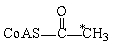
(Multiple Choice)
4.9/5 (85)
(85) What makes the reaction catalyzed by citrate synthase highly exergonic?
(Multiple Choice)
4.9/5 (78)
(78) The mechanism of malate synthase that catalyzes the conversion of glyoxylate and acetyl-CoA to malate would be most similar to which citric acid cycle enzyme?
(Multiple Choice)
4.8/5 (66)
(66) 
Filters
- Essay(0)
- Multiple Choice(0)
- Short Answer(0)
- True False(0)
- Matching(0)