



 Chat with AI
Exam 6: Lower Limb

Exam 1: Preliminary Steps in Radiography33 Questions
Exam 2: Compensating Filters14 Questions
Exam 3: General Anatomy and Radiographic Positioning Terminology101 Questions
Exam 4: Upper Limb125 Questions
Exam 5: Shoulder Girdle92 Questions
Exam 6: Lower Limb143 Questions
Exam 7: Pelvis and Upper Femora53 Questions
Exam 8: Vertebral Column175 Questions
Exam 9: Bony Thorax58 Questions
Exam 10: Thoracic Viscera74 Questions
Exam 11: Long Bone Measurement10 Questions
Exam 12: Contrast Arthrography5 Questions
Exam 13: Trauma Radiography10 Questions
Exam 14: Mouth and Salivary Glands10 Questions
Exam 15: Anterior Part of Neck9 Questions
Exam 16: Abdomen30 Questions
Exam 17: Digestive System: Alimentary Canal130 Questions
Exam 18: Urinary System and Venipuncture96 Questions
Exam 19: Reproductive System11 Questions
Exam 20: Skull, Facial Bones, and Paranasal Sinuses196 Questions
Exam 21: Mammography35 Questions
Exam 22: Central Nervous System15 Questions
Exam 23: Vascular, Cardiac, and Interventional Radiography40 Questions
Exam 24: Pediatric Imaging20 Questions
Exam 25: Geriatric Radiography18 Questions
Exam 26: Mobile Radiography20 Questions
Exam 27: Surgical Radiography10 Questions
Exam 28: Sectional Anatomy for Radiographers30 Questions
Exam 29: Computed Tomography16 Questions
Exam 30: Magnetic Resonance Imaging21 Questions
Exam 31: Diagnostic Ultrasound14 Questions
Exam 32: Nuclear Medicine18 Questions
Exam 33: Bone Densitometry18 Questions
Exam 34: Radiation Oncology20 Questions
Select questions type


The central-ray angle for a lateral projection of the ankle is:
(Multiple Choice)
4.9/5  (68)
(68) To better demonstrate the TMT joint spaces of the foot, a posterior angulation of how many degrees is required?
(Multiple Choice)
4.9/5 (77)
(77) The superior portion of the calcaneus contains a groove called the calcaneal sulcus. The inferior portion of the talus contains a matching groove called the sulcus tali. Collectively, these two sulci form the:
(Multiple Choice)
4.8/5 (69)
(69) Which projections of the foot will best demonstrate the structural status of the longitudinal arch?
(Multiple Choice)
4.8/5 (82)
(82) How many degrees are the lower leg and foot rotated for the AP oblique projection of the toes in medial rotation?
(Multiple Choice)
4.8/5 (67)
(67) Where should the central ray be directed for a PA projection of the patella?
(Multiple Choice)
4.9/5 (92)
(92) On the anterior surface of the tibia is a prominent process called the:
(Multiple Choice)
4.8/5 (88)
(88) Often, the leg is too long to fit on one IR for radiographs. Which joint or joints should be included on the IR when the site of a lesion is known?
(Multiple Choice)
4.8/5 (65)
(65) The central-ray angulation for a lateral projection of the calcaneus is:
(Multiple Choice)
4.9/5 (72)
(72) The two flat, superior surfaces of the tibia are called the:
(Multiple Choice)
4.9/5 (79)
(79) What anatomy is labeled with the letter C in the image below?
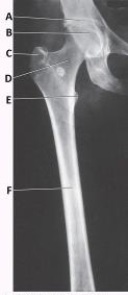
(Multiple Choice)
4.8/5 (79)
(79) Which projections of the ankle are performed on a patient following an inversion or eversion injury?
(Multiple Choice)
4.8/5 (77)
(77) What is the central-ray angle for an AP projection of the femur?
(Multiple Choice)
4.9/5 (89)
(89) The central-ray angulation for an AP oblique projection of the toes is:
(Multiple Choice)
4.8/5 (90)
(90) What is the position of the femoral condyles when the leg is properly positioned for an AP projection?
(Multiple Choice)
4.8/5 (82)
(82) Where is the central ray directed for an AP projection of the knee?
(Multiple Choice)
5.0/5 (93)
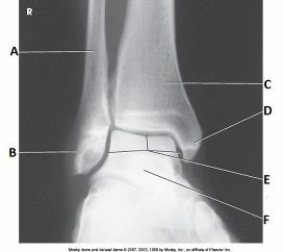
(93) 

Filters
- Essay(0)
- Multiple Choice(0)
- Short Answer(0)
- True False(0)
- Matching(0)