



 Chat with AI
Exam 5: Shoulder Girdle

Exam 1: Preliminary Steps in Radiography33 Questions
Exam 2: Compensating Filters14 Questions
Exam 3: General Anatomy and Radiographic Positioning Terminology101 Questions
Exam 4: Upper Limb125 Questions
Exam 5: Shoulder Girdle92 Questions
Exam 6: Lower Limb143 Questions
Exam 7: Pelvis and Upper Femora53 Questions
Exam 8: Vertebral Column175 Questions
Exam 9: Bony Thorax58 Questions
Exam 10: Thoracic Viscera74 Questions
Exam 11: Long Bone Measurement10 Questions
Exam 12: Contrast Arthrography5 Questions
Exam 13: Trauma Radiography10 Questions
Exam 14: Mouth and Salivary Glands10 Questions
Exam 15: Anterior Part of Neck9 Questions
Exam 16: Abdomen30 Questions
Exam 17: Digestive System: Alimentary Canal130 Questions
Exam 18: Urinary System and Venipuncture96 Questions
Exam 19: Reproductive System11 Questions
Exam 20: Skull, Facial Bones, and Paranasal Sinuses196 Questions
Exam 21: Mammography35 Questions
Exam 22: Central Nervous System15 Questions
Exam 23: Vascular, Cardiac, and Interventional Radiography40 Questions
Exam 24: Pediatric Imaging20 Questions
Exam 25: Geriatric Radiography18 Questions
Exam 26: Mobile Radiography20 Questions
Exam 27: Surgical Radiography10 Questions
Exam 28: Sectional Anatomy for Radiographers30 Questions
Exam 29: Computed Tomography16 Questions
Exam 30: Magnetic Resonance Imaging21 Questions
Exam 31: Diagnostic Ultrasound14 Questions
Exam 32: Nuclear Medicine18 Questions
Exam 33: Bone Densitometry18 Questions
Exam 34: Radiation Oncology20 Questions
Select questions type


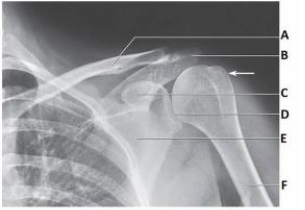
The glenoid of the scapula in the image below is labeled as letter:

Free
(Multiple Choice)
4.7/5  (70)
(70) Correct Answer: Verified
C
A lateral projection of the shoulder and proximal humerus can be obtained with which of the following?
Free
(Multiple Choice)
4.8/5 (81)
(81) Correct Answer:Verified
VerifiedD
How is the central ray directed for an inferosuperior axial projection of the shoulder joint?
Free
(Multiple Choice)
4.9/5 (62)
(62) Correct Answer:Verified
VerifiedB
What is the central-ray angulation for the AP oblique projection (Grashey method) of the shoulder joint?
(Multiple Choice)
4.8/5 (65)
(65) For an AP projection of the scapula, the IR size and its position should be:
(Multiple Choice)
4.8/5 (74)
(74) For delineation of the acromion and coracoid processes of the scapula in the lateral projection, how is the arm positioned?
(Multiple Choice)
4.7/5 (77)
(77) Which of the following projections clearly demonstrates the glenoid cavity?
(Multiple Choice)
4.9/5 (89)
(89) How should the central ray be angled for the AP projection (Pearson method) of the AC joints?
(Multiple Choice)
4.9/5 (74)
(74) If the patient places the back of the hand against the hip, the humerus will be in:
(Multiple Choice)
4.9/5 (83)
(83) If the patient cannot elevate the unaffected shoulder for a transthoracic lateral projection of the shoulder, the central ray should be angled _____ degrees.
(Multiple Choice)
4.8/5 (76)
(76) For delineation of the body of the scapula for the lateral projection, how is the arm positioned?
(Multiple Choice)
4.8/5 (71)
(71) To obtain a more uniform image density, the respiration phase for the AP projection of the clavicle should be:
(Multiple Choice)
4.9/5 (92)
(92) Which of the following projections are improved significantly with the use of a compensating filter?
1)AP shoulder
2)Lateral scapula
3)PA oblique (scapular Y)
(Multiple Choice)
4.9/5 (67)
(67) Which of the following methods best demonstrates the supraspinatus outlet (coracoacromial arch)?
(Multiple Choice)
4.9/5 (75)
(75) The scapulohumeral articulation is classified as a _____ joint, _____ type.
(Multiple Choice)
4.9/5 (88)
(88) The use of compensating filters is particularly useful when using:
(Multiple Choice)
4.7/5 (85)
(85) Which of the following will be directly superimposed over the junction of the Y on the PA oblique (scapular Y) projection?
(Multiple Choice)
5.0/5 (88)
(88) 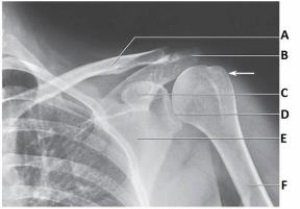
The greater tubercle will be partially superimposed over the humeral head on which of the following projections and positions?
(Multiple Choice)
4.7/5 (80)
(80) 
Filters
- Essay(0)
- Multiple Choice(0)
- Short Answer(0)
- True False(0)
- Matching(0)