



 Chat with AI
Exam 20: Skull, Facial Bones, and Paranasal Sinuses

Exam 1: Preliminary Steps in Radiography33 Questions
Exam 2: Compensating Filters14 Questions
Exam 3: General Anatomy and Radiographic Positioning Terminology101 Questions
Exam 4: Upper Limb125 Questions
Exam 5: Shoulder Girdle92 Questions
Exam 6: Lower Limb143 Questions
Exam 7: Pelvis and Upper Femora53 Questions
Exam 8: Vertebral Column175 Questions
Exam 9: Bony Thorax58 Questions
Exam 10: Thoracic Viscera74 Questions
Exam 11: Long Bone Measurement10 Questions
Exam 12: Contrast Arthrography5 Questions
Exam 13: Trauma Radiography10 Questions
Exam 14: Mouth and Salivary Glands10 Questions
Exam 15: Anterior Part of Neck9 Questions
Exam 16: Abdomen30 Questions
Exam 17: Digestive System: Alimentary Canal130 Questions
Exam 18: Urinary System and Venipuncture96 Questions
Exam 19: Reproductive System11 Questions
Exam 20: Skull, Facial Bones, and Paranasal Sinuses196 Questions
Exam 21: Mammography35 Questions
Exam 22: Central Nervous System15 Questions
Exam 23: Vascular, Cardiac, and Interventional Radiography40 Questions
Exam 24: Pediatric Imaging20 Questions
Exam 25: Geriatric Radiography18 Questions
Exam 26: Mobile Radiography20 Questions
Exam 27: Surgical Radiography10 Questions
Exam 28: Sectional Anatomy for Radiographers30 Questions
Exam 29: Computed Tomography16 Questions
Exam 30: Magnetic Resonance Imaging21 Questions
Exam 31: Diagnostic Ultrasound14 Questions
Exam 32: Nuclear Medicine18 Questions
Exam 33: Bone Densitometry18 Questions
Exam 34: Radiation Oncology20 Questions
Select questions type


The topographic line identified in the figure below is the _____ line.


Free
(Multiple Choice)
4.9/5  (82)
(82) Correct Answer: Verified
D
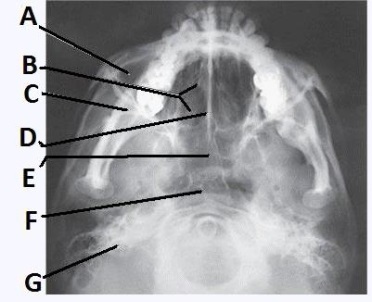
The letter E in the image below of the paranasal sinuses labels the _____ sinuses.
Free
(Multiple Choice)
4.8/5 (88)
(88) Correct Answer:Verified
VerifiedB
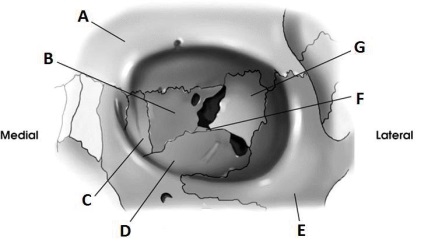
Letter F in the diagram below of the orbit labels the:
Free
(Multiple Choice)
4.9/5 (75)
(75) Correct Answer:Verified
VerifiedD
Radiographic demonstration of the cranial base is performed by which method?
(Multiple Choice)
4.8/5 (90)
(90) 
Which of the following projections will clearly demonstrate any medial or lateral displacement of fractures of the mandibular rami?
1)PA
2)PA axial
3)Axiolateral oblique
(Multiple Choice)
4.9/5 (83)
(83) For the submentovertical projection of the zygomatic arches, the central ray is directed perpendicular to the _____ line.
(Multiple Choice)
4.8/5 (89)
(89) The respiration phase for all projections of the facial bones and sinuses is:
(Multiple Choice)
5.0/5 (72)
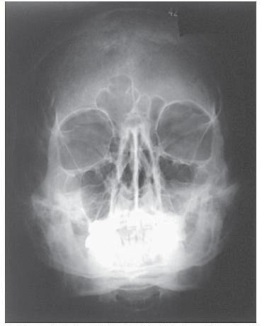
(72) What projection (method) of the facial bones is demonstrated in the image below?
(Multiple Choice)
4.9/5 (71)
(71) In a typically shaped head, the petrous pyramids project anteriorly and medially at what angle?
(Multiple Choice)
5.0/5 (74)
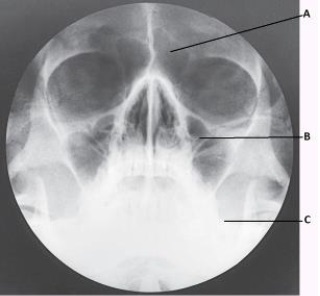
(74) The letter B in the image below of the paranasal sinuses labels the _____ sinuses.
(Multiple Choice)
4.9/5 (84)
(84) The letter D in the image below of the paranasal sinuses labels the _____ sinuses.
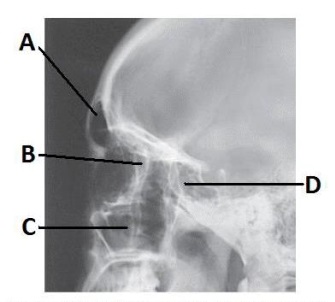
(Multiple Choice)
4.9/5 (72)
(72) Which of the following are demonstrated on an AP axial (Towne method) projection of the skull?
1)Petrous pyramids
2)Occipital bone
3)Posterior portion of the foramen magnum
(Multiple Choice)
4.9/5 (80)
(80) Which sinus is located immediately below the sella turcica?
(Multiple Choice)
4.8/5 (76)
(76) For the tangential projection of the zygomatic arch, the head is positioned so that the midsagittal plane is _____ degrees _____ the side being examined.
(Multiple Choice)
4.7/5 (75)
(75) The letter D in the image below of the paranasal sinuses labels the:
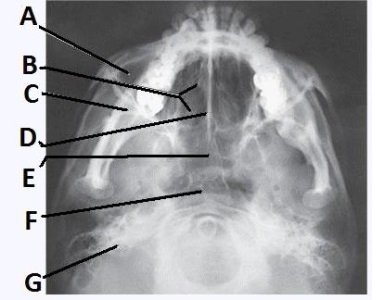
(Multiple Choice)
4.8/5 (72)
(72) If the infraorbitomeatal line is placed perpendicular to the image receptor during an AP axial (Towne) projection of the skull, how much is the central ray angled?
(Multiple Choice)
4.7/5 (84)
(84) Which of the following lines is placed parallel with the transverse axis of the IR for the axiolateral oblique projection of the TMJ?
(Multiple Choice)
4.8/5 (85)
(85) 
Filters
- Essay(0)
- Multiple Choice(0)
- Short Answer(0)
- True False(0)
- Matching(0)