



 Chat with AI
Exam 20: Skull, Facial Bones, and Paranasal Sinuses

Exam 1: Preliminary Steps in Radiography33 Questions
Exam 2: Compensating Filters14 Questions
Exam 3: General Anatomy and Radiographic Positioning Terminology101 Questions
Exam 4: Upper Limb125 Questions
Exam 5: Shoulder Girdle92 Questions
Exam 6: Lower Limb143 Questions
Exam 7: Pelvis and Upper Femora53 Questions
Exam 8: Vertebral Column175 Questions
Exam 9: Bony Thorax58 Questions
Exam 10: Thoracic Viscera74 Questions
Exam 11: Long Bone Measurement10 Questions
Exam 12: Contrast Arthrography5 Questions
Exam 13: Trauma Radiography10 Questions
Exam 14: Mouth and Salivary Glands10 Questions
Exam 15: Anterior Part of Neck9 Questions
Exam 16: Abdomen30 Questions
Exam 17: Digestive System: Alimentary Canal130 Questions
Exam 18: Urinary System and Venipuncture96 Questions
Exam 19: Reproductive System11 Questions
Exam 20: Skull, Facial Bones, and Paranasal Sinuses196 Questions
Exam 21: Mammography35 Questions
Exam 22: Central Nervous System15 Questions
Exam 23: Vascular, Cardiac, and Interventional Radiography40 Questions
Exam 24: Pediatric Imaging20 Questions
Exam 25: Geriatric Radiography18 Questions
Exam 26: Mobile Radiography20 Questions
Exam 27: Surgical Radiography10 Questions
Exam 28: Sectional Anatomy for Radiographers30 Questions
Exam 29: Computed Tomography16 Questions
Exam 30: Magnetic Resonance Imaging21 Questions
Exam 31: Diagnostic Ultrasound14 Questions
Exam 32: Nuclear Medicine18 Questions
Exam 33: Bone Densitometry18 Questions
Exam 34: Radiation Oncology20 Questions
Select questions type


At which level will the central ray be placed for the SMV projection of the zygomatic arches?
(Multiple Choice)
4.8/5  (75)
(75) Which projections will demonstrate the ethmoidal sinuses?
1)Lateral
2)PA axial (Caldwell)
3)SMV
(Multiple Choice)
4.8/5 (87)
(87) For a lateral projection of the facial bones, the central ray will enter:
(Multiple Choice)
4.9/5 (70)
(70) Which line is placed perpendicular to the plane of the image receptor for the AP axial projection of the zygomatic arches?
(Multiple Choice)
4.7/5 (81)
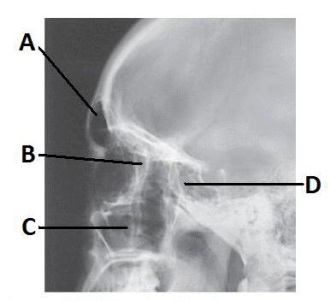
(81) The letter A in the image below of the paranasal sinuses labels the:
(Multiple Choice)
4.8/5 (87)
(87) Which plane of the head is placed parallel to the plane of the image receptor for a lateral projection of the skull?
(Multiple Choice)
4.9/5 (80)
(80) Which of the following is placed perpendicular to the front edge of the IR for a lateral projection of the facial bones?
(Multiple Choice)
4.8/5 (89)
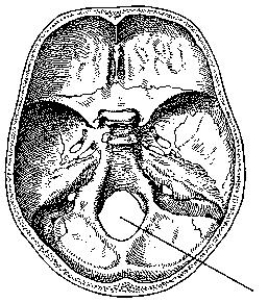
(89) The part of the cranial base identified in the figure below is the:
(Multiple Choice)
4.8/5 (72)
(72) The vestibulocochlear organ is the organ of:
1)hearing.
2)sensation.
3)balance.
(Multiple Choice)
4.8/5 (77)
(77) 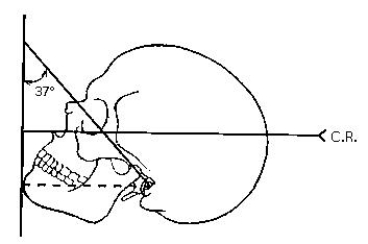
Which method of examining the skull will demonstrate the petrous ridges in the orbits, the ethmoid and frontal sinuses, and the crista galli?
(Multiple Choice)
4.8/5 (75)
(75) The thickest and densest portion of bone in the cranium is the _____ bone.
(Multiple Choice)
4.9/5 (87)
(87) Where are the petrous ridges seen on an image of a parietoacanthial (Waters method) projection of the paranasal sinuses?
(Multiple Choice)
4.8/5 (77)
(77) To successfully demonstrate the ethmoidal and sphenoidal sinuses on the SMV projection, which of the following must occur?
1)The patient must be recumbent.
2)The infraorbitomeatal line must be parallel with the IR.
3)The central ray must be perpendicular to the infraorbitomeatal line and horizontal.
(Multiple Choice)
4.8/5 (86)
(86) The central-ray angle for the PA axial (Caldwell) projection of the skull is:
(Multiple Choice)
4.7/5 (77)
(77) Which reference line is perpendicular to the IR for the PA and PA axial mandibular rami?
(Multiple Choice)
4.9/5 (94)
(94) For a lateral projection of the paranasal sinuses the central ray is directed:
(Multiple Choice)
4.7/5 (84)
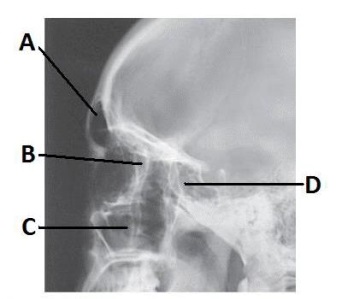
(84) The letter C in the image below of the paranasal sinuses labels the:
(Multiple Choice)
4.8/5 (85)
(85) 
Filters
- Essay(0)
- Multiple Choice(0)
- Short Answer(0)
- True False(0)
- Matching(0)