



 Chat with AI
Exam 6: Lower Limb

Exam 1: Preliminary Steps in Radiography33 Questions
Exam 2: Compensating Filters14 Questions
Exam 3: General Anatomy and Radiographic Positioning Terminology101 Questions
Exam 4: Upper Limb125 Questions
Exam 5: Shoulder Girdle92 Questions
Exam 6: Lower Limb143 Questions
Exam 7: Pelvis and Upper Femora53 Questions
Exam 8: Vertebral Column175 Questions
Exam 9: Bony Thorax58 Questions
Exam 10: Thoracic Viscera74 Questions
Exam 11: Long Bone Measurement10 Questions
Exam 12: Contrast Arthrography5 Questions
Exam 13: Trauma Radiography10 Questions
Exam 14: Mouth and Salivary Glands10 Questions
Exam 15: Anterior Part of Neck9 Questions
Exam 16: Abdomen30 Questions
Exam 17: Digestive System: Alimentary Canal130 Questions
Exam 18: Urinary System and Venipuncture96 Questions
Exam 19: Reproductive System11 Questions
Exam 20: Skull, Facial Bones, and Paranasal Sinuses196 Questions
Exam 21: Mammography35 Questions
Exam 22: Central Nervous System15 Questions
Exam 23: Vascular, Cardiac, and Interventional Radiography40 Questions
Exam 24: Pediatric Imaging20 Questions
Exam 25: Geriatric Radiography18 Questions
Exam 26: Mobile Radiography20 Questions
Exam 27: Surgical Radiography10 Questions
Exam 28: Sectional Anatomy for Radiographers30 Questions
Exam 29: Computed Tomography16 Questions
Exam 30: Magnetic Resonance Imaging21 Questions
Exam 31: Diagnostic Ultrasound14 Questions
Exam 32: Nuclear Medicine18 Questions
Exam 33: Bone Densitometry18 Questions
Exam 34: Radiation Oncology20 Questions
Select questions type


Where is the IR centered for an AP projection of the knee?

Free
(Multiple Choice)
4.8/5  (91)
(91) Correct Answer: Verified
C
Which projection of the foot will show the cuboid in profile?
Free
(Multiple Choice)
4.8/5 (61)
(61) Correct Answer:Verified
VerifiedD
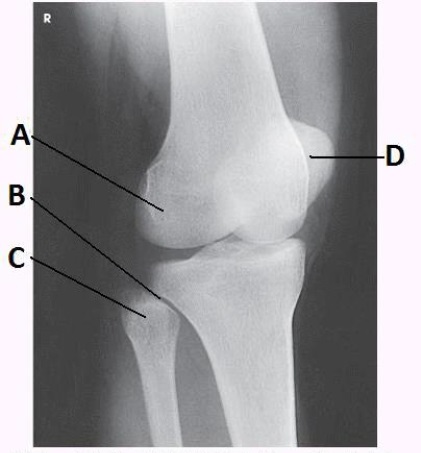
What lower limb position is required to obtain the image below?
Free
(Multiple Choice)
4.7/5 (80)
(80) Correct Answer:Verified
VerifiedB
How is the patient placed for a lateral projection of the great toe and second toe?
(Multiple Choice)
5.0/5 (79)
(79) When the femur is vertical, the medial condyle is lower than the lateral condyle. How many degrees difference is there between the two?
(Multiple Choice)
4.8/5 (70)
(70) 
How much is the knee flexed for a lateral projection of the patella?
(Multiple Choice)
4.9/5 (79)
(79) Which of the following positions can be used to demonstrate the intercondylar fossa using the Holmblad method?
1)Standing (horizontal central ray)
2)Kneeling on the table (vertical central ray)
3)Standing with knee on stool (vertical central ray)
(Multiple Choice)
4.8/5 (89)
(89) When the knee is properly positioned for an AP projection, the patella will lie:
(Multiple Choice)
4.9/5 (73)
(73) In which position is the patient placed for a PA projection of the patella?
(Multiple Choice)
4.8/5 (73)
(73) How much should the leg be flexed for a lateral projection of the knee?
(Multiple Choice)
4.8/5 (84)
(84) The preferred method of positioning the patient for the tangential projection (Settegast method) of the patella is:
(Multiple Choice)
4.9/5 (74)
(74) The central-ray angulation for a lateral projection of the knee is:
(Multiple Choice)
4.9/5 (81)
(81) To place the patella parallel with the plane of the IR for a PA projection, the heel must be rotated:
(Multiple Choice)
4.7/5 (77)
(77) Which of the following must be rotated for all oblique projections of the ankle?
1)Pelvis
2)Leg
3)Foot
(Multiple Choice)
4.8/5 (88)
(88) The medial and lateral oblique projections of the ankle require the leg and foot to be rotated how many degrees?
(Multiple Choice)
4.8/5 (80)
(80) What is the central-ray angle for an AP projection of the leg?
(Multiple Choice)
4.7/5 (83)
(83) For an AP oblique projection of the knee, the limb is rotated _____ degrees.
(Multiple Choice)
4.7/5 (71)
(71) 
Filters
- Essay(0)
- Multiple Choice(0)
- Short Answer(0)
- True False(0)
- Matching(0)