



 Chat with AI
Exam 6: Lower Limb

Exam 1: Preliminary Steps in Radiography33 Questions
Exam 2: Compensating Filters14 Questions
Exam 3: General Anatomy and Radiographic Positioning Terminology101 Questions
Exam 4: Upper Limb125 Questions
Exam 5: Shoulder Girdle92 Questions
Exam 6: Lower Limb143 Questions
Exam 7: Pelvis and Upper Femora53 Questions
Exam 8: Vertebral Column175 Questions
Exam 9: Bony Thorax58 Questions
Exam 10: Thoracic Viscera74 Questions
Exam 11: Long Bone Measurement10 Questions
Exam 12: Contrast Arthrography5 Questions
Exam 13: Trauma Radiography10 Questions
Exam 14: Mouth and Salivary Glands10 Questions
Exam 15: Anterior Part of Neck9 Questions
Exam 16: Abdomen30 Questions
Exam 17: Digestive System: Alimentary Canal130 Questions
Exam 18: Urinary System and Venipuncture96 Questions
Exam 19: Reproductive System11 Questions
Exam 20: Skull, Facial Bones, and Paranasal Sinuses196 Questions
Exam 21: Mammography35 Questions
Exam 22: Central Nervous System15 Questions
Exam 23: Vascular, Cardiac, and Interventional Radiography40 Questions
Exam 24: Pediatric Imaging20 Questions
Exam 25: Geriatric Radiography18 Questions
Exam 26: Mobile Radiography20 Questions
Exam 27: Surgical Radiography10 Questions
Exam 28: Sectional Anatomy for Radiographers30 Questions
Exam 29: Computed Tomography16 Questions
Exam 30: Magnetic Resonance Imaging21 Questions
Exam 31: Diagnostic Ultrasound14 Questions
Exam 32: Nuclear Medicine18 Questions
Exam 33: Bone Densitometry18 Questions
Exam 34: Radiation Oncology20 Questions
Select questions type


The second largest tarsal bone, and the one that occupies the highest position in the foot, is the:
(Multiple Choice)
4.9/5  (84)
(84) Which specific projections of the ankle are performed to diagnose a tear of the medial or lateral ligament?
1)AP, eversion stress
2)AP, inversion stress
3)AP oblique, 15- to 20-degree medial rotation
(Multiple Choice)
4.7/5 (86)
(86) For an AP projection of the ankle, the central ray must enter the:
(Multiple Choice)
4.8/5 (75)
(75) For an axial projection of the calcaneus, the ankle should be dorsiflexed so the plantar surface of the foot is:
(Multiple Choice)
4.9/5 (80)
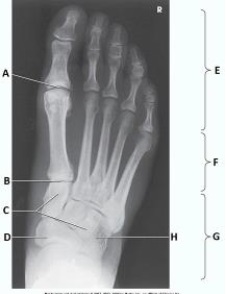
(80) The group of bones labeled as G in the image below are the:
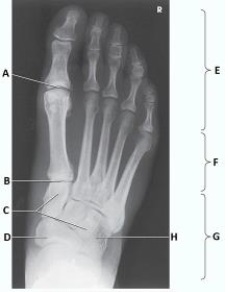
(Multiple Choice)
4.8/5 (75)
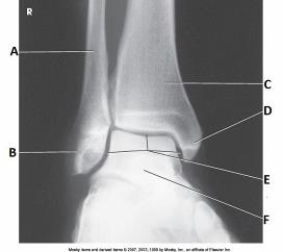
(75) 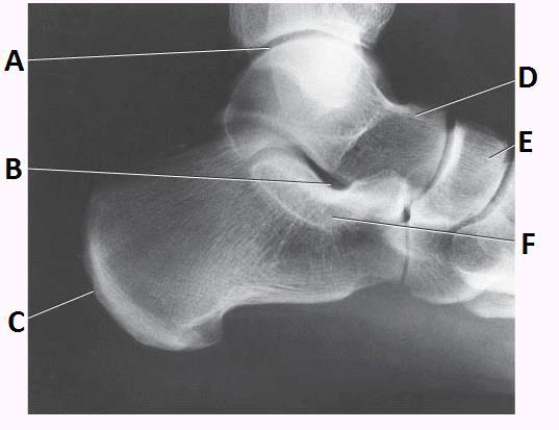
What anatomy is labeled with the letter B in the image below?
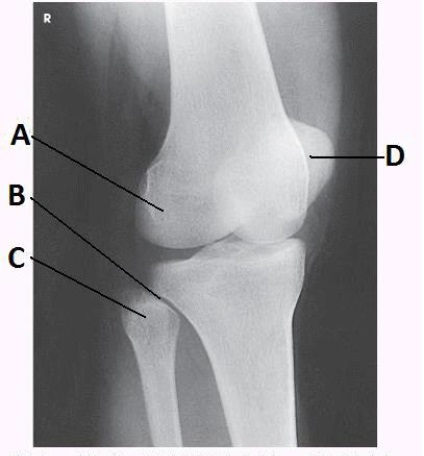
(Multiple Choice)
4.9/5 (93)
(93) An avulsion fracture of the base of the fifth metatarsal is called a ____ fracture.
(Multiple Choice)
4.9/5 (77)
(77) How is the lower limb positioned to obtain the projection in the image below?
(Multiple Choice)
4.7/5 (83)
(83) Which of the following projections of the knee best demonstrates the narrowing of a joint space?
(Multiple Choice)
4.9/5 (69)
(69) Which of the following will clearly demonstrate the cuboid?
(Multiple Choice)
4.8/5 (82)
(82) Which of the following positions can be used to perform the tangential projection (Settegast method) of the patella?
1)Seated
2)Supine
3)Prone
(Multiple Choice)
4.7/5 (95)
(95) Which anatomic part must be identified on lateral radiographs of the knee in order to identify over- or under-rotation?
(Multiple Choice)
4.9/5 (75)
(75) For an AP oblique projection of the foot in either medial or lateral rotation, the plantar surface of the foot should form an angle of _____ degrees.
(Multiple Choice)
4.7/5 (65)
(65) If a lateral projection of the femur will include the hip joint, where should the top of the IR/collimated field be placed?
(Multiple Choice)
4.8/5 (70)
(70) The central-ray angle for AP oblique projections of the knee is:
(Multiple Choice)
4.8/5 (87)
(87) What is the central-ray angle for a lateral projection of the patella?
(Multiple Choice)
4.8/5 (79)
(79) Where is the central ray directed for an AP projection of knees, weight-bearing?
(Multiple Choice)
4.8/5 (81)
(81) 
Filters
- Essay(0)
- Multiple Choice(0)
- Short Answer(0)
- True False(0)
- Matching(0)