



 Chat with AI
Exam 6: Lower Limb

Exam 1: Preliminary Steps in Radiography33 Questions
Exam 2: Compensating Filters14 Questions
Exam 3: General Anatomy and Radiographic Positioning Terminology101 Questions
Exam 4: Upper Limb125 Questions
Exam 5: Shoulder Girdle92 Questions
Exam 6: Lower Limb143 Questions
Exam 7: Pelvis and Upper Femora53 Questions
Exam 8: Vertebral Column175 Questions
Exam 9: Bony Thorax58 Questions
Exam 10: Thoracic Viscera74 Questions
Exam 11: Long Bone Measurement10 Questions
Exam 12: Contrast Arthrography5 Questions
Exam 13: Trauma Radiography10 Questions
Exam 14: Mouth and Salivary Glands10 Questions
Exam 15: Anterior Part of Neck9 Questions
Exam 16: Abdomen30 Questions
Exam 17: Digestive System: Alimentary Canal130 Questions
Exam 18: Urinary System and Venipuncture96 Questions
Exam 19: Reproductive System11 Questions
Exam 20: Skull, Facial Bones, and Paranasal Sinuses196 Questions
Exam 21: Mammography35 Questions
Exam 22: Central Nervous System15 Questions
Exam 23: Vascular, Cardiac, and Interventional Radiography40 Questions
Exam 24: Pediatric Imaging20 Questions
Exam 25: Geriatric Radiography18 Questions
Exam 26: Mobile Radiography20 Questions
Exam 27: Surgical Radiography10 Questions
Exam 28: Sectional Anatomy for Radiographers30 Questions
Exam 29: Computed Tomography16 Questions
Exam 30: Magnetic Resonance Imaging21 Questions
Exam 31: Diagnostic Ultrasound14 Questions
Exam 32: Nuclear Medicine18 Questions
Exam 33: Bone Densitometry18 Questions
Exam 34: Radiation Oncology20 Questions
Select questions type


The superior surface of the foot is termed the _____ surface.
(Multiple Choice)
4.9/5  (69)
(69) The PA axial intercondylar fossa (Camp-Coventry) projection requires the knee to be flexed _____ degrees.
1)30
2)40
3)50
(Multiple Choice)
4.7/5 (84)
(84) Which lateral projection of the foot is the most commonly performed?
(Multiple Choice)
4.8/5 (80)
(80) The essential projections of the calcaneus are:
1)axial (plantodorsal).
2)axial (dorsoplantar).
3)lateral (mediolateral).
(Multiple Choice)
4.7/5 (85)
(85) How many degrees of angulation are required to open the IP joint spaces of the toes on an AP projection?
(Multiple Choice)
4.9/5 (75)
(75) Which of the following projections would benefit from the use of a compensating filter?
1)AP toes
2)AP foot
3)Axial calcaneus
(Multiple Choice)
4.8/5 (88)
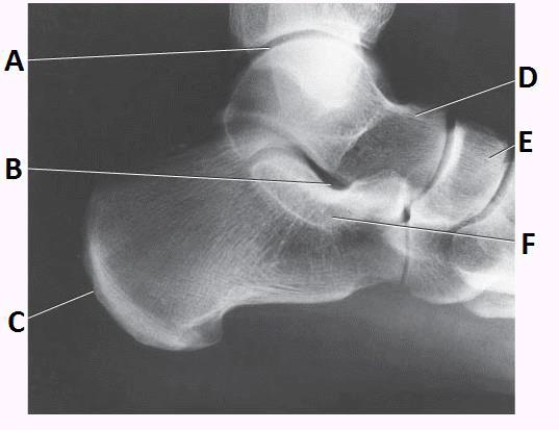
(88) 
When the ASIS-to-tabletop measurement is greater than 24 cm, the central-ray angulation for an AP knee is:
(Multiple Choice)
4.9/5 (92)
(92) What anatomy is labeled with the letter B in the image below?
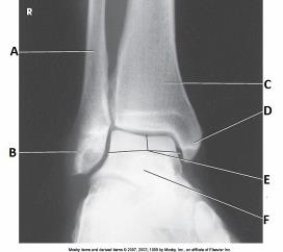
(Multiple Choice)
5.0/5 (63)
(63) Valgus and varus deformities of the knee can be evaluated with which of the following projections?
(Multiple Choice)
4.8/5 (85)
(85) Where is the central ray directed for a lateral projection of the calcaneus?
(Multiple Choice)
4.8/5 (81)
(81) How far should the IR/collimated field extend below the knee for a lateral projection of the femur?
(Multiple Choice)
4.8/5 (78)
(78) Which of the following are the essential oblique projections of the ankle?
1)AP oblique, 45-degree medial rotation
2)AP oblique, 45-degree lateral rotation
3)AP oblique, 15- to 20-degree medial rotation for the ankle mortise
(Multiple Choice)
4.8/5 (74)
(74) Which of the following is not clearly demonstrated on an AP projection of the ankle?
(Multiple Choice)
4.9/5 (88)
(88) Where will the fibula be located on a properly positioned lateral radiograph of the ankle?
(Multiple Choice)
4.9/5 (70)
(70) To demonstrate the ankle mortise, the leg and foot should be rotated medially how many degrees?
(Multiple Choice)
4.8/5 (71)
(71) For an AP projection of the toes, the central ray is directed to the _____ MTP joint.
(Multiple Choice)
4.7/5 (67)
(67) 
Filters
- Essay(0)
- Multiple Choice(0)
- Short Answer(0)
- True False(0)
- Matching(0)