



 Chat with AI
Exam 4: Upper Limb

Exam 1: Preliminary Steps in Radiography33 Questions
Exam 2: Compensating Filters14 Questions
Exam 3: General Anatomy and Radiographic Positioning Terminology101 Questions
Exam 4: Upper Limb125 Questions
Exam 5: Shoulder Girdle92 Questions
Exam 6: Lower Limb143 Questions
Exam 7: Pelvis and Upper Femora53 Questions
Exam 8: Vertebral Column175 Questions
Exam 9: Bony Thorax58 Questions
Exam 10: Thoracic Viscera74 Questions
Exam 11: Long Bone Measurement10 Questions
Exam 12: Contrast Arthrography5 Questions
Exam 13: Trauma Radiography10 Questions
Exam 14: Mouth and Salivary Glands10 Questions
Exam 15: Anterior Part of Neck9 Questions
Exam 16: Abdomen30 Questions
Exam 17: Digestive System: Alimentary Canal130 Questions
Exam 18: Urinary System and Venipuncture96 Questions
Exam 19: Reproductive System11 Questions
Exam 20: Skull, Facial Bones, and Paranasal Sinuses196 Questions
Exam 21: Mammography35 Questions
Exam 22: Central Nervous System15 Questions
Exam 23: Vascular, Cardiac, and Interventional Radiography40 Questions
Exam 24: Pediatric Imaging20 Questions
Exam 25: Geriatric Radiography18 Questions
Exam 26: Mobile Radiography20 Questions
Exam 27: Surgical Radiography10 Questions
Exam 28: Sectional Anatomy for Radiographers30 Questions
Exam 29: Computed Tomography16 Questions
Exam 30: Magnetic Resonance Imaging21 Questions
Exam 31: Diagnostic Ultrasound14 Questions
Exam 32: Nuclear Medicine18 Questions
Exam 33: Bone Densitometry18 Questions
Exam 34: Radiation Oncology20 Questions
Select questions type


Rotating the arm medially for a lateral projection of the humerus will place the epicondyles _____ with the plane of the IR.

Free
(Multiple Choice)
4.9/5  (84)
(84) Correct Answer: Verified
D
The only saddle joint in the human body is the _____ joint.
Free
(Multiple Choice)
4.9/5 (80)
(80) Correct Answer:Verified
VerifiedC
Which of the following is shown in profile on a lateral projection of the humerus?
Free
(Multiple Choice)
4.8/5 (82)
(82) Correct Answer:Verified
VerifiedC
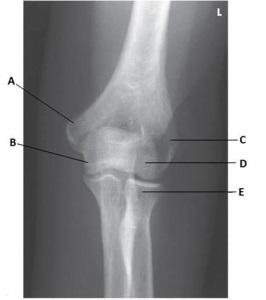
The primary structures shown when demonstrating the elbow using the Coyle method is the:
1)coracoid process.
2)coronoid process.
3)radial head.
(Multiple Choice)
4.8/5 (87)
(87) 
A fracture of the distal radius with posterior displacement is known as a _____ fracture.
(Multiple Choice)
4.9/5 (78)
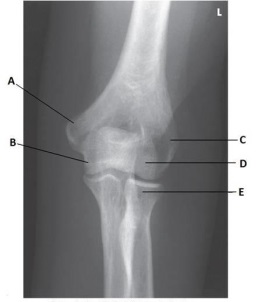
(78) The central-ray angulation for the tangential projection (inferosuperior) of demonstrating the carpal canal is _____ degrees.
(Multiple Choice)
4.9/5 (87)
(87) 
At the lateral (thumb) side of the hand, the digit is called the _____ digit.
(Multiple Choice)
4.8/5 (75)
(75) Which of the following devices is necessary to demonstrate the IP joints with a PA oblique projection of the hand?
(Multiple Choice)
4.9/5 (91)
(91) The forearm consists of which of the following bones?
1)Ulna
2)Radius
3)Humerus
(Multiple Choice)
4.7/5 (61)
(61) For a lateral projection of the wrist, the elbow must be flexed _____ degrees.
(Multiple Choice)
4.8/5 (87)
(87) For the PA projection of the wrist in ulnar deviation, the central ray is angled _____ degrees.
(Multiple Choice)
4.8/5 (73)
(73) For the PA projection of the wrist in ulnar deviation, the central ray is directed to the:
(Multiple Choice)
4.8/5 (61)
(61) To demonstrate the coronoid process in the axiolateral projection of the elbow (Coyle method), the elbow is flexed _____ degrees.
(Multiple Choice)
4.8/5 (73)
(73) Which of the following must be clearly demonstrated on a lateral projection of the humerus?
1)Glenoid cavity
2)Elbow joint
3)Shoulder joint
(Multiple Choice)
4.8/5 (87)
(87) Which fat pad lies parallel with the anterior aspect of the proximal radius?
(Multiple Choice)
4.8/5 (81)
(81) Which of the following are well demonstrated on a PA oblique projection of the wrist?
1)Capitate
2)Trapezium
3)Scaphoid
(Multiple Choice)
4.9/5 (67)
(67) For the lateral projection of the elbow, the elbow joint should be flexed _____ degrees.
(Multiple Choice)
4.9/5 (66)
(66) 
Filters
- Essay(0)
- Multiple Choice(0)
- Short Answer(0)
- True False(0)
- Matching(0)