



 Chat with AI
Exam 18: Urinary System and Venipuncture

Exam 1: Preliminary Steps in Radiography33 Questions
Exam 2: Compensating Filters14 Questions
Exam 3: General Anatomy and Radiographic Positioning Terminology101 Questions
Exam 4: Upper Limb125 Questions
Exam 5: Shoulder Girdle92 Questions
Exam 6: Lower Limb143 Questions
Exam 7: Pelvis and Upper Femora53 Questions
Exam 8: Vertebral Column175 Questions
Exam 9: Bony Thorax58 Questions
Exam 10: Thoracic Viscera74 Questions
Exam 11: Long Bone Measurement10 Questions
Exam 12: Contrast Arthrography5 Questions
Exam 13: Trauma Radiography10 Questions
Exam 14: Mouth and Salivary Glands10 Questions
Exam 15: Anterior Part of Neck9 Questions
Exam 16: Abdomen30 Questions
Exam 17: Digestive System: Alimentary Canal130 Questions
Exam 18: Urinary System and Venipuncture96 Questions
Exam 19: Reproductive System11 Questions
Exam 20: Skull, Facial Bones, and Paranasal Sinuses196 Questions
Exam 21: Mammography35 Questions
Exam 22: Central Nervous System15 Questions
Exam 23: Vascular, Cardiac, and Interventional Radiography40 Questions
Exam 24: Pediatric Imaging20 Questions
Exam 25: Geriatric Radiography18 Questions
Exam 26: Mobile Radiography20 Questions
Exam 27: Surgical Radiography10 Questions
Exam 28: Sectional Anatomy for Radiographers30 Questions
Exam 29: Computed Tomography16 Questions
Exam 30: Magnetic Resonance Imaging21 Questions
Exam 31: Diagnostic Ultrasound14 Questions
Exam 32: Nuclear Medicine18 Questions
Exam 33: Bone Densitometry18 Questions
Exam 34: Radiation Oncology20 Questions
Select questions type


A GFR of 90 mL or below is an indication of:

Free
(Multiple Choice)
4.8/5  (77)
(77) Correct Answer: Verified
D
Which of the following serves as the filter for the blood in the kidney?
Free
(Multiple Choice)
4.7/5 (81)
(81) Correct Answer:Verified
VerifiedA
A normal creatinine level is _____ mg/100 mL.
Free
(Multiple Choice)
4.8/5 (88)
(88) Correct Answer:Verified
VerifiedA
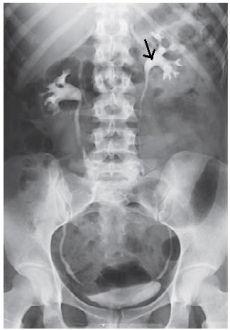
The dilated, proximal portion of the ureter is labeled with an arrow. What is the name of this anatomy shown in the image from an IVU below?
(Multiple Choice)
4.8/5 (85)
(85) How much is the body rotated for the AP oblique projection during a male or female cystourethrogram?
(Multiple Choice)
4.7/5 (78)
(78) Which projection would place the right kidney perpendicular to the IR?
(Multiple Choice)
4.9/5 (69)
(69) Which of the following is considered an operative examination?
(Multiple Choice)
4.7/5 (86)
(86) Which plane is centered to the grid for a lateral projection during a cystogram?
(Multiple Choice)
4.9/5 (82)
(82) Which of the following is true with regard to the use of injection needles used for venipuncture?
1)Steel needles may be sterilized and used again.
2)The needles may only be used one time.
3)All needles can be sterilized and used again.
(Multiple Choice)
4.9/5 (73)
(73) The series of radiographic images made during an IVU examination are typically done at time intervals between _____ minutes.
(Multiple Choice)
4.9/5 (83)
(83) Before venipuncture is performed, the radiologic technologist must assess which of the following?
1)Age of the patient
2)Allergic reaction to iodine tincture (if used)
3)Adverse reaction to the medication being administered
(Multiple Choice)
4.9/5 (79)
(79) The technical factors used for an IVU should provide sufficient exposure technique to clearly demonstrate the:
1)outline of the kidneys.
2)lower border of the liver.
3)lateral margin of the psoas muscle.
(Multiple Choice)
5.0/5 (93)
(93) Within how many minutes does contrast medium appear in the pelvicalyceal system?
(Multiple Choice)
4.8/5 (80)
(80) The vessels most often used for venipuncture are found on the:
1)anterior forearm.
2)posterior hand.
3)ulnar aspect of the wrist.
(Multiple Choice)
4.8/5 (84)
(84) Which decubitus position is commonly used during an IVU examination to demonstrate the ureteropelvic junction?
(Multiple Choice)
4.7/5 (86)
(86) How much is the patient rotated from the supine for an AP oblique projection of the urinary system?
(Multiple Choice)
4.8/5 (76)
(76) 
Filters
- Essay(0)
- Multiple Choice(0)
- Short Answer(0)
- True False(0)
- Matching(0)