



 Chat with AI
Exam 18: Urinary System and Venipuncture

Exam 1: Preliminary Steps in Radiography33 Questions
Exam 2: Compensating Filters14 Questions
Exam 3: General Anatomy and Radiographic Positioning Terminology101 Questions
Exam 4: Upper Limb125 Questions
Exam 5: Shoulder Girdle92 Questions
Exam 6: Lower Limb143 Questions
Exam 7: Pelvis and Upper Femora53 Questions
Exam 8: Vertebral Column175 Questions
Exam 9: Bony Thorax58 Questions
Exam 10: Thoracic Viscera74 Questions
Exam 11: Long Bone Measurement10 Questions
Exam 12: Contrast Arthrography5 Questions
Exam 13: Trauma Radiography10 Questions
Exam 14: Mouth and Salivary Glands10 Questions
Exam 15: Anterior Part of Neck9 Questions
Exam 16: Abdomen30 Questions
Exam 17: Digestive System: Alimentary Canal130 Questions
Exam 18: Urinary System and Venipuncture96 Questions
Exam 19: Reproductive System11 Questions
Exam 20: Skull, Facial Bones, and Paranasal Sinuses196 Questions
Exam 21: Mammography35 Questions
Exam 22: Central Nervous System15 Questions
Exam 23: Vascular, Cardiac, and Interventional Radiography40 Questions
Exam 24: Pediatric Imaging20 Questions
Exam 25: Geriatric Radiography18 Questions
Exam 26: Mobile Radiography20 Questions
Exam 27: Surgical Radiography10 Questions
Exam 28: Sectional Anatomy for Radiographers30 Questions
Exam 29: Computed Tomography16 Questions
Exam 30: Magnetic Resonance Imaging21 Questions
Exam 31: Diagnostic Ultrasound14 Questions
Exam 32: Nuclear Medicine18 Questions
Exam 33: Bone Densitometry18 Questions
Exam 34: Radiation Oncology20 Questions
Select questions type


For which of the following anatomic areas is the retrograde technique used?
1)Bladder
2)Lower ureters
3)Urethra
(Multiple Choice)
4.9/5  (75)
(75) The concave medial border of the kidney where the blood vessels and ureter exit is called the:
(Multiple Choice)
4.9/5 (90)
(90) After the needle enters the skin during venipuncture, the angle of the needle is reduced how many degrees to the long axis of the vessel?
(Multiple Choice)
4.8/5 (70)
(70) 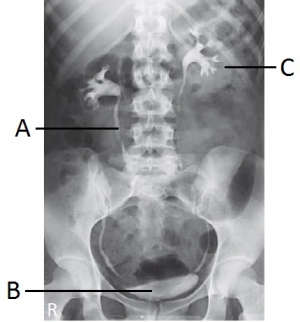
Which projection will demonstrate the mobility of the kidneys during intravenous urography?
(Multiple Choice)
4.8/5 (80)
(80) Which technique is used to get contrast medium into the urinary bladder for a cystogram?
(Multiple Choice)
4.8/5 (75)
(75) The area of the kidney identified in the figure below is the:

(Multiple Choice)
4.8/5 (72)
(72) How much is the body rotated for the AP oblique projection of the urinary bladder during a cystogram?
(Multiple Choice)
4.9/5 (90)
(90) The technique of injecting contrast media into a vein and taking radiographic images of the kidneys, ureters, and bladder is termed:
(Multiple Choice)
4.9/5 (92)
(92) Which of the following projections are used during a cystogram?
1)AP
2)AP oblique
3)Lateral
(Multiple Choice)
4.8/5 (86)
(86) Preparation of the patient for an IVU includes:
1)a light evening meal.
2)a non-gas forming laxative.
3)NPO after midnight.
(Multiple Choice)
4.8/5 (53)
(53) Before venipuncture, the skin is cleansed in a circular motion. How much of an area is cleansed?
(Multiple Choice)
4.8/5 (85)
(85) Which of the following serve(s) as a reservoir to store urine?
(Multiple Choice)
5.0/5 (83)
(83) The cluster of blood capillaries contained within the capsule of a nephron is called the:
(Multiple Choice)
4.8/5 (84)
(84) When blood or the medication injected into a vessel leaks out, it is called:
(Multiple Choice)
5.0/5 (73)
(73) A mild reaction to a medication or contrast medium would be:
(Multiple Choice)
4.9/5 (73)
(73) Compression should not be used during an IVU if the patient has a(n):
1)iodine allergy.
2)aneurysm.
3)colostomy.
(Multiple Choice)
4.9/5 (93)
(93) 
Filters
- Essay(0)
- Multiple Choice(0)
- Short Answer(0)
- True False(0)
- Matching(0)