



 Chat with AI
Exam 23: Vascular, Cardiac, and Interventional Radiography

Exam 1: Preliminary Steps in Radiography33 Questions
Exam 2: Compensating Filters14 Questions
Exam 3: General Anatomy and Radiographic Positioning Terminology101 Questions
Exam 4: Upper Limb125 Questions
Exam 5: Shoulder Girdle92 Questions
Exam 6: Lower Limb143 Questions
Exam 7: Pelvis and Upper Femora53 Questions
Exam 8: Vertebral Column175 Questions
Exam 9: Bony Thorax58 Questions
Exam 10: Thoracic Viscera74 Questions
Exam 11: Long Bone Measurement10 Questions
Exam 12: Contrast Arthrography5 Questions
Exam 13: Trauma Radiography10 Questions
Exam 14: Mouth and Salivary Glands10 Questions
Exam 15: Anterior Part of Neck9 Questions
Exam 16: Abdomen30 Questions
Exam 17: Digestive System: Alimentary Canal130 Questions
Exam 18: Urinary System and Venipuncture96 Questions
Exam 19: Reproductive System11 Questions
Exam 20: Skull, Facial Bones, and Paranasal Sinuses196 Questions
Exam 21: Mammography35 Questions
Exam 22: Central Nervous System15 Questions
Exam 23: Vascular, Cardiac, and Interventional Radiography40 Questions
Exam 24: Pediatric Imaging20 Questions
Exam 25: Geriatric Radiography18 Questions
Exam 26: Mobile Radiography20 Questions
Exam 27: Surgical Radiography10 Questions
Exam 28: Sectional Anatomy for Radiographers30 Questions
Exam 29: Computed Tomography16 Questions
Exam 30: Magnetic Resonance Imaging21 Questions
Exam 31: Diagnostic Ultrasound14 Questions
Exam 32: Nuclear Medicine18 Questions
Exam 33: Bone Densitometry18 Questions
Exam 34: Radiation Oncology20 Questions
Select questions type


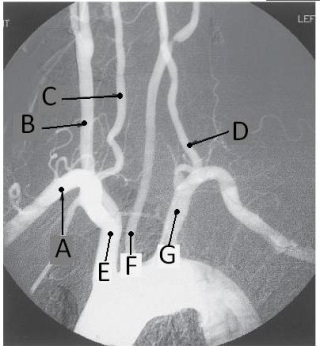
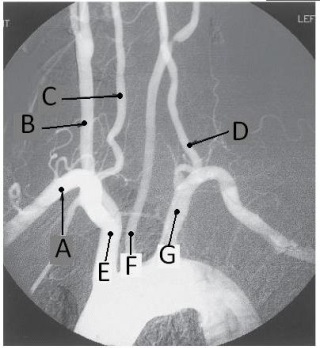
Letter D in the angiographic image of the aortic arch and its branches below is the _____ artery.

Free
(Multiple Choice)
4.9/5  (87)
(87) Correct Answer: Verified
D
According to the American College of Cardiology and the American Heart Association (ACC/AHA), all of the following are relative contraindications for cardiac catheterization except:
Free
(Multiple Choice)
4.8/5 (79)
(79) Correct Answer:Verified
VerifiedC
The muscular wall of the heart is called the:
Free
(Multiple Choice)
4.9/5 (80)
(80) Correct Answer:Verified
VerifiedA
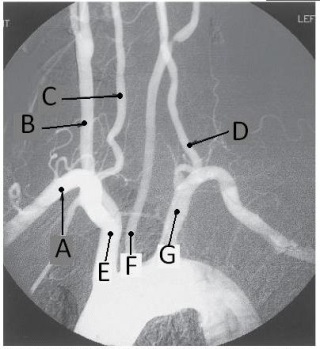
Letter C in the angiographic image of the aortic arch and its branches below is the _____ artery.
(Multiple Choice)
4.7/5 (75)
(75) Which of the following has been identified as a major predictor of increased complication risk from a cardiac catheterization?
(Multiple Choice)
4.8/5 (74)
(74) The radiographic recording of blood vessels on movie IR is termed:
(Multiple Choice)
4.7/5 (75)
(75) Potential complications of angiographic procedures include:
1)bleeding at the puncture site.
2)stroke.
3)death.
(Multiple Choice)
4.9/5 (72)
(72) Which of the following compose the circulatory system?
1)Central nervous system
2)Lymphatic system
3)Blood-vascular system
(Multiple Choice)
4.9/5 (91)
(91) Which of the following pumps deoxygenated blood into the pulmonary artery?
(Multiple Choice)
4.8/5 (75)
(75) The most widely used method of catheterization for selective angiography is known as the _____ method.
(Multiple Choice)
4.9/5 (74)
(74) Why is an introducer sheath used in many angiographic procedures?
(Multiple Choice)
5.0/5 (72)
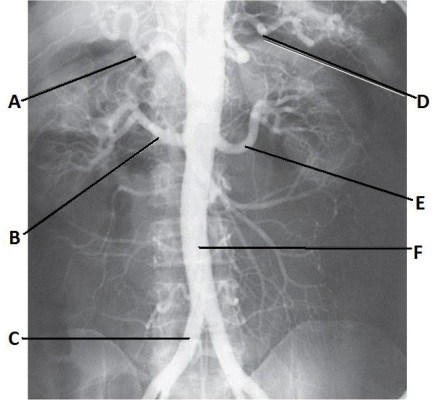
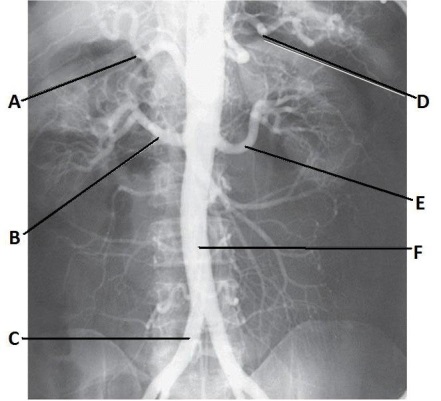
(72) Letter A in the abdominal aortogram image below is the _____ artery.
(Multiple Choice)
4.8/5 (80)
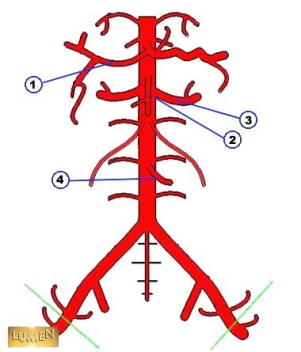
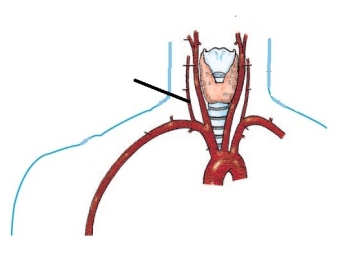
(80) The artery in the figure labeled 3 below is the _____ artery.
(Multiple Choice)
4.8/5 (73)
(73) The computerized technique by which bone structures are removed from an image of bone and opacified vessels, leaving an unobscured image of the vessels, is termed:
(Multiple Choice)
4.9/5 (84)
(84) Letter E in the angiographic image of the aortic arch and its branches below is the _____ artery.
(Multiple Choice)
4.8/5 (84)
(84) 
Letter E in the abdominal aortogram image below is the _____ artery.
(Multiple Choice)
4.9/5 (90)
(90) 
Filters
- Essay(0)
- Multiple Choice(0)
- Short Answer(0)
- True False(0)
- Matching(0)